Sydney Hobart 2025 — the regime story
A Southerly moved up the course. The physics knew which boats it favored.
The Southerly, replayed.
Watching the 2025 Rolex Sydney Hobart, a big Southerly front moved up the course and the analysts struggled to call it. The best they could do was predict that the DH rating would fare best — not which hulls, not which sail plans, and certainly not which crews would fare best sailing to windward.
That race is where the SailrScience story begins — and this page is FleetEdge™ by SailrScience going back to answer it properly. Take the boats that sailed, read each one’s certificate-derived physics, and ask the regime question directly: in a blustery Southerly — hard on the wind first, then reaching and running down the coast to Tasmania — which hulls were designed to love it?
Everything below is a reading of designed potential. Each scatter prints its own basis — “certificate physics — no race result” — and where FleetEdge’s own observed layer speaks, it is labeled as exactly that.
Windward work.
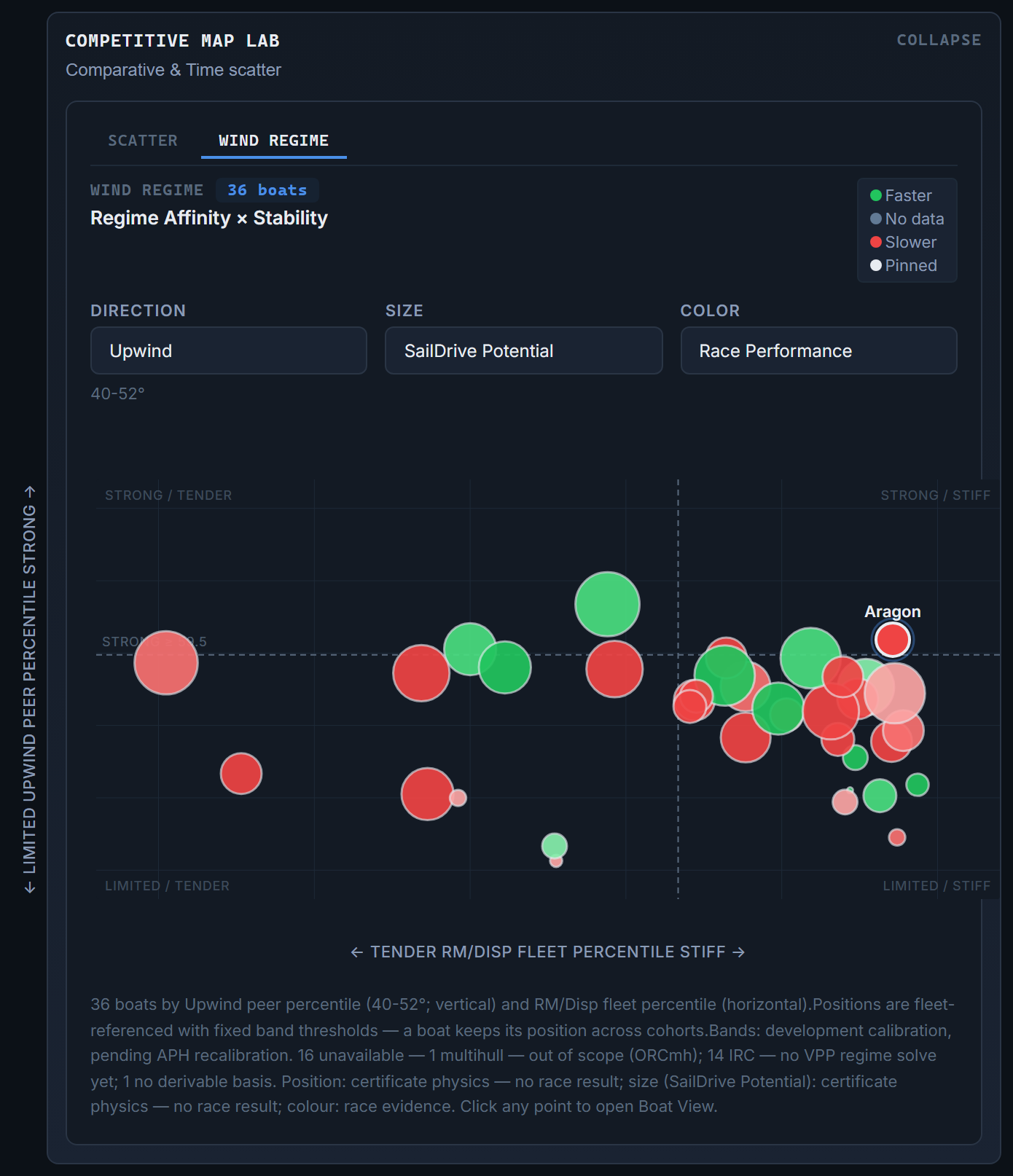
Hard on the wind out of the Heads, the Southerly asks its first question: which hulls convert stability (how much righting moment the boat carries relative to its displacement) into drive when the breeze is on the nose?
In the upwind read, the strong-and-stiff corner belongs to a small group — the pinned boat, Aragon, sits at its far edge, the powered group beside her, while the rest of the selection queues along the band. These are readings of designed potential, not a forecast of any finishing order.

Down the coast.
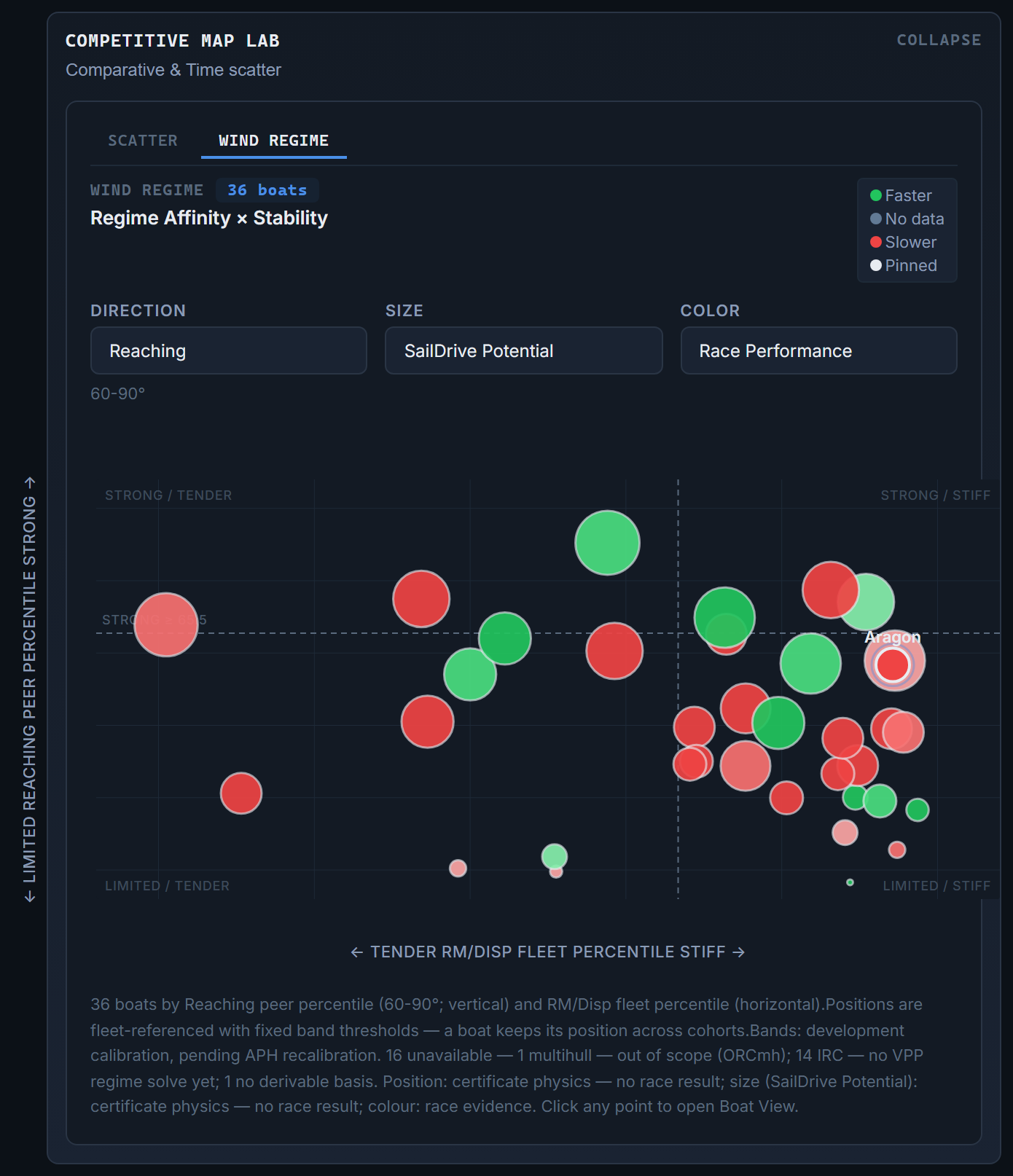
The front does not stay on the nose. As the course bends south the same hulls are asked a different question — and the map answers differently.
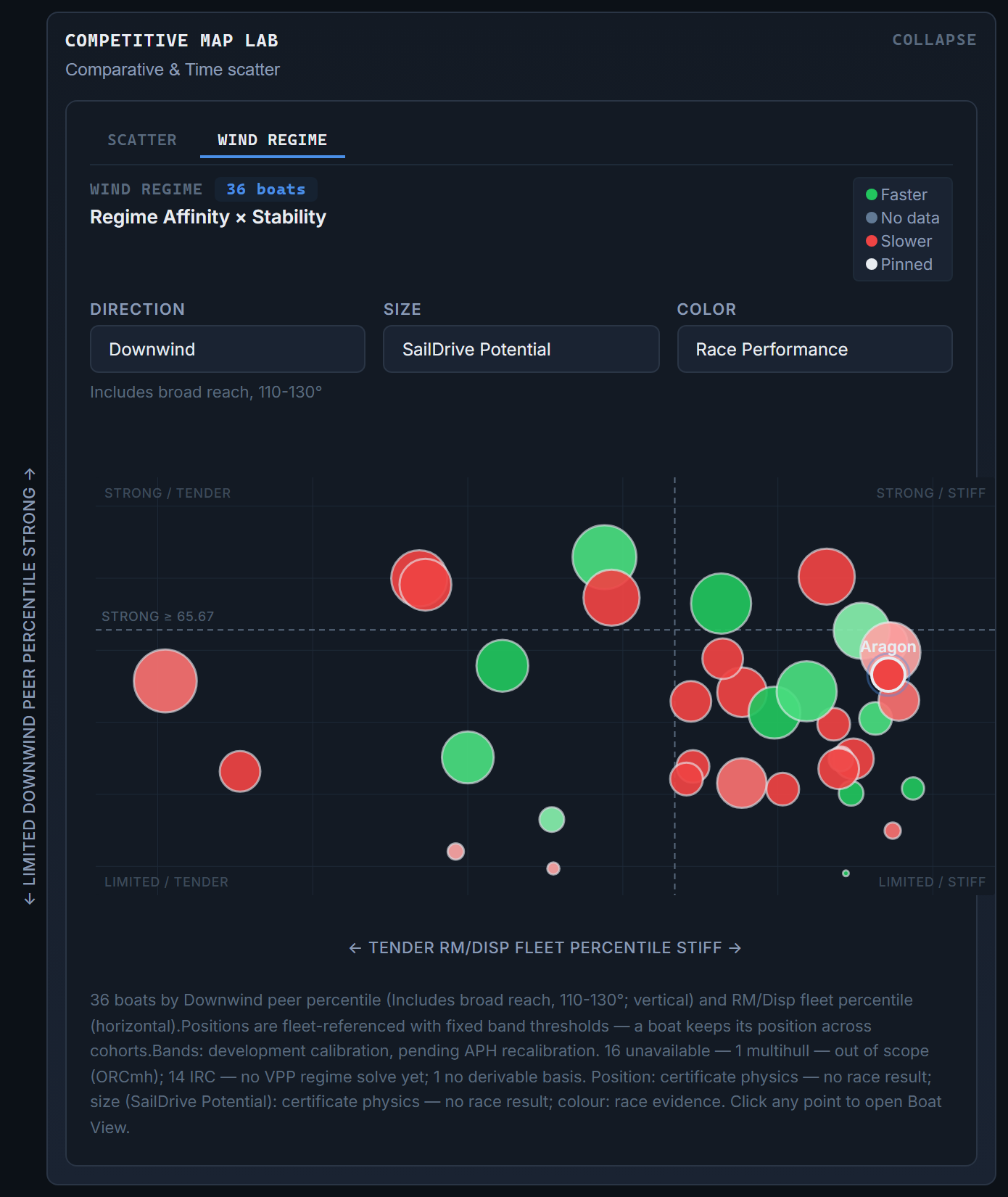
The stiff, powered group carries its authority into the reach and the run: Aragon leads the stiff group in every regime the race served up — clear of the strong band upwind, riding its edge by the run. Behind her, the middle of the map reshuffles — hulls that queued behind the leaders upwind step forward as the drive question changes. The positions remain readings of designed potential, regime by regime; the color carries the observed race-performance layer, labeled as race evidence.
The super maxi at the edge of the map.
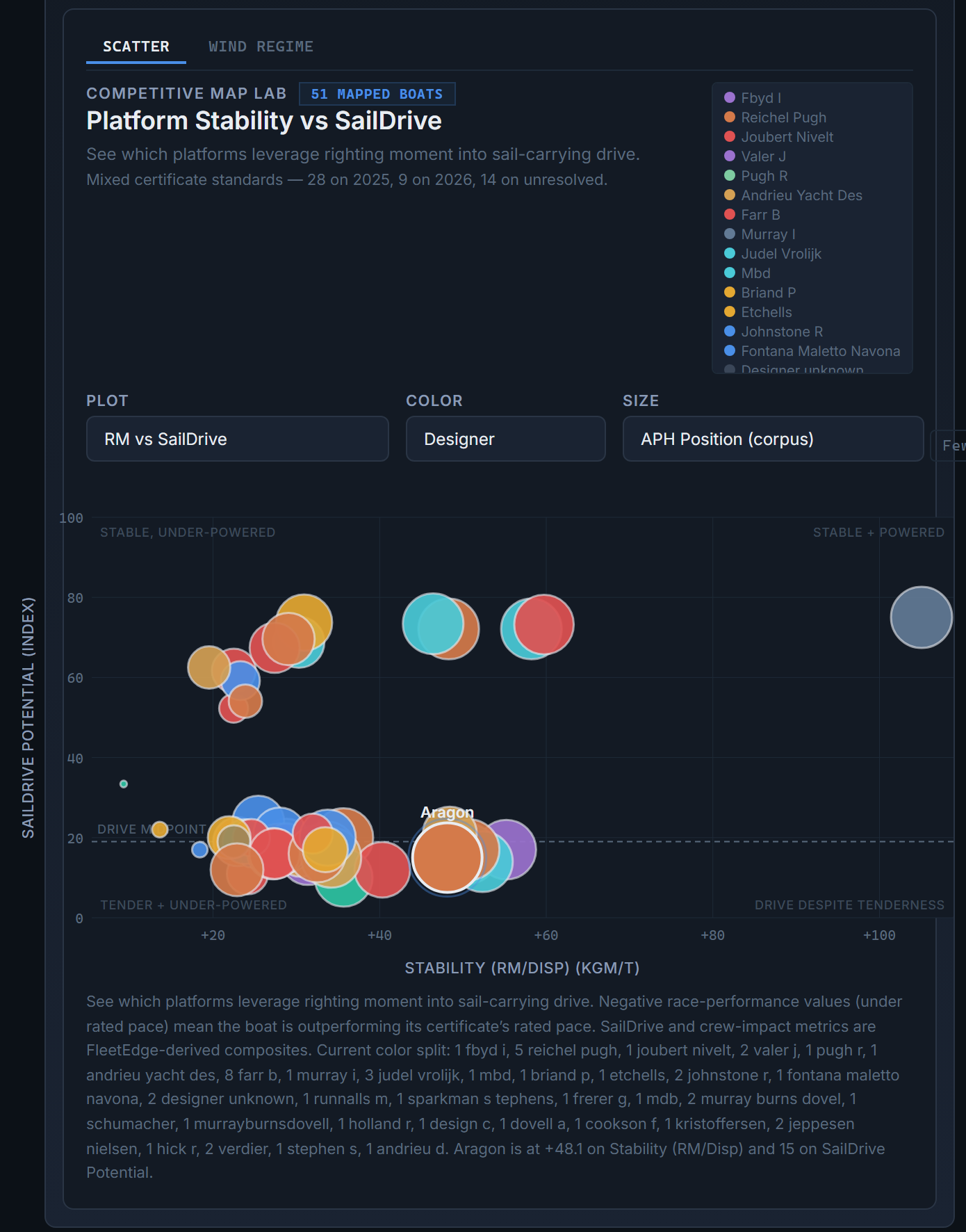
One entrant does not appear in the regime reads above, and the honest answer is scope. SHK Scallywag, a super maxi, sits among the entries the regime read cannot yet derive — the surface’s own accounting, above, says who is missing and why.
The stability map shows why. She sits alone at the far edge — extreme righting moment for her displacement, extreme sail-carrying drive — beyond the reference-geometry envelope that FleetEdge’s R16 righting-moment reconstruction is matched against: the DSYHS hull library the physics is built on does not extend to hulls of her class.
Her absence is a statement about the model’s declared scope, not about the boat. A read the model is not validated to make is a read FleetEdge does not publish.
The fleet, boat by boat.
The full selection lives in the product: every boat, its physics dimensions, its observed reads, and the stories the analysis surfaces — each carrying its population and its evidence on its face.
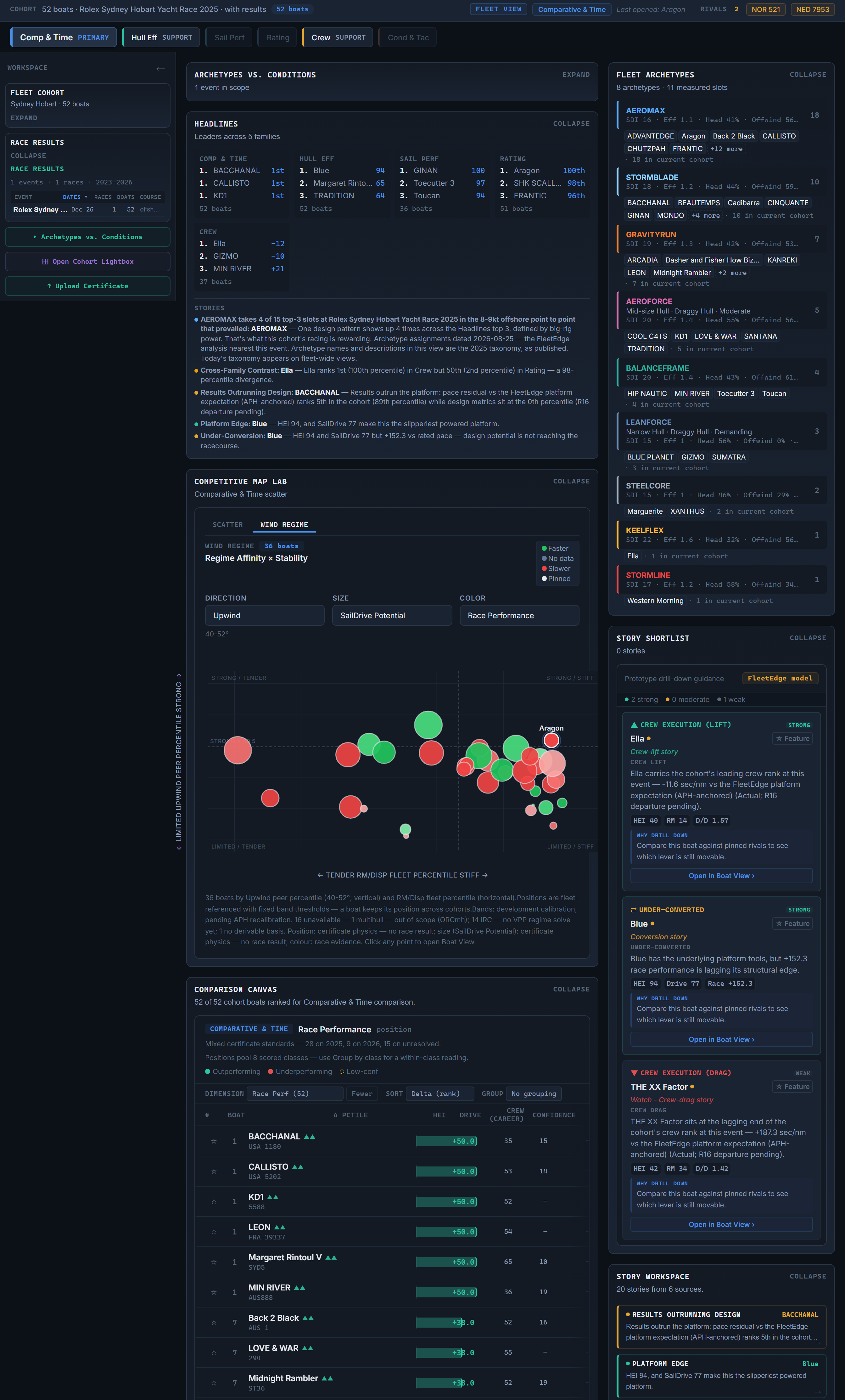
Boats are named as rendered by FleetEdge’s versioned capture of its served analysis; naming implies no current official standing, endorsement, or continuing status.
Read a fleet like this for your race.
The regime reads on this page come from the live product — certificate physics first, the racing record alongside.