Sydney Hobart 2025 — the regime story
A Southerly moved up the course. The physics knew which boats it favored.
The Southerly, replayed.
Watching the 2025 Rolex Sydney Hobart, a big Southerly front moved up the course and the analysts struggled to call it. The best they could do was predict that the DH rating would fare best — not which hulls, not which sail plans, and certainly not which crews would fare best sailing to windward.
What changed
· Regime readings re-evaluated on the certificate physics of 13 November 2026
What changed. Every boat’s regime reading was re-evaluated on FleetEdge’s certificate physics of 13 November 2026, and the reaching regime returned beside upwind and downwind. Reaching is the boat’s speed at 12 knots of true wind at its fastest angle between 75 and 120 degrees off the wind.
The comparison now. Each regime reading places a boat as a percentile among the boats of its length band. The race record is read beside it: whether it agrees with the physics, and how much evidence stands behind it.
Reading a changed ranking. A boat’s place in a regime can move because its certificate physics was re-evaluated, even when its race results did not change. Compare boats within one length band and one date, and read the agreement and the evidence strength before reading a place as an advantage.
Evidence. Regime Affinity, re-shot on 13 November 2026 · The Sydney Hobart 2025 regime story
That race is where the SailrScience story begins — and this page is FleetEdge™ by SailrScience going back to answer it properly. Take the boats that sailed, read each one’s certificate-derived physics, and ask the regime question directly: in a blustery Southerly — hard on the wind first, then reaching and running down the coast to Tasmania — which hulls were designed to love it?
Everything below is a reading of designed potential. Each scatter prints its own basis — “certificate physics — no race result” — and where FleetEdge’s own observed layer speaks, it is labeled as exactly that.
Windward work.
Hard on the wind out of the Heads, the Southerly asks its first question: which hulls convert stability (how much righting moment the boat carries relative to its displacement) into drive when the breeze is on the nose?
In the upwind read, the strong-and-stiff corner holds most of the stiff hulls in the selection: nineteen of the twenty-five on the stiff side sit above the strong line. The pinned boat, BACCHANAL — rendered by FleetEdge as the IRC Division 4 winner — sits high in that corner, at the 95th percentile. These are readings of designed potential, not a forecast of any finishing order.
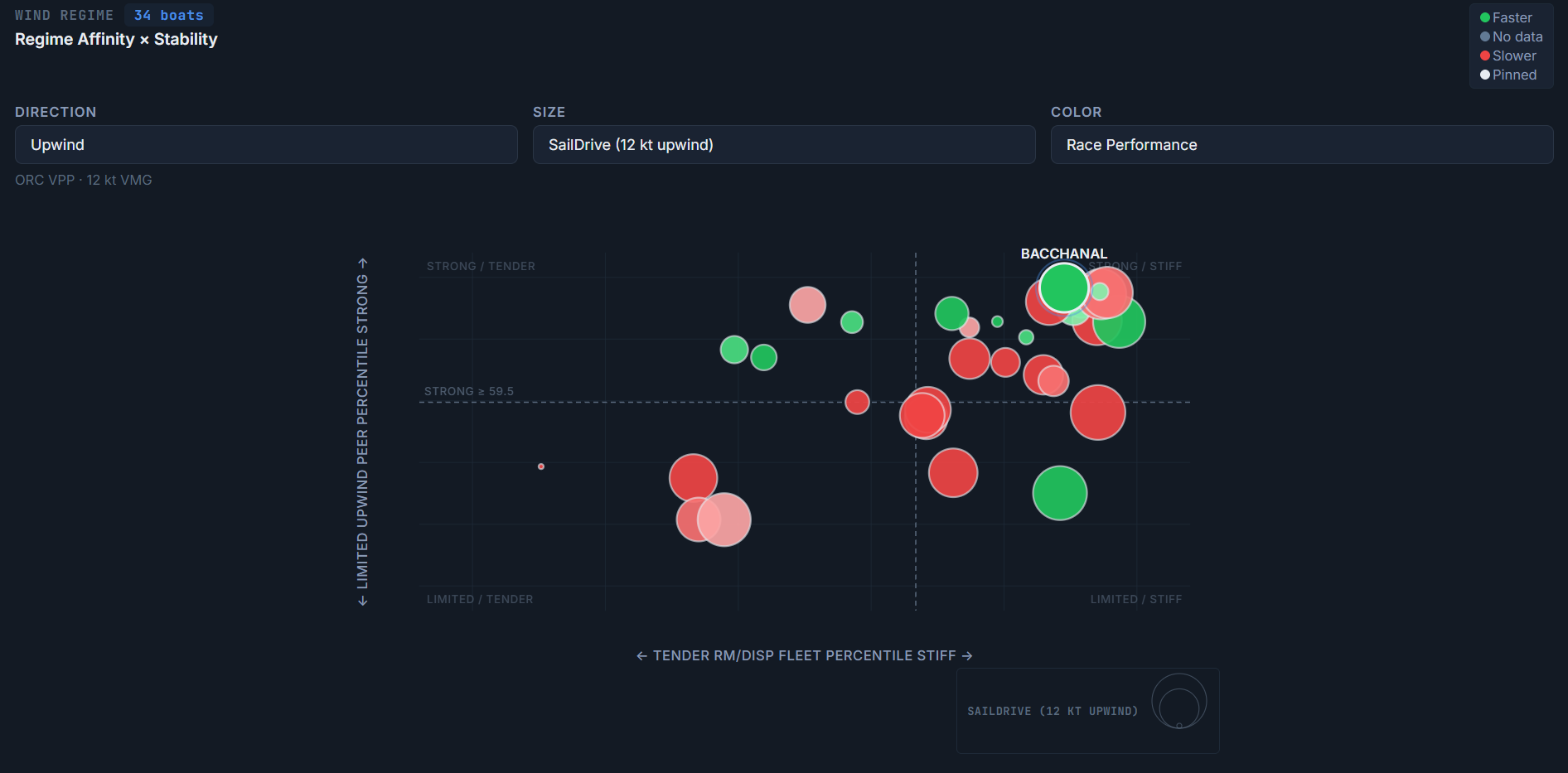
The surface also reports who it does not show, and why: twenty-two boats unavailable — twenty-one IRC entries without a VPP regime solve yet, one with no derivable basis. The full story is below.
Down the coast.
The front does not stay on the nose. As the course bends south the same hulls are asked a different question — and the map answers differently.
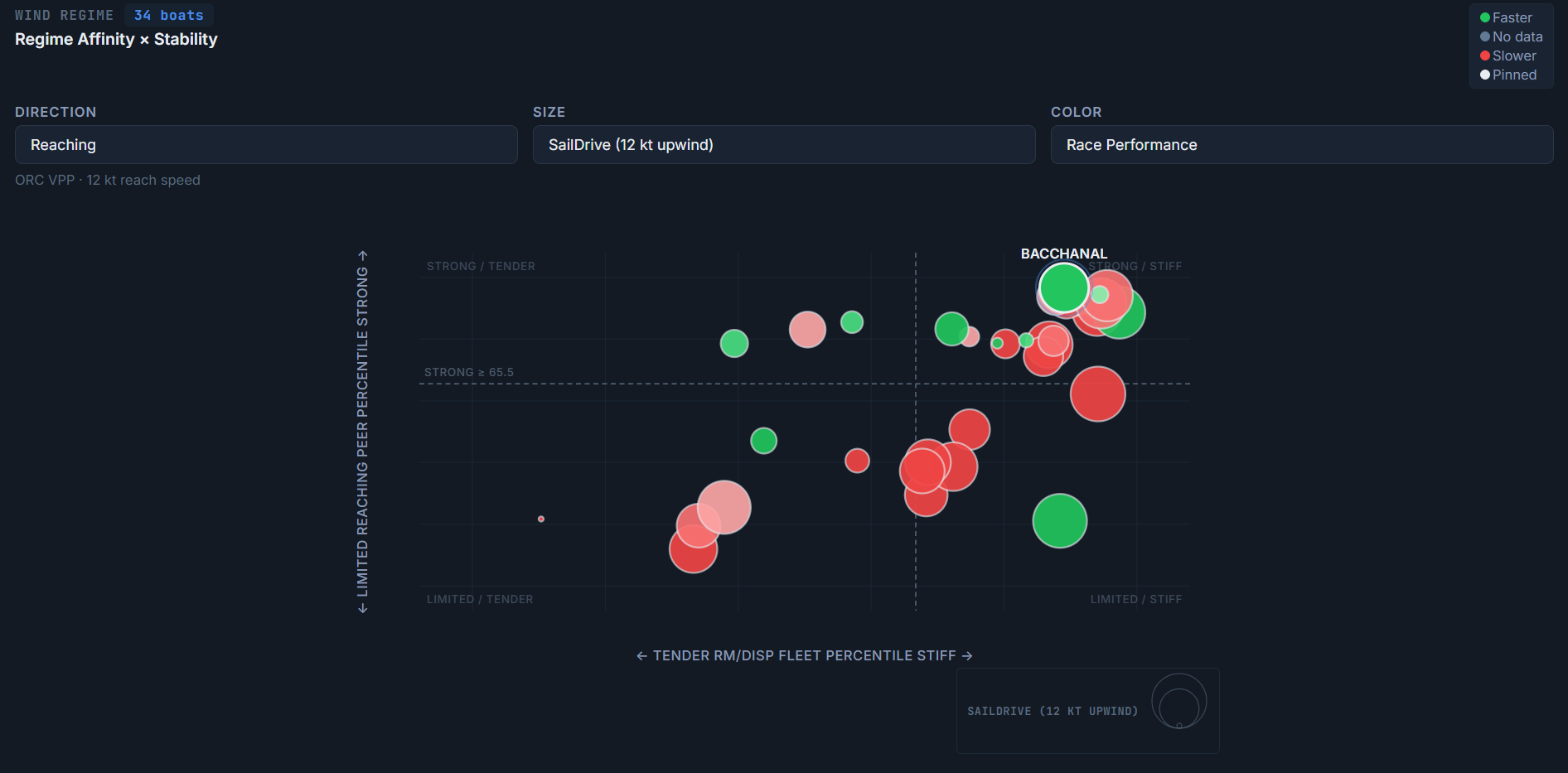
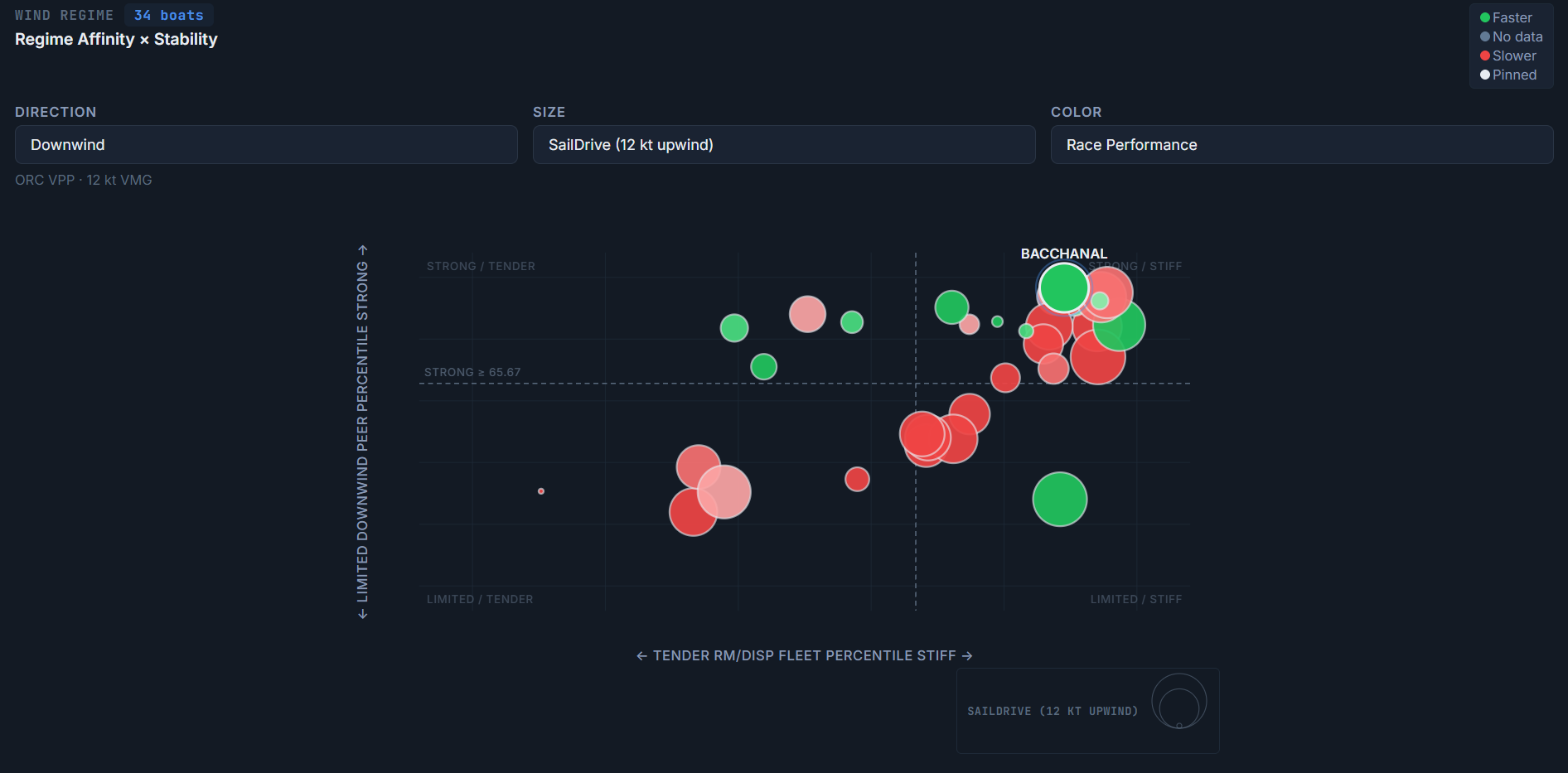
Off the wind the stiff corner holds. On the reach the strong line rises and the strong-and-stiff corner holds eighteen boats; on the run it holds nineteen again. The pinned boat, BACCHANAL, keeps the 95th percentile on the beat, the reach and the run alike — strong in all three regimes. The positions remain readings of designed potential, regime by regime; the color carries the observed race-performance layer, labeled as race evidence.
The super maxi outside the map.
One entrant does not appear in the regime reads above, and the honest answer is scope. SHK Scallywag, a super maxi, sits among the entries the regime read cannot yet derive — the surface’s own accounting, above, says who is missing and why.
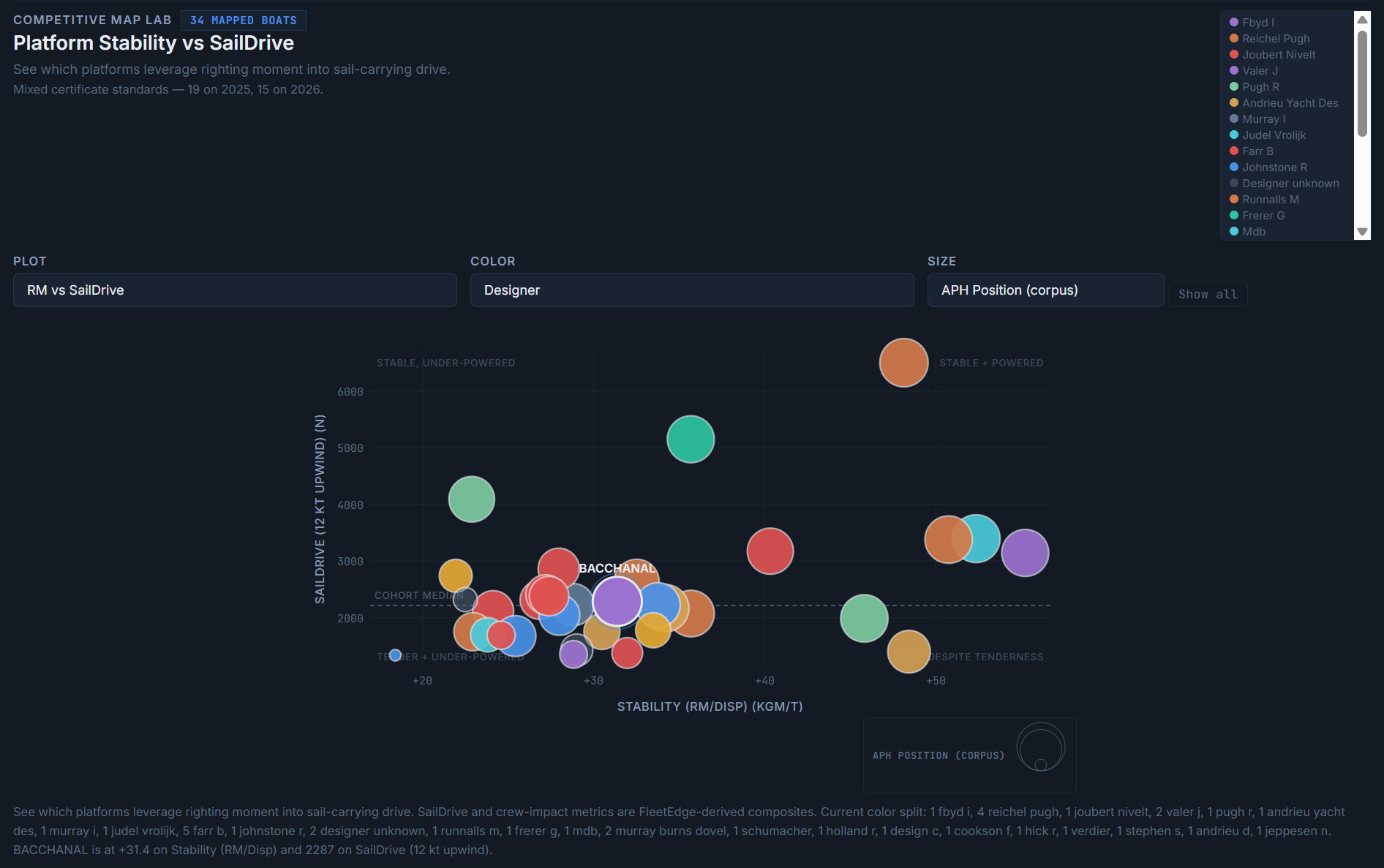
The stability map leaves her out as well: it draws the same thirty-four boats as the regime reads, and the super maxi is not among them. Her hull lies beyond the reference-geometry envelope that FleetEdge’s R16 righting-moment reconstruction is matched against: the DSYHS hull library the physics is built on does not extend to hulls of her class. Among the boats it does draw, Aragon stands alone at the top of the drive axis, with the stiffest hulls of the selection to her right at lower drive; the pinned boat, BACCHANAL, sits in the pack, just above the cohort median on drive.
Her absence is a statement about the model’s declared scope, not about the boat. A read the model is not validated to make is a read FleetEdge does not publish.
The fleet, boat by boat.
The full selection lives in the product: every boat, its physics dimensions, its observed reads, and the stories the analysis surfaces — each carrying its population and its evidence on its face.
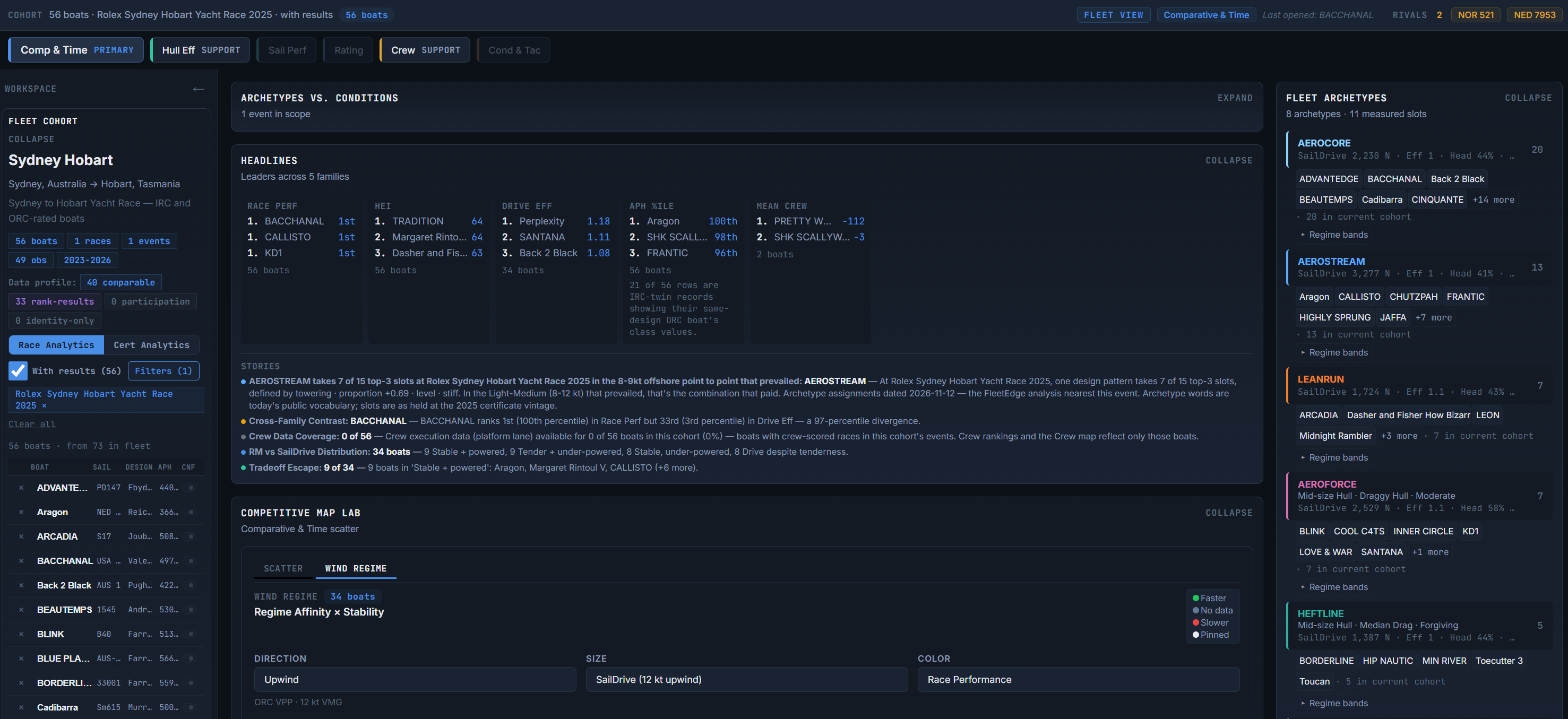
Boats are named as rendered by FleetEdge’s versioned capture of its served analysis; naming implies no current official standing, endorsement, or continuing status.
Read a fleet like this for your race.
The regime reads on this page come from the live product — certificate physics first, the racing record alongside.