Fleet Analytics: One Event, End to End
The main FleetEdge story, walked through one championship class — from the World fleet to the winning boat, with every claim carrying its scope.
Every fleet has a fingerprint.
From the Solent to the Aegean — see how the physics plays in your waters.
Hidden ShapeThe hidden shape of the fleet.
The kinds of boat that keep appearing when every hull is measured the same way.
The shape of the fleet, before the scoreboard has anything to say.
In beta as a product. These fleet analytics power the Federation Dashboard — the private governance workspace for class associations and national authorities. See Federation Dashboard →
The ORC World Championship 2026 raced eight scored races off Sorrento in May. Class C published a 38-entrant scoreboard — and that scoreboard carries the label Provisional as published, a status every standings-dependent sentence on this page inherits. This is the FleetEdge story in one walk: choose a fleet, choose the event, narrow to the class, read the class as a fleet, find the certificate dimensions that separated the front — and finish inside the winner's own decomposition.
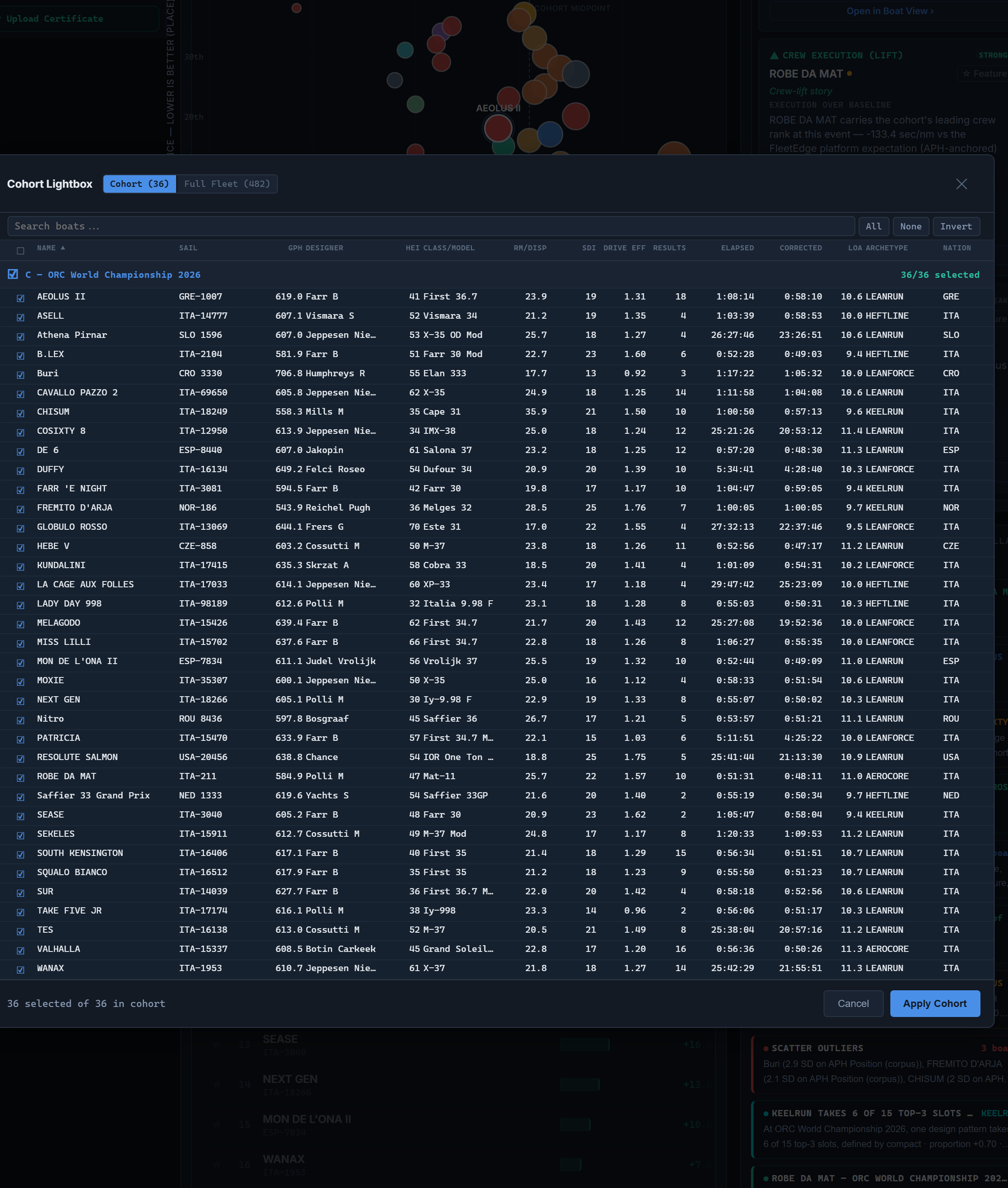
One walk, several counts, each true at its own grain: the published class scoreboard lists thirty-eight entrants; the product’s class selection below holds thirty-six boats with model coverage; the step-five workspace reading now spans that same thirty-six-boat selection, its denominator on the card’s own face; the event-wide figures on this walk read across all four classes.
Everything below is a downstream analytical reading of published certificate data and published results. It alters no rating and no score — ORC remains the rating and scoring authority.
Six steps from the World fleet to the winning boat.
1 · Choose the fleet
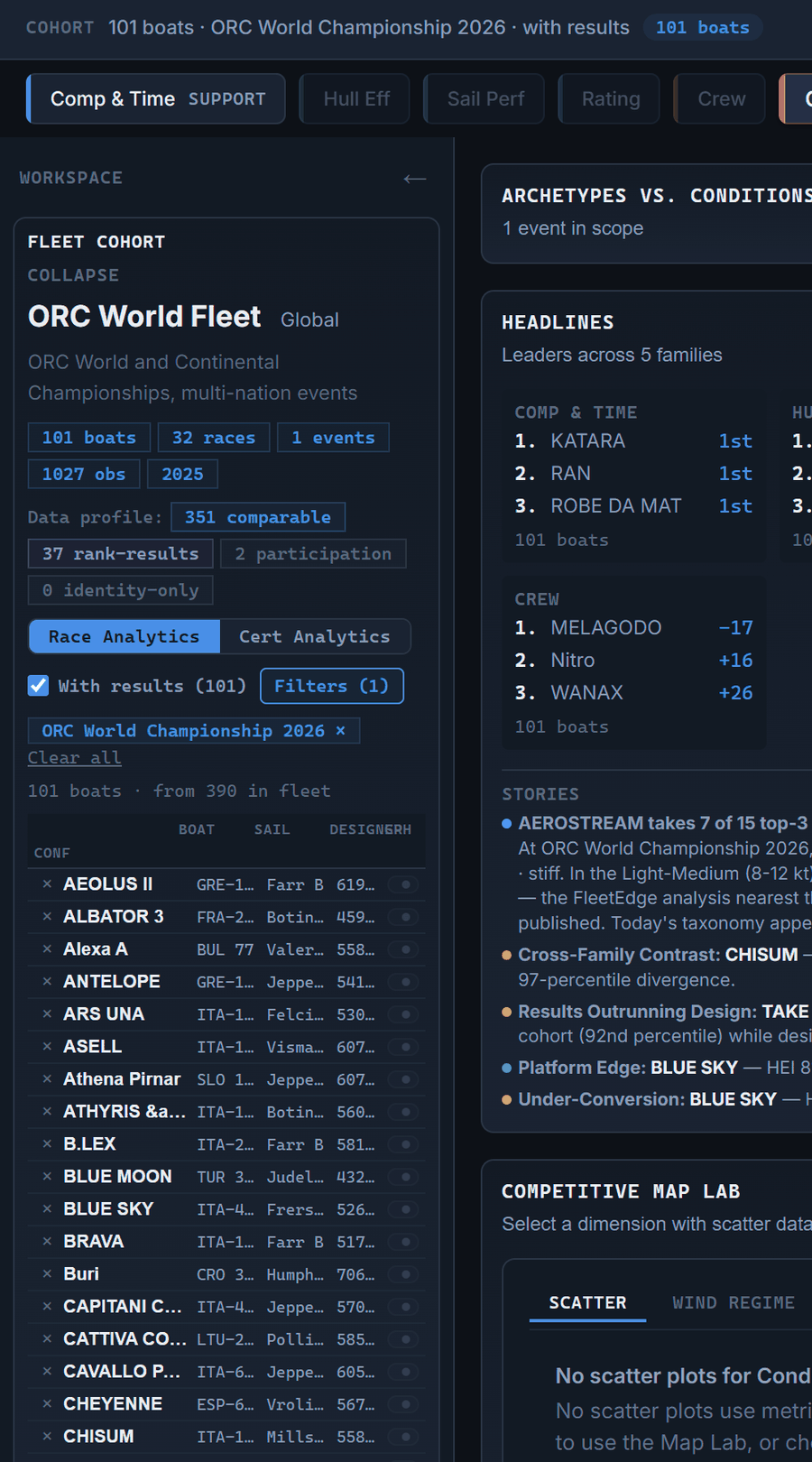
Every story starts with a cohort (the boats a figure is computed over — a real entry list, a class, a fleet — named on every figure). Load the ORC World Fleet — the multi-nation championship slice of the analyzed fleet — and the workspace assembles the boats, their races, and their evidence depth before a single claim is made. What you can compare is always declared before what you conclude.
2 · Choose the event
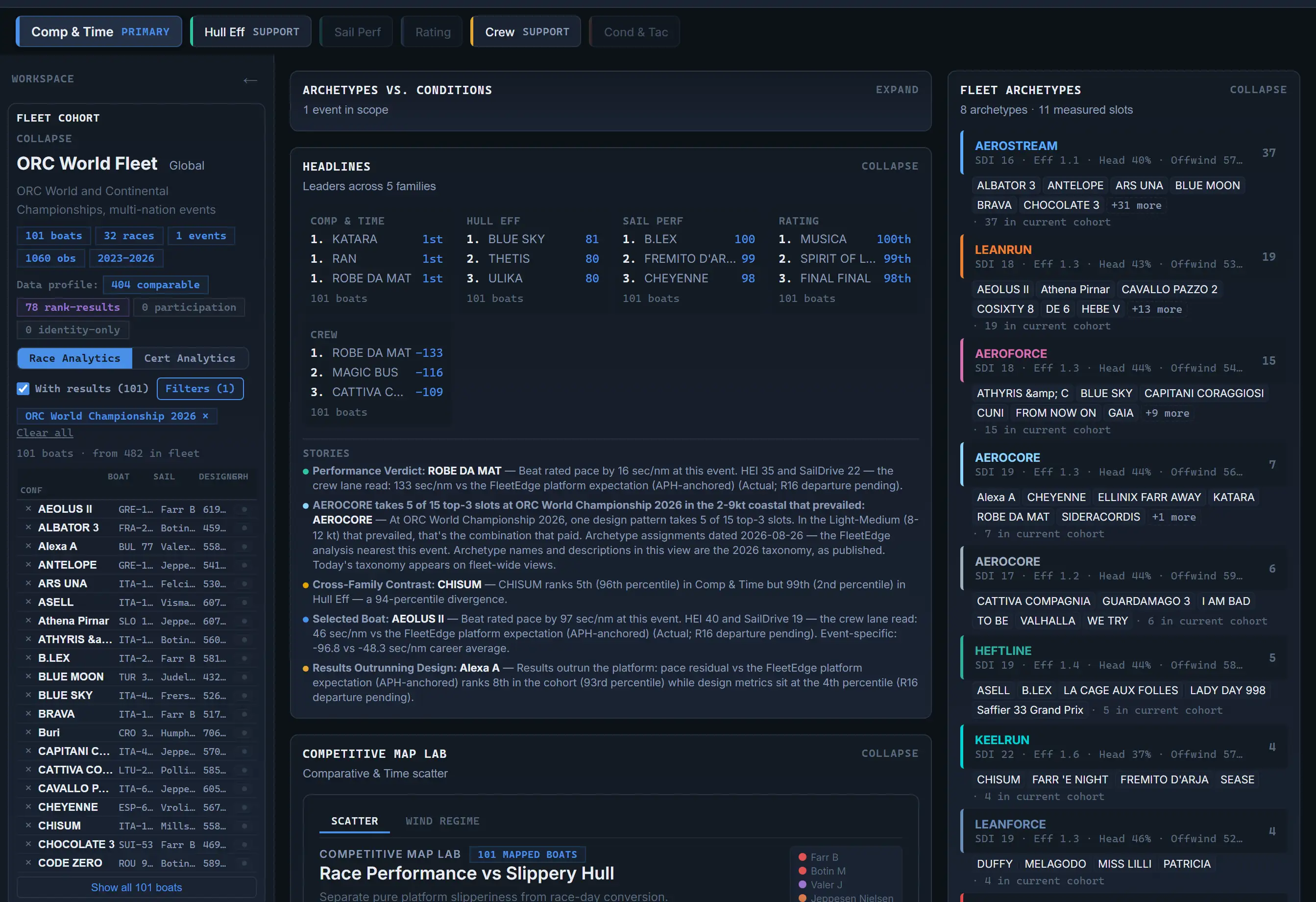
Filter to one event and the fleet becomes a regatta. With ORC World Championship 2026 selected “with results,” every surface downstream carries the event’s own racing — and the scoreboard’s published status (Provisional as published) rides along with it.
3 · Narrow to the class
4 · Read the class as a fleet
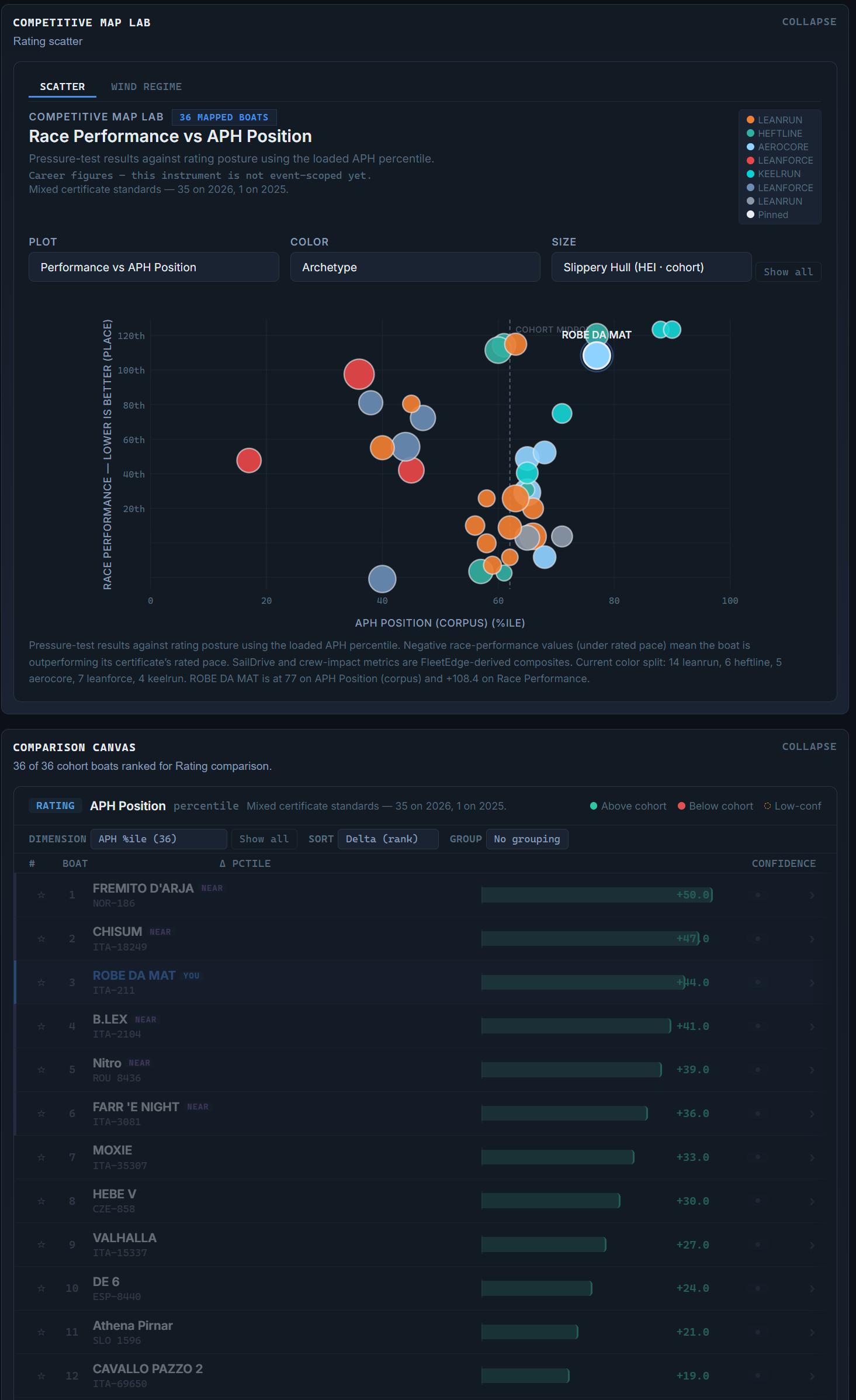
Now the class reads as a fleet. Under the Rating family, the Competitive Map Lab scatter — each boat’s career race-performance reading against its APH Position (where the boat’s rating sits in the fleet’s distribution, as a percentile), colored by archetype (one of the fleet's eight recurring design types); its own face says the instrument is not event-scoped yet — sits above the ranked comparison canvas, the full class ordered on APH Position with the faster-rated end at the top. Design pattern and rating posture, on one screen, each labeled with what it is — and the eventual winner, ROBE DA MAT (Provisional as published), is the selected boat on both: pinned and labeled on the scatter, the highlighted row on the board.
5 · Find what separated the front
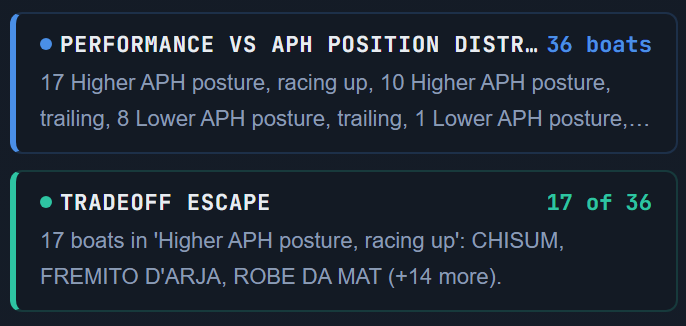
Which certificate dimensions separated the front at this event? Rating posture, most visibly — read at the current cut, the workspace’s distribution card counts seventeen of the thirty-six boats in ‘Higher APH posture, racing up’, the eventual champion among them; the cards state the split counts and the denominator on their own faces. The certificates knew the podium’s neighborhood; conversion on the water chose the winner.
6 · Finish on the winner
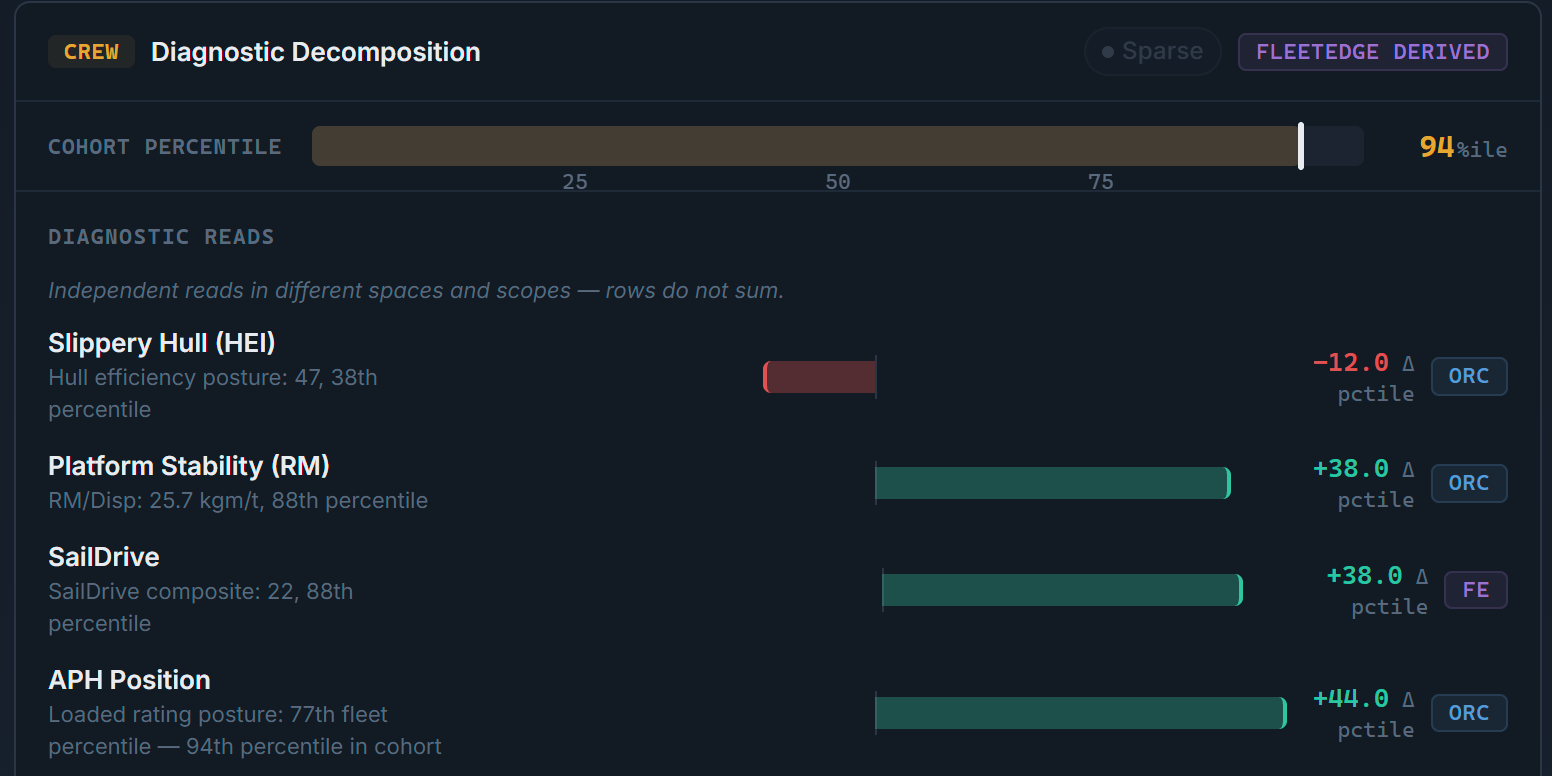
ROBE DA MAT’s Boat View decomposes the result: a below-median hull read, an 88th-percentile stability (how much righting moment the boat carries relative to its displacement), an 88th-percentile drive composite, and a 94th-percentile rating posture in the cohort — and a series won on conversion, 19 net points across the eight races with five race cells of 2 points or better (Provisional as published). No single dimension explains the win. The decomposition shows exactly which ones carried it — and, just as plainly, which ones did not.
The walk is the product.
Fleet selection, event selection, cohort selection, fleet view, dimension reading, boat view — the same six steps read any fleet, any event, any class in the governed corpus. The performance archetypes the fleet sorts into have their own page; every country, fleet, and event page on this site is the same analytics, already walked for you.
Reading discipline carries throughout: standings quoted from a published scoreboard keep its published status; career-lane figures say when an instrument is not yet event-scoped; and dimensions are read as associations at a stated scope — never as a verdict on any crew.
See Fleet Analytics in the USA ORC fleet.
USA ORC racing brings fleet analytics into sharp relief — see how the physics meets the fleet's regime and rivalries.
Explore USA ORCSee your fleet in a new dimension.
FleetEdge reveals the structural patterns that shape ORC racing.