IRC & SailrScience
Independent analytics bridging IRC and ORC with physics.
Every fleet has a fingerprint.
How FleetEdge brings multi-dimensional intelligence to IRC offshore classics.
Hidden ShapeThe hidden shape of the fleet.
The kinds of boat that keep appearing when every hull is measured the same way.
The shape of the fleet, before the scoreboard has anything to say.
SailrScience is an independent analytics company. It is not affiliated with, endorsed by, or certified by the Royal Ocean Racing Club (RORC) or IRC. FleetEdge integrates publicly available IRC race results — finishing positions, elapsed times, and corrected times from IRC-rated events — combined with SailrScience's proprietary physics model, weather intelligence, and multi-dimensional analysis framework.
The relationship between IRC and SailrScience is one of data consumer and published results. IRC defines the rating system and governs the events. SailrScience consumes the published race results and integrates them into the FleetEdge analytical framework alongside ORC data.
This independence is by design. FleetEdge’s value in the IRC space comes from bridging two systems that have historically operated in isolation. Using measured hull dimensions from IRC certificates — length, beam, draft, and displacement ratio — FleetEdge matches each IRC boat to its ORC design-family equivalent and projects the full physics profile. 11,207 boats across ORC and IRC are now analyzed through a single 52-dimensional lens — a cross-handicap fleet analytics platform.
Published results. Independent analysis.
IRC Race Results: What the Fleet Did
FleetEdge reads IRC race results from published event data — finishing positions, elapsed times, corrected times, and fleet composition. These results cover the six flagship offshore series — the Rolex Sydney Hobart, Rolex Fastnet, Rolex Middle Sea Race, RORC Caribbean 600, RORC Transatlantic, and the Cowes Offshore Racing Series — across multiple race editions.
FleetEdge never reads IRC rating values, handicap calculations, or any proprietary IRC rating data — the hull-dimension match uses publicly available dimensions only. The race results are public event records.
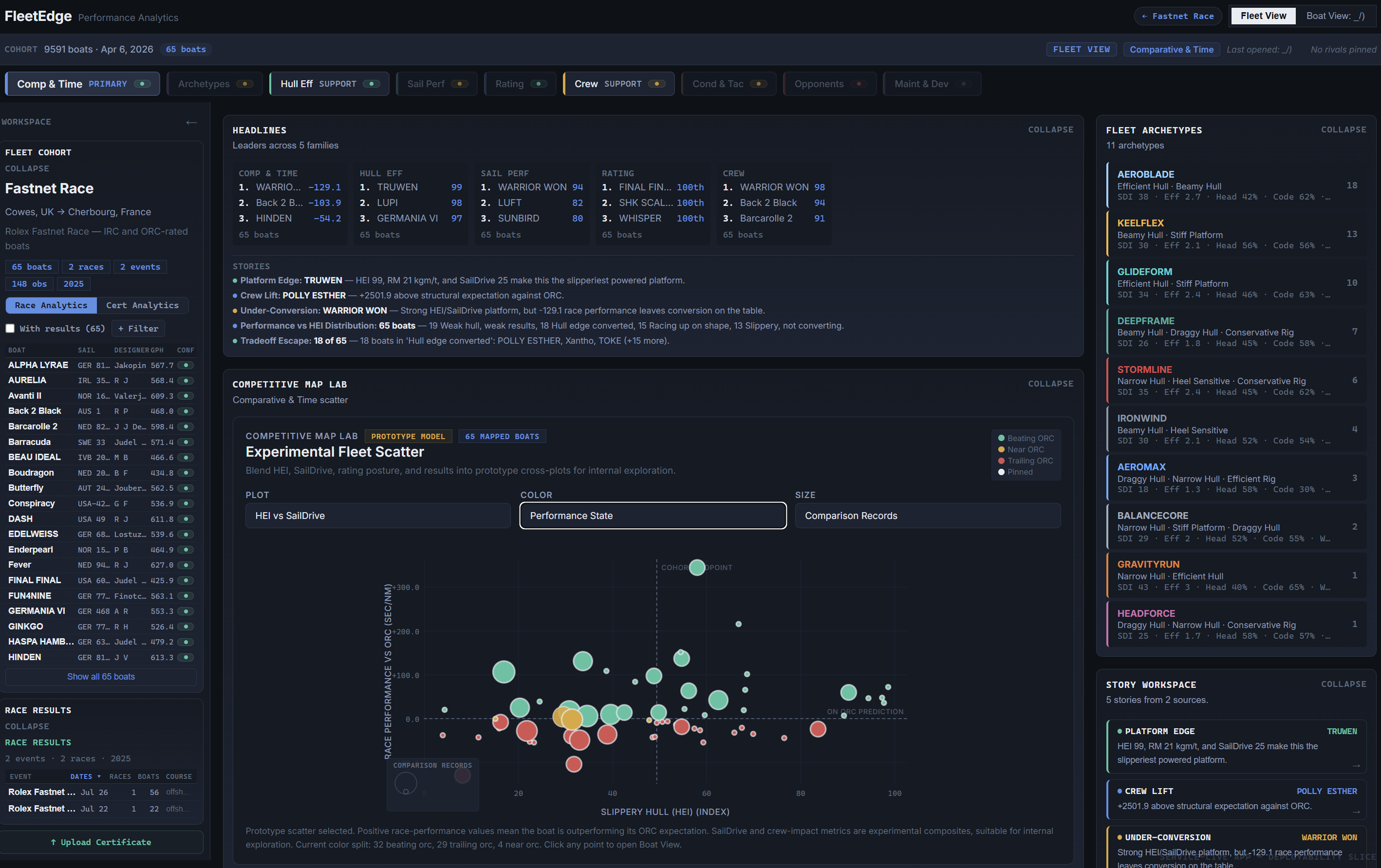
The IRC-to-ORC mapping: Physics Across Handicap Systems
1,600+ IRC boats that have never held an ORC certificate are now analyzed with ORC-grade physics. FleetEdge’s IRC-to-ORC mapping process matches each IRC certificate to its ORC design-family equivalent using measured hull dimensions — validated against dual-rated boats where both certificates exist. Four confidence tiers cover exact sail-number matches, name-plus-geometry concordance, class-sibling hull clustering, and unmatched boats. The projection-accuracy comparison is published in the validation analyses. The matched IRC boat inherits the full ORC physics profile: polar performance data, hull hydrodynamics, rig geometry, and stability characteristics.
SailEdge then completes the picture above the deck. Each mapped IRC hull receives a modern sail package matched to its rig geometry, and SailEdge computes the full aerodynamic drive layer — lift, drag, and drive force across the wind range — from the composite of mapped hull and sail plan. The result is a complete physics evaluation (pace computed from the boat’s certificate physics) that couples hydrodynamic and aerodynamic performance in a single model.
This physics-based bridge between the two systems is FleetEdge’s own. Every twin is transparently labeled as a class-sibling projection — not as measured certificate data. The ORC certificate’s integrity is preserved. What changes is its reach.
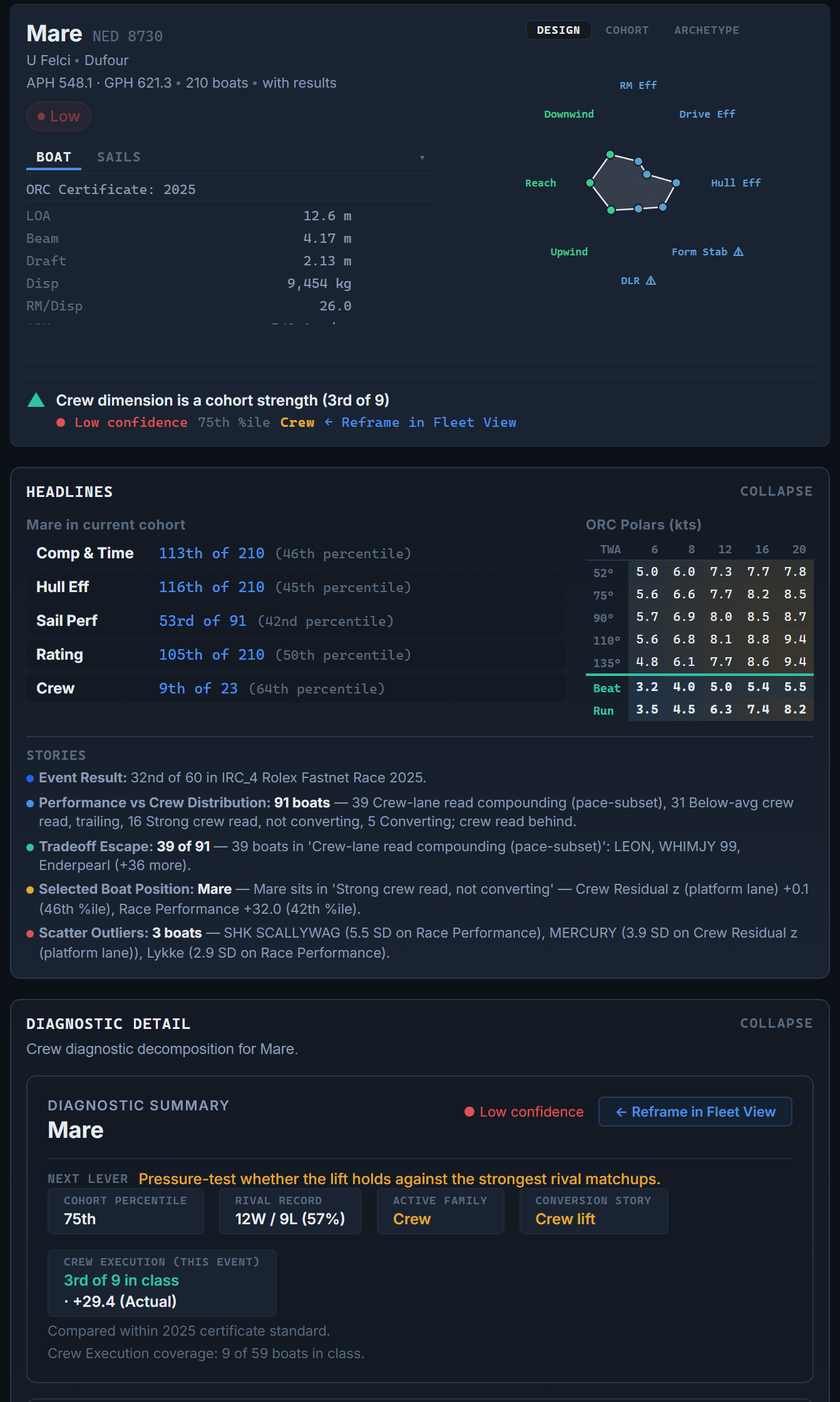
FleetEdge also reads two public-domain environmental reanalysis datasets alongside the race results: ECMWF’s ERA5 atmospheric reanalysis and the U.S. Naval Research Laboratory’s HYCOM GLBy 93.0 ocean-current reanalysis, sampled leg by leg along each race's course where the course geometry is on record, and across the venue for every covered flagship. Same boundary as the race-result feed: FleetEdge consumes these datasets and integrates them; it does not produce environmental data, and current-derived dimensions are disclosed as flagship-scoped on the IRC offshore classics — Cowes, Fastnet, Rolex Middle Sea, Sydney–Hobart, and RORC Caribbean 600 — where tidal flow is a first-order variable. See Ocean Intelligence for the race-by-race current treatment.
What FleetEdge does not do.
Clarity about boundaries matters. FleetEdge is a downstream analytics tool — it consumes IRC data, it does not produce it. The following boundaries are by design and will not change.
FleetEdge never reads IRC TCC values, handicap calculations, or proprietary IRC rating data — the mapping uses publicly available hull dimensions only. It does not modify, influence, or replace IRC ratings. It does not communicate with IRC's rating systems. It does not claim endorsement from RORC or IRC.
FleetEdge is an analytical layer that reads published race results from IRC events and combines them with independent data sources to produce multi-dimensional fleet analysis. The race result is an input. FleetEdge's analysis is the output.
Bridging IRC and ORC.
Independent multi-dimensional analytics for the international offshore fleet.