Regime Affinity
Where a boat’s edge belongs — and whether the race record agrees.
The question a rating list cannot answer.
Watching the 2025 Rolex Sydney Hobart, a big Southerly front moved up the course and the analysts struggled to call it. The best they could do was predict that the DH rating would fare best — not which hulls, not which sail plans, and certainly not which crews would fare best sailing to windward.
That sentence is where the SailrScience story begins, and it names a real gap. A rating list can say which band a forecast should favor. It cannot say which boats — because that answer lives in each boat’s own physics, regime by regime.
Regime Affinity is the FleetEdge™ by SailrScience read built for that gap: it measures how favorably a boat is suited to a defined wind regime, relative to a named fleet or peer cohort (the boats a figure is computed over — a real entry list, a class, a fleet — named on every figure) — the question the 2025 Sydney Hobart commentary could not answer, answered boat by boat.
Physics affinity: sail drive, read against the rating.
FleetEdge starts from the certificate-derived boat — hull, rig, rated sail inventory, stability (how much righting moment the boat carries relative to its displacement), and the ORC performance data — and runs it through the governed SailEdge physics.
The pipeline computes sail drive (the rig’s drive potential on a 0–100 scale) across the boat’s polar envelope — the 72-anchor-cell wind matrix, nine true-wind speeds across eight true-wind angles — and summarizes where that drive is strongest relative to the boat’s rating context.
APH is a certificate-era rating summary expressed as a time allowance, not a boat speed for individual polar cells — ORC’s standard single-number rating since 2022, averaged across the full rated range of wind speeds and directions. FleetEdge never subtracts a handicap from a speed in knots; the comparison runs through the governed affinity transformation, preserving compatible units and the certificate vintage (the dated data cut a figure or an archetype assignment is computed at — never a display rule) that supplied the rating value.
What comes out is a map of designed potential: where the boat’s physics evaluations (pace computed from the boat’s certificate physics) say its relative edge should live — and where the boat outperforms the level its rating allowance implies.
Observed affinity: the record, conditioned by weather.
Then FleetEdge reads the racing record. Each eligible boat-event observation is joined to the weather recorded for the race window — the same ERA5 conditioning behind Weather Intelligence — and assigned to a governed wind regime.
The observed layer asks a different question: when the boat raced in this regime, did it perform above, near, or below the expectation established by its rating and its comparison cohort?
Repeated observations across races and venues reveal whether the physics signal is confirmed, mixed, or challenged by the record. A single result does not establish affinity — and FleetEdge does not pretend it does.
One read, four parts — each traceable.
A published Regime Affinity read keeps its two evidence layers separate and traceable, and says how much weight the conclusion can bear.
Physics signal
The sail-drive pattern across the regime’s polar cells, interpreted in the boat’s certificate-era APH rating context.
Observed signal
Rating-relative race performance in weather-conditioned observations, always against a named cohort and denominator.
Agreement
Whether the record confirms, mixes with, or challenges the physics — or is not yet testable where the evidence has not been banked.
Evidence
How many observations, races, and venues stand behind the read, with weather coverage (the share of the race seen by meteorological observations) stated. The weakest link sets the tier: strong physics coverage never conceals a thin race record.
When race evidence sits below the governed floor, FleetEdge publishes the physics result on its own — labeled as structural — or marks the row as thin evidence. It does not turn sparse observations into a performance claim.
Watch the map turn: one class, three regimes.
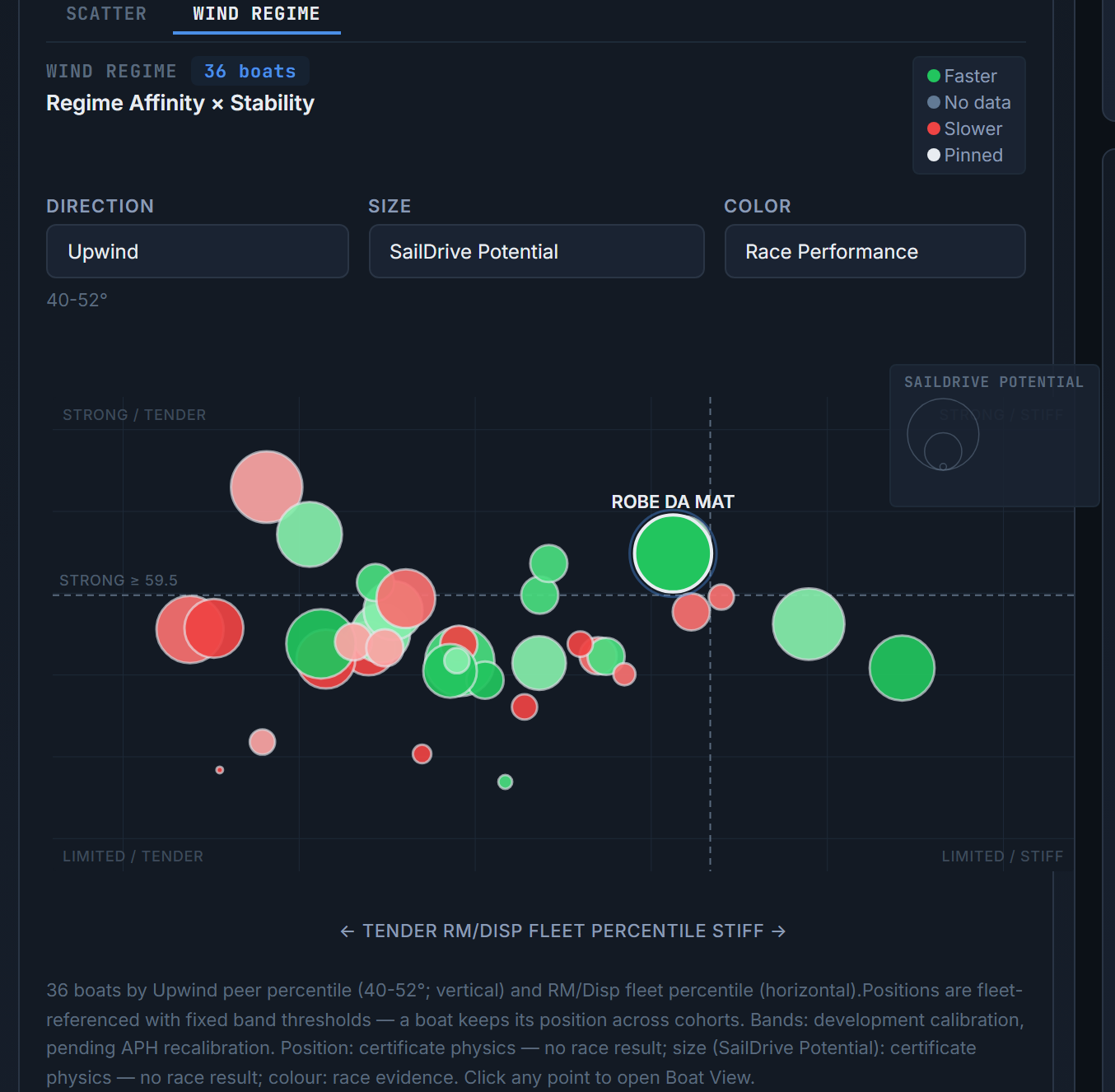
Hold a class still and rotate the wind, and the value of a hull changes in front of you. The scatters here are the same ORC Worlds 2026 Class C cohort as the upwind read above — same axes, same boats, one regime changed at a time.
Some boats hold the strong band in every regime. Others trade places entirely — a hull that queues mid-pack upwind can carry the strongest reaching drive in the class. That migration is the point of the read: a boat’s edge is not one number, it is an address that moves with the wind.
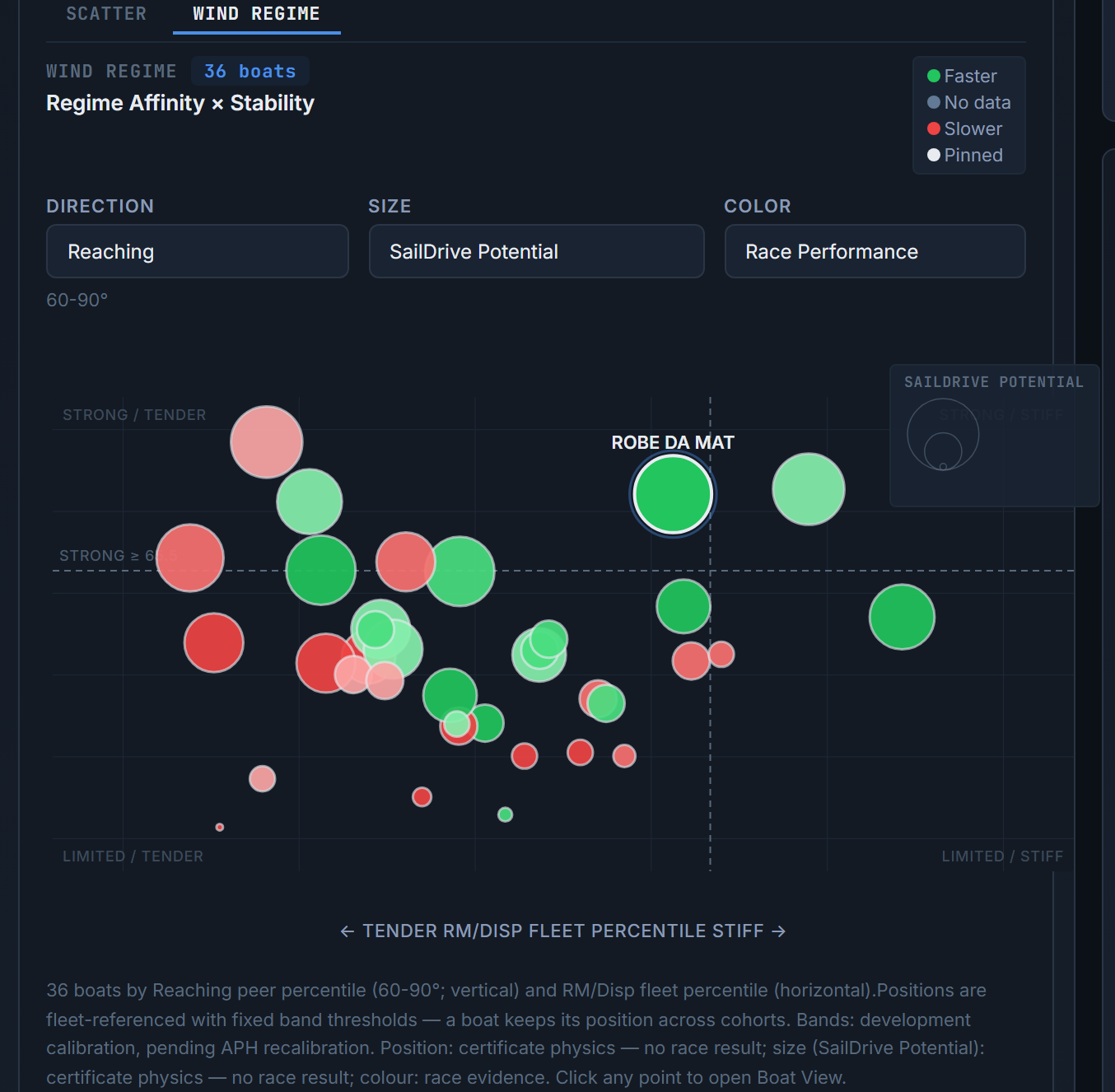
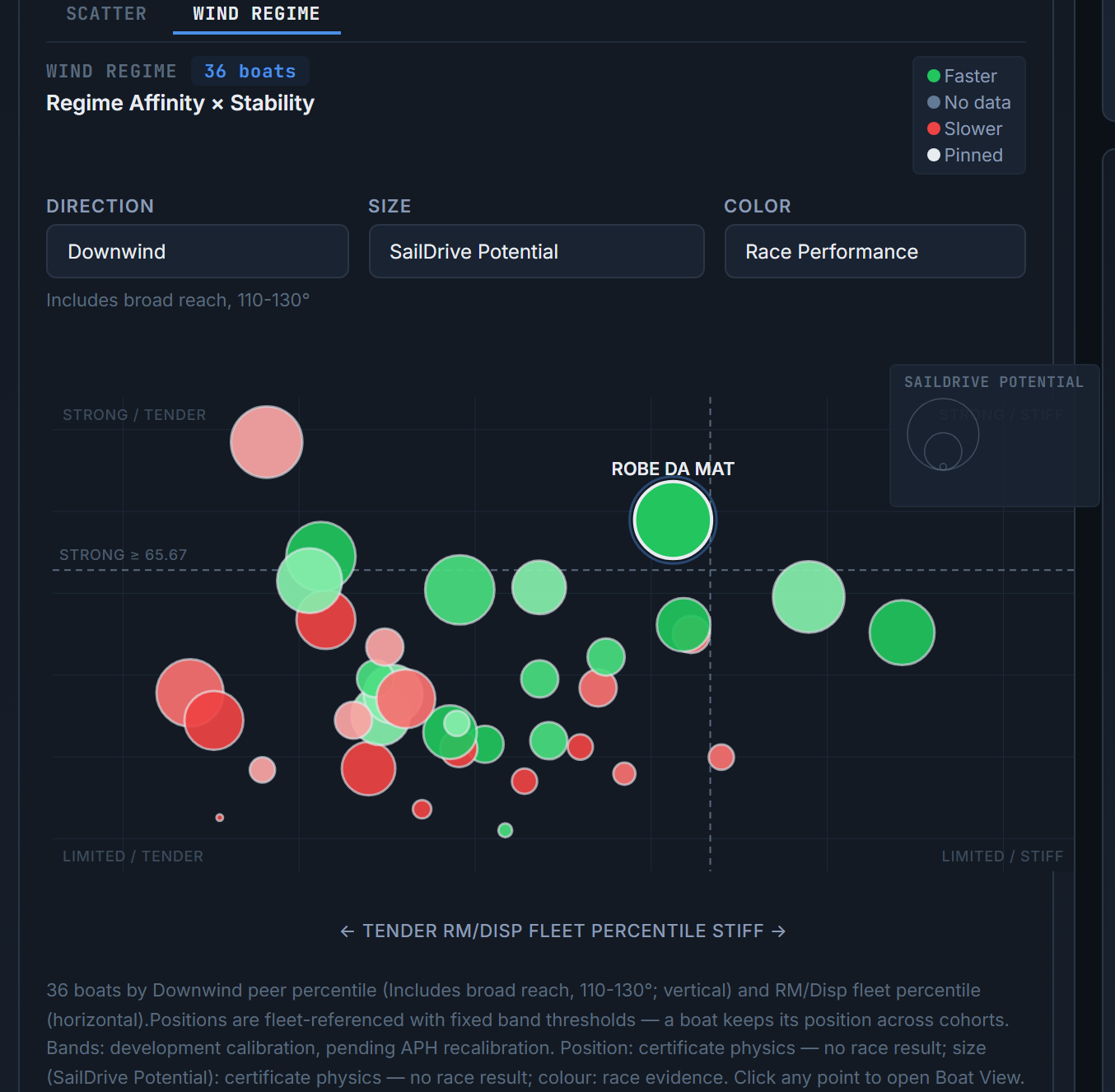
Boats are named as rendered by FleetEdge’s versioned capture of this analysis; naming implies no current official standing, endorsement, or continuing status. All three regime views were captured in one session on 2026-08-31 from FleetEdge’s current published analysis — same cohort, same publication cut.
Not a handicap. Not a forecast of a finish.
Regime Affinity is a regime-level profile of one boat against a named cohort. It is not a new rating, and it is not a percentage chance of winning.
Reads are cohort-relative: a strong value means strong relative affinity within the named cohort, under the named regime definition, at the stated publication date. A wide middle band reads as neutral — no directional claim — and stronger language takes both a position outside that band and enough evidence to carry it.
It is also not Venue Fit. Regime Affinity describes the boat under a stable, governed regime definition; how much a particular venue’s expected conditions overlap that profile is a later, route-specific question. Keeping the two apart is what keeps reads comparable from page to page.
What it can say — and what it cannot.
It can show
Where the physics indicates a boat should be relatively strong or weak. Whether weather-conditioned race observations support that signal. How the answer changes across wind regimes — and how much evidence stands behind each conclusion.
It cannot, by itself
Establish that one sail, trim choice, or crew action caused a result. Turn a fleet-relative association into a guaranteed future gain. Substitute for ORC rating or race scoring. Or read angle-specific performance into races whose record lacks course context.
Sea state is its own layer too: wave height and period come from the environmental record, not from the wind polar, and any sea-state-conditioned slice is labeled separately. And the boundary that frames all of it: FleetEdge alters no rating and settles no result — ORC remains the rating and scoring authority.
The full answer to the opening question.
Sydney Hobart 2025 — the regime story
The Southerly, replayed through the certificate physics: windward work, the run down the coast, and the super maxi at the edge of the map.
Weather Intelligence
How FleetEdge conditions race observations with ERA5 wind and wave data.
The physics names the possibility. The race record tests it.
Regime Affinity shows where the two agree — and where more evidence is still needed.