Sail Performance
The rig's contribution — drive and its efficiency, the wardrobe, and the VMG the physics evaluates.
In beta as a product. Sail-performance analysis is part of Design Benchmarks — the private peer-benchmarking workspace for naval architects and lofts. See Design Benchmarks →
- dimension family (one of the nine groups of FleetEdge readings — six on the Fleet View ribbon — each reading one aspect of the boat or its racing)
- physics potential (the PPI pillar that captures hull and sail-plan efficiency, from the certificate alone)
- observation (one boat's result in one scored race, joined to the weather of its race window)
Sail Performance (registry short label: Sail) is the FleetEdge dimension family that reads the rig: how much drive the sail plan develops and how efficiently, how that drive is shared between the headsail and the off-wind sails, the breadth of the wardrobe, the upwind and downwind VMG the physics evaluates at twelve knots, the Design PPI score and the Physics Potential pillar of the Performance Potential Index. Every reading but one needs no race result; the Archetype Condition Delta needs a weather-joined race observation.
What Sail Performance measures.
The largest family in the registry. Drive readings say how much force the rig can deliver and at what cost in drag; the shares say where that drive comes from; the wardrobe readings describe the inventory the certificate declares; the VMG readings are the physics evaluation's answer at twelve knots; the two Performance Index readings pace the design against its length band and the fleet; the condition delta says how its design type shifts under a race's weather; the last two place it on the Performance Potential Index.
| Dimension | Unit | Reading |
|---|---|---|
| Drive Efficiency (L/D) | ratio | Lift over drag for the sail plan — higher is better |
| Specific Drive | N/kg⅔ | Drive normalized by displacement to the two-thirds power — higher is better |
| Sail Drive Index | 0-100 | The rig's drive potential on a 0-100 scale — the App's SailDrive Potential, compact Drive Index; higher is better |
| Performance Index (LOA) | sec/NM | Evaluated pace (the pace the certificate physics say the boat should hold) against boats of similar length — lower is better |
| Performance Index (Fleet) | sec/NM | Evaluated pace against the fleet — lower is better |
| Headsail Drive % (Upwind) | % | The headsail's share of drive on the beat — higher is better |
| Offwind Sail Drive % (Reach) | % | The off-wind sails' share of drive on a reach — higher is better |
| Wardrobe Diversity | index | How varied the declared sail inventory is — higher is better |
| Asymmetric Sail Types | count | How many asymmetric sail types the certificate declares — higher is better |
| Upwind VMG (12kt) | kt | Velocity made good to windward at twelve knots of breeze — higher is better |
| Downwind VMG (12kt) | kt | Velocity made good downwind at twelve knots of breeze — higher is better |
| Archetype Condition Delta | sec/nm | The design type's pace shift under the race's conditions — lower is better |
| Design PPI | 0-100 | The Performance Potential Index scored from the certificate alone — race data not required — higher is better |
| Physics Potential | percentile | The physics pillar of the Performance Potential Index — where the physics evaluation (pace computed from the boat's certificate physics) places the design, ranked against its cohort (the boats a figure is computed over — a real entry list, a class, a fleet — named on every figure); higher is better |
Reading the polarity. Higher is better for the drive, share, wardrobe, VMG, and potential readings. Lower is better for the two Performance Index readings — seconds per nautical mile, so less time per mile is faster — and for the Archetype Condition Delta. The labels and units are the App's own; on the Web the drive-potential reading carries its ratified public name, Sail Drive Index.
Where the family renders.
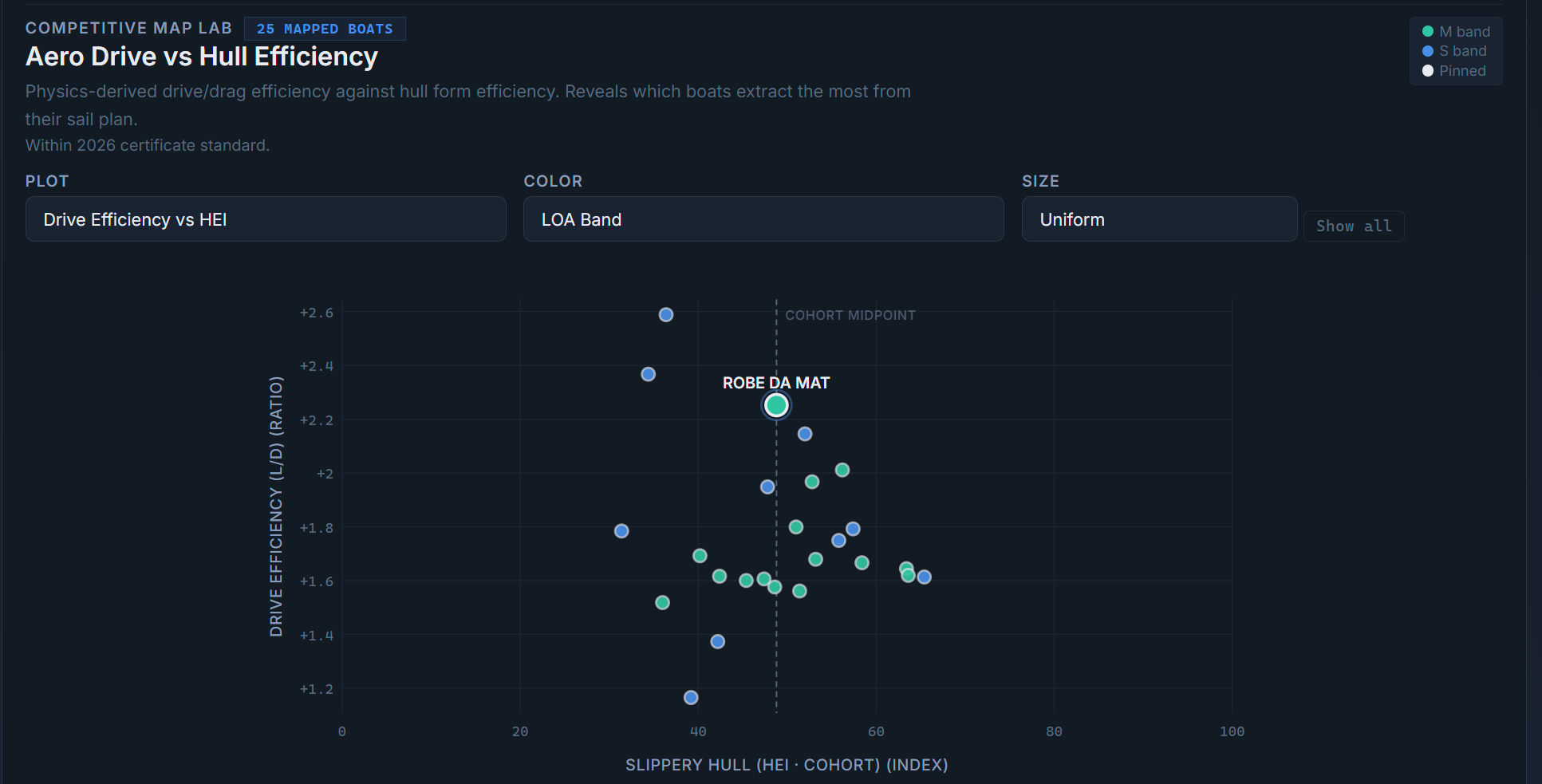
In the Fleet View, Sail Performance sits on the dimension ribbon, landing on Drive Efficiency (L/D); the Sail Drive Index board is where a fleet's rig potential lines up. In the Boat View, it is the sail story — the rig read beside the hull it drives and the rating it is scored under — and a boat's rivals rank on the Sail Drive Index.
Every reading but the Archetype Condition Delta rests on the certificate's declared sail plan and the SailEdge physics evaluation of it; that one reads the design type against a weather-joined race record. Nothing else here is measured on the water — that is what the race-dependent families are for.

Go deeper.
Hull & Platform
The platform the rig drives — hull efficiency, stability (how much righting moment the boat carries relative to its displacement), heel, and geometry.
The Physics
The force-balance model behind the drive and VMG readings.
Fleet Archetypes
The eight design archetypes (the fleet's eight recurring design types) and their sail signatures.
What the sail readings can and cannot say. They place a certificate's declared sail plan, and the physics evaluation of it, among the fleet's. They cannot see sail age, trim, or how a crew handles the inventory on the day; those live outside the certificate.
FleetEdge alters no rating and no score — ORC remains the rating and scoring authority.
Every rig tells a story. FleetEdge reads it.
Sail Performance — the rig family of FleetEdge's fleet-wide analysis, read from the certificate and the physics, with one condition reading from the race record.