Separate the boat from the crew.
FleetEdge Team Diagnostic · Beta
Beta — access by request · The product is running: the screens below are a real campaign on the live corpus, in beta. Every panel carries the product’s own status fence — LIVE, UNDER VALIDATION, or PLANNED — in the screen itself; a panel’s fence governs its claims.
Separate what the boat gave you from what the crew earned — a private diagnostic for your campaign.
For racing teams, tacticians, campaign managers, and coaches. Access by request.
Universe: one boat — yours Story: ORC Worlds 2025, Tallinn Private to your team
Scope: one boat — yours
Visible to: your team only — no other team, federation, or public surface can see this view
Access: by request — the product opens once your access is granted.
The campaign view, live.
A season on one screen: the crew-pillar headline, every collected event with its standing and pace, the improvement queue, and the rivals you pinned. The screens below are our own demonstration campaign on published race data — customer campaigns stay private to their teams.
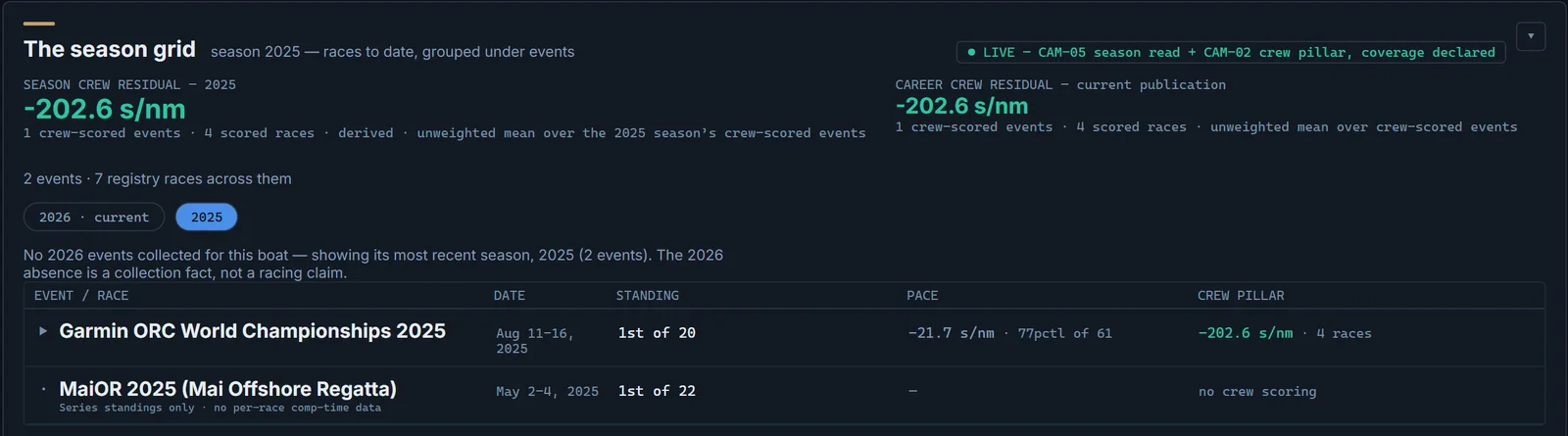
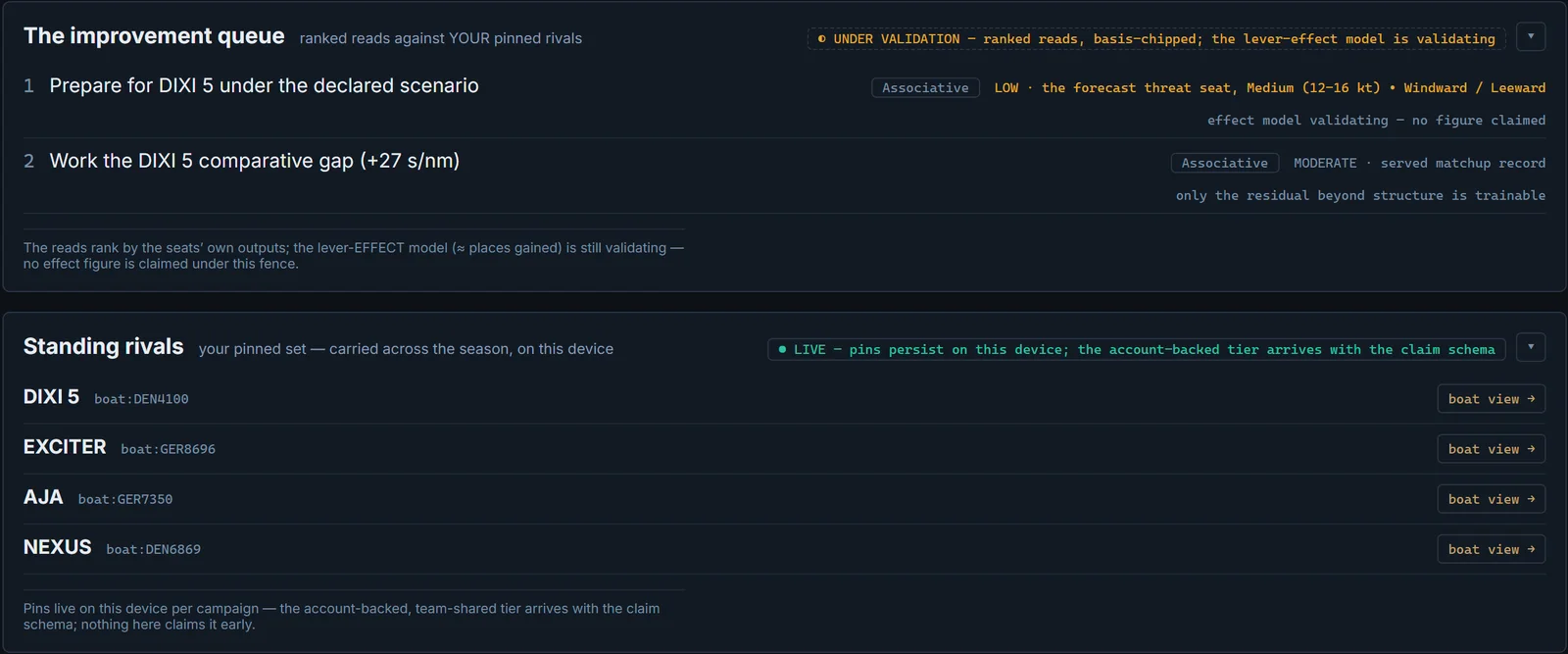
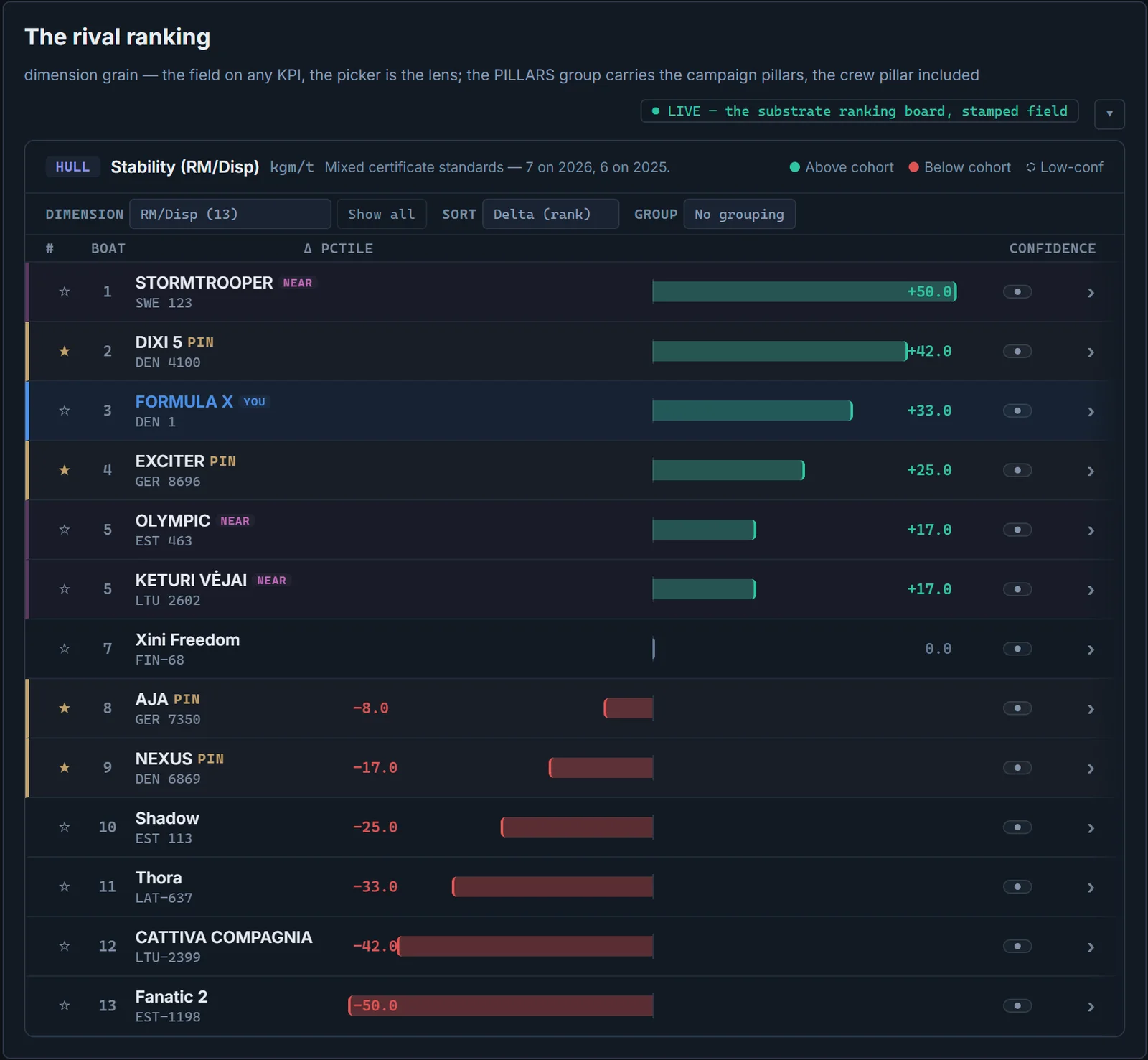
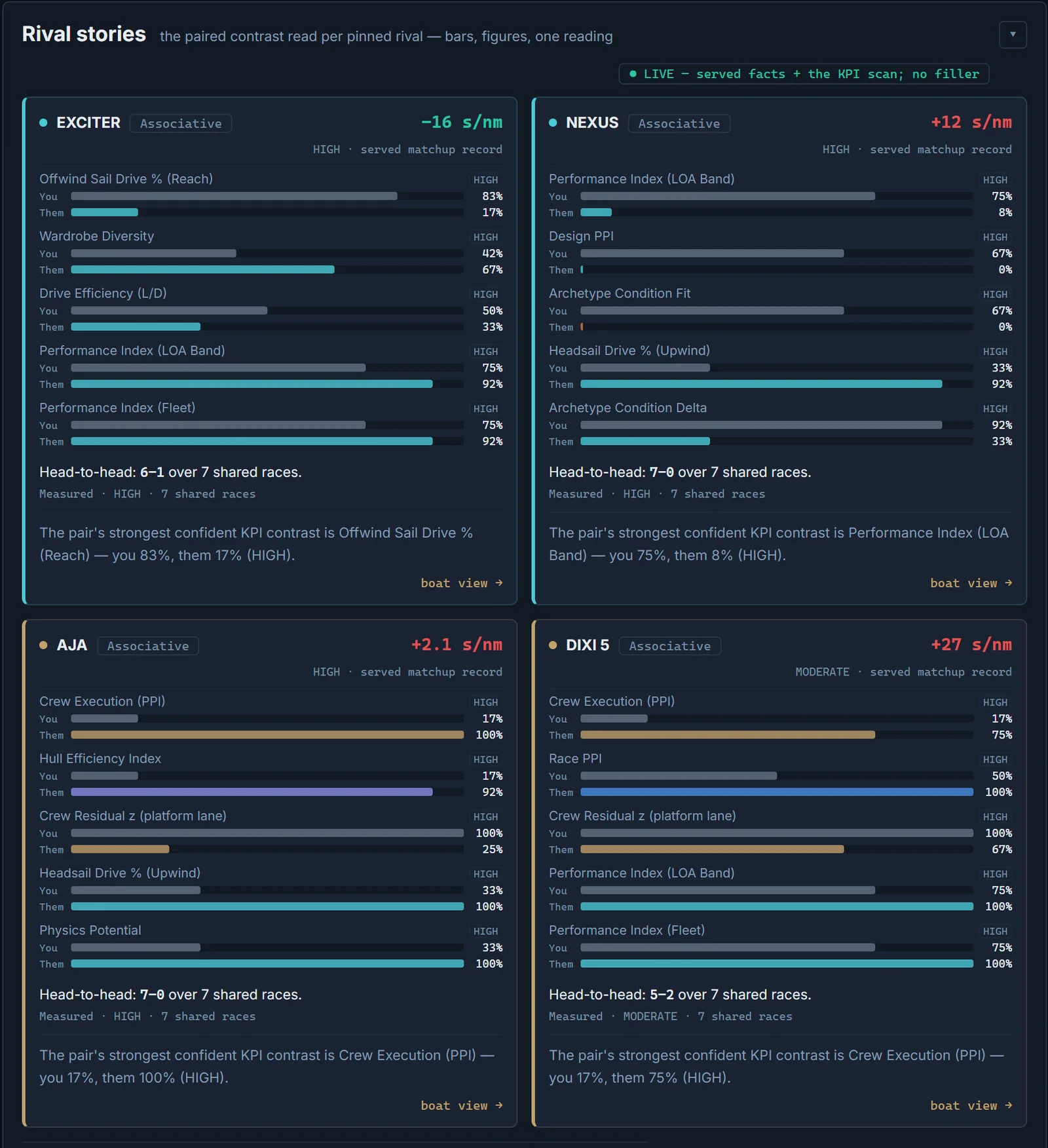
The field, placed and decomposed.
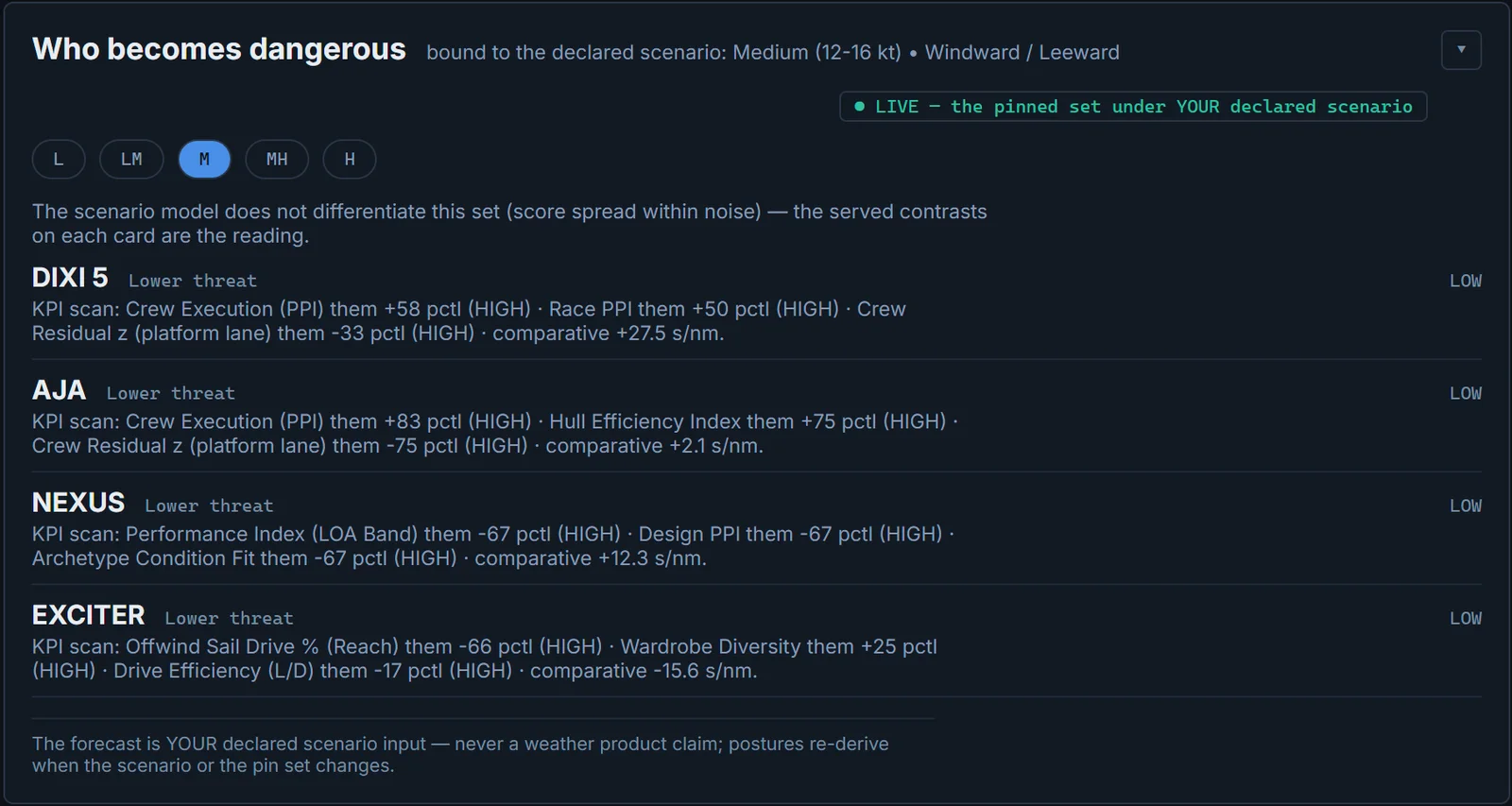
Pick a dimension and the board ranks your field around you — green is better, not higher, and confidence rides every row. Each pinned rival gets a paired contrast card composed from the served facts, and the threat panel re-reads the pinned set under your declared forecast band.
Preparation against a declared race.
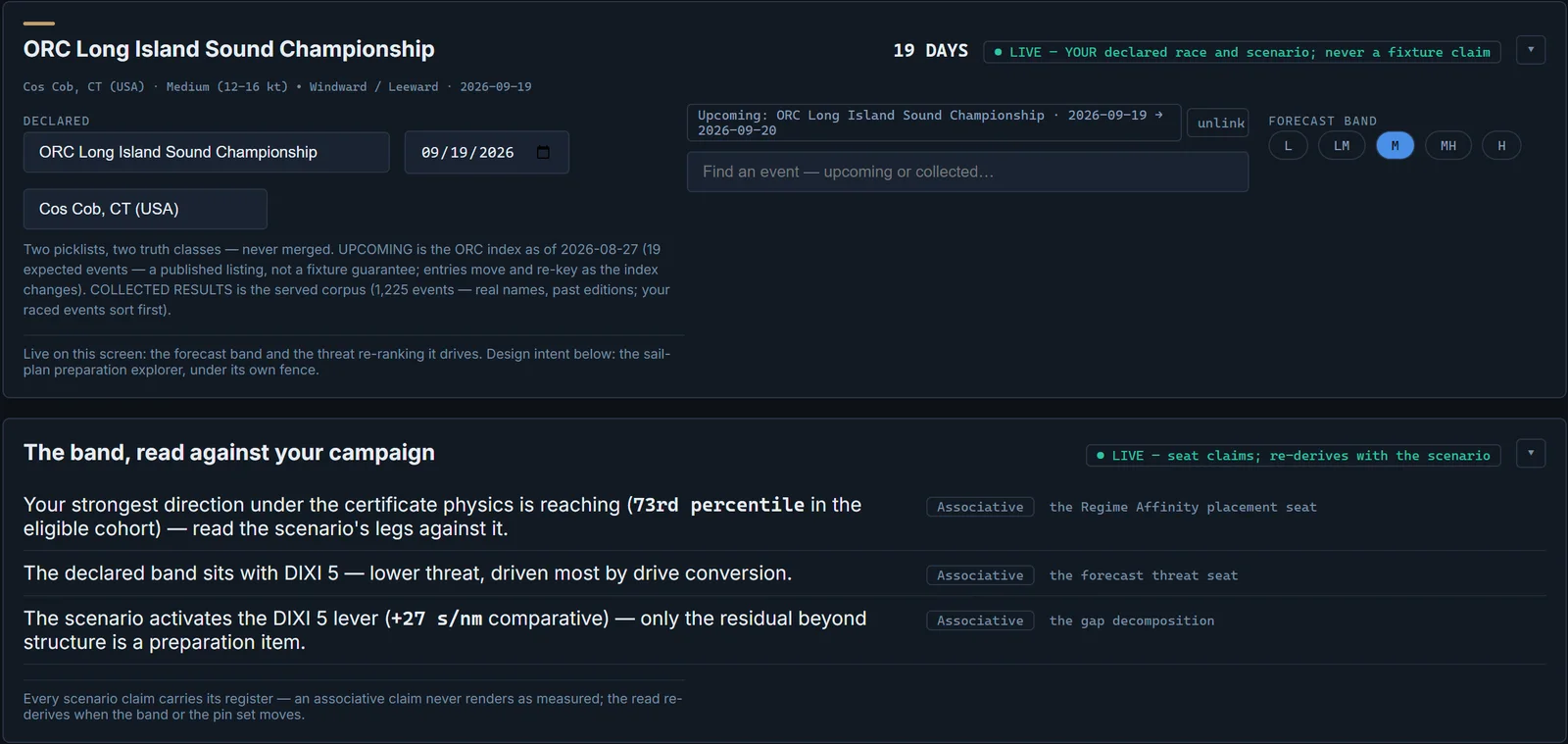
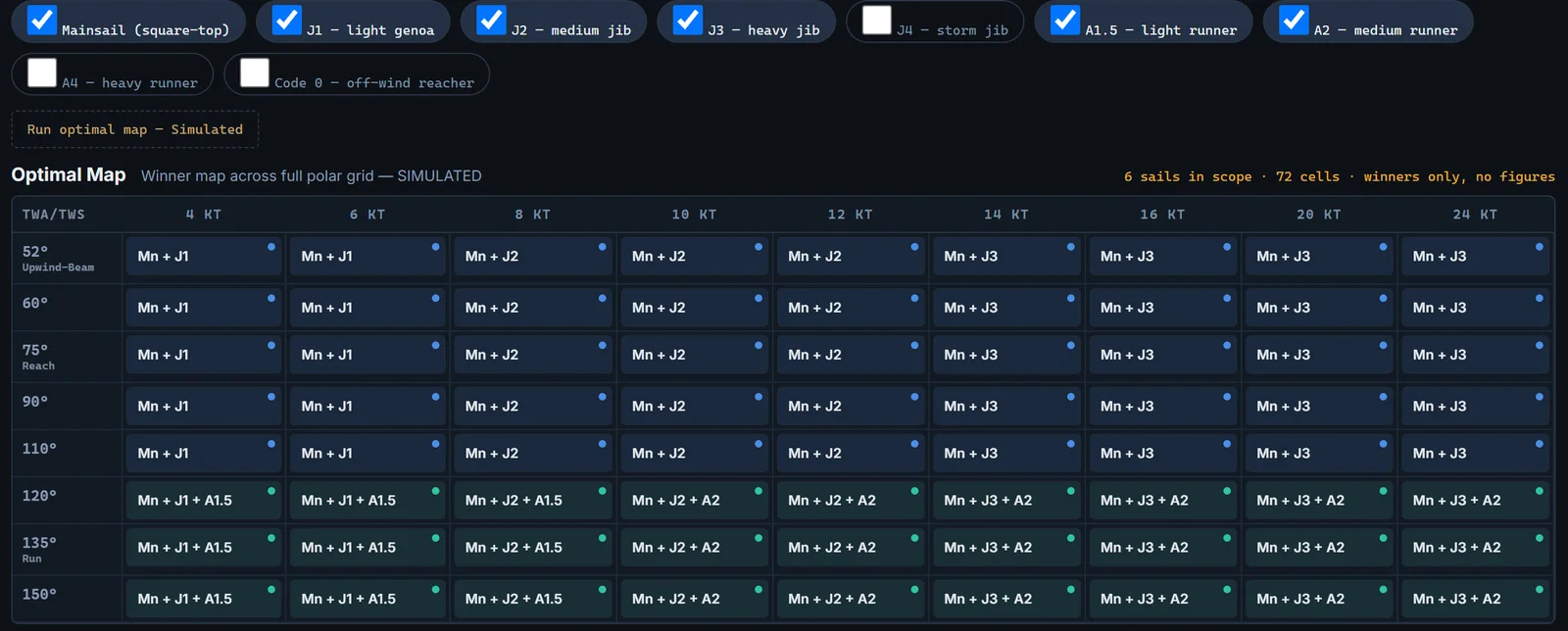
Declare the race and the countdown, forecast band, and seat claims compose against it — every claim carries its register in-line, and an associative claim never renders as measured. The sail-plan crossover explorer runs a simulated optimal map over a specimen wardrobe; the live flow will load your certificate’s declared inventory, and the panel’s own fence says exactly what is and is not claimed.
The pack the product prepares.
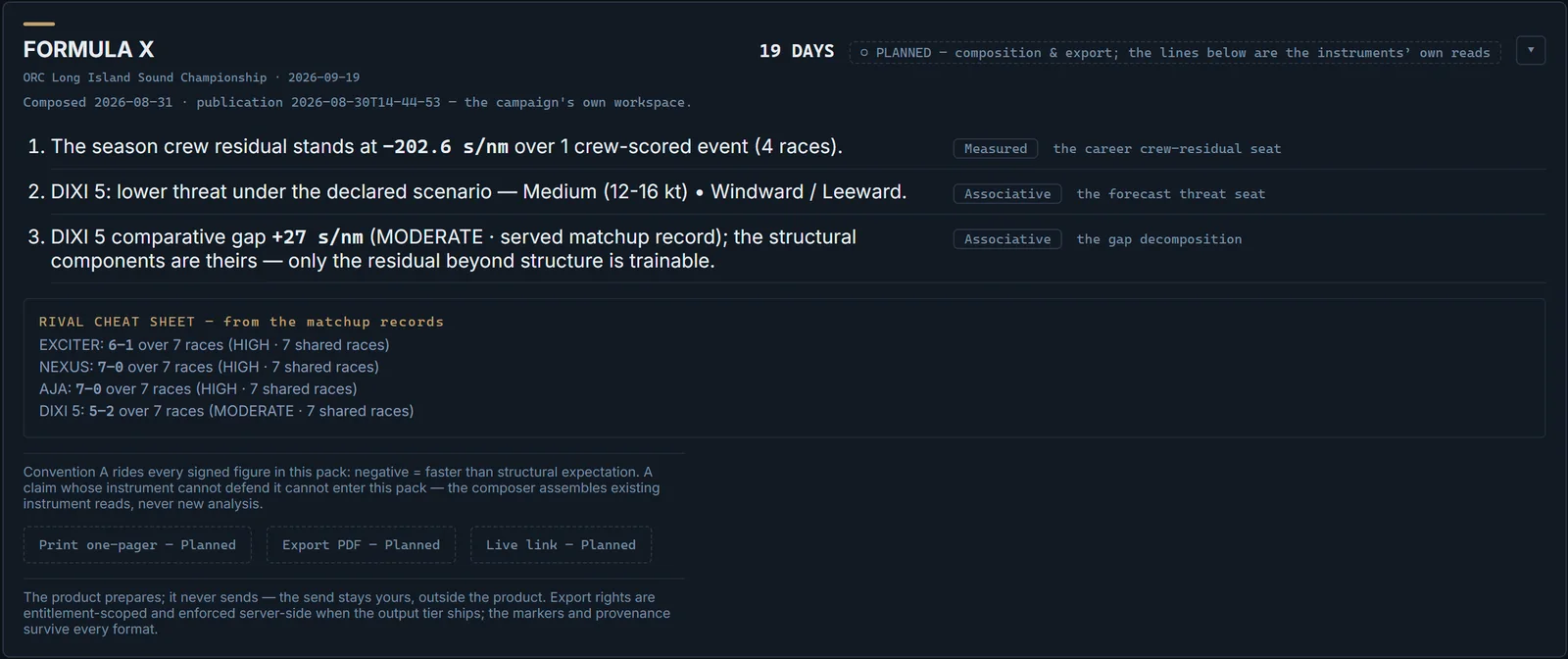
The briefing assembles only what the instruments defend — every line carries its register and names its instrument, and the rival cheat sheet composes from the matchup records. Export is deliberately marked Planned: the product prepares; the send stays yours.
Team Diagnostic, over the one App.
- PPI (the Performance Potential Index)
- crew pillar (the crew-execution share of PPI)
- condition fit (how well the design suited the conditions it met)
- crew-execution residual (what remains after the boat’s evaluated pace is accounted for — negative is faster, in s/nm)
Built on the FleetEdge platform, curated to a competitive team: your boat at full private depth, the rivals you meet across the season at comparison depth, and the crew pillar you actually control front and center.
Competitor × event map
Pin the boats you race and see PPI for every one, event after event — where you lead, where you trail, and against whom.
Three-pillar decomposition
Physics potential (the PPI pillar that captures hull and sail-plan efficiency, from the certificate alone), condition fit, and the crew-execution residual — confidence-tiered, with a reason chain. The private depth is on your own boat.
Stack-rank & compare
Sort the field by overall PPI or by the crew pillar alone, per event or per season — platform gaps and execution gaps, separated.
Prepare for the next event
Set the expected conditions and a target rival, then explore sail-plan crossovers across the wind range. Directional guidance to plan against.
Wind-regime affinity
Where your boat’s edge lives across the wind regimes (a governed band of wind conditions — upwind, reaching or downwind — a race observation is assigned to) — and how that overlaps with the venues you race.
Your season on the record
Headlines, story cards, and the boat detail for every event you sailed — the published record your private read sits on.
The panels above run on FleetEdge instruments at the product’s own stated tiers — LIVE, UNDER VALIDATION, or PLANNED, declared on each screen: Boat detail Crew PPI · three pillars Dimension stack ranking Competitor context Wind-regime affinity Archetypes × conditions Fleet scatter Headlines Story cards
Deliberately not here: a rival’s private workspace — competitors appear at comparison depth from the same published results anyone can see, and you never see their what-ifs. Not one event — bound-to-one-event is Event Pack’s lane; this view crosses your season. No on-board telemetry: the residual is derived under the FleetEdge physics model, and a sail plan is directional guidance until you sail it.
Pin. Map. Rank. Decompose. Plan.
For campaign leads and coaches racing a season-long circuit against a known set of rivals, who want the one thing the scoreboard can’t tell them: where does the gap actually live, and how much of it is ours to move?
- Pin — open the team workspace and pin the boats you race across the circuit: your standing cohort (the boats a figure is computed over — a real entry list, a class, a fleet — named on every figure).
- Map — read the competitor-by-event grid: PPI for every rival at every event, where they lead and where they trail.
- Rank — stack-rank the field by PPI, then by the crew pillar alone, to see who is beating you on the boat versus on execution.
- Decompose — split your result and a rival’s into physics, fit, and crew — and find which pillar the gap lives in.
- Plan — pick the next event’s expected conditions and a target rival; get a directional sail plan for the band where your edge pays.
One design, four crews.
Three sister-ships took 1st, 2nd, and 4th in Class B at the 2025 ORC Worlds. A fourth — same hull, same rig, nearly the same rating — finished deep in the fleet. When the boat is held constant, what separates the winners?
This story is built from published race results. Your own diagnostic stays private to your team.
Tallinn, Class B — the natural experiment
Four Xr-41s inside a 12-boat comparison group (the product’s event cohort runs wider): the same 12.7-meter racer, four different crews, ratings within a handful of seconds per nautical mile. FleetEdge reads the whole cohort through one lens — what the design gave, what the crew earned.
The crew ladder is the finishing ladder
In the Study of this cohort (fleet view as of 1 July 2026), the four boats with negative crew residuals — FORMULA X, MABELLE II, DIXI 5, EXCITER — are exactly the top four finishers. FORMULA X’s −25.4 s/nm (seconds per nautical mile — pace normalized by distance) crew residual against DIXI 5’s −10.0 is the regatta, in one number.
FORMULA X — she won it on the water
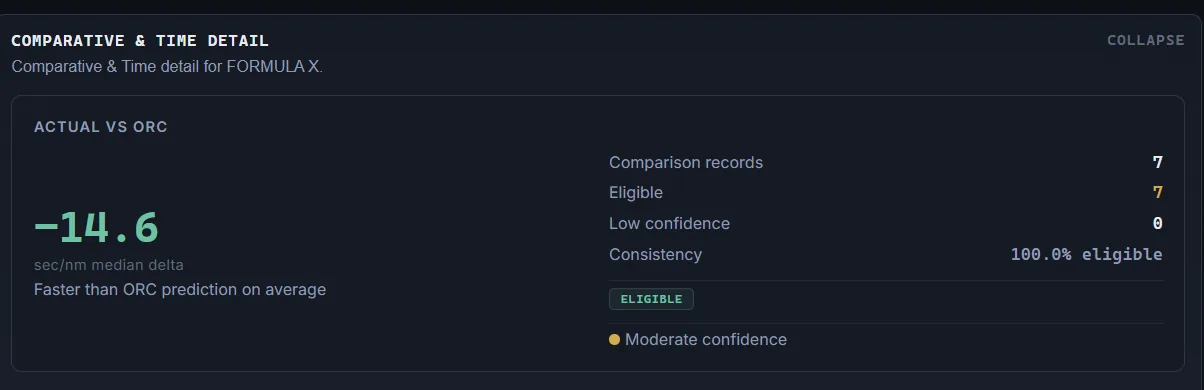
The platform gave her nothing her sister-ships didn’t have: near-identical certificate ratings across the cluster. The Study attributes the win to the best crew residual in the cohort — −25.4 s/nm — on top of the best race delta (−14.6). The boat view carried the diagnostic behind that attribution; the current publication serves this event’s crew column differently, so no current frame can reproduce the Study’s read — the figures here are the Study’s, and the beta product itself now runs a live campaign on the same boat: the walkthrough above is her live campaign, on her most recent collected season.
The decomposition, behind the readout
The crew-execution signal across the campaign’s eligible records — stated as bounded, not causal, with that line in frame.
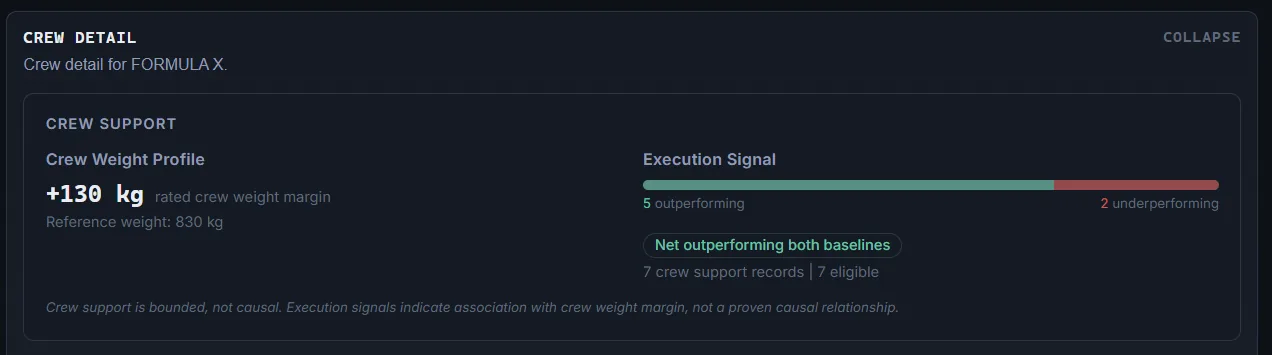
The decomposition methodology is under on-site validation — readouts are directional and say so.
XBOX — same platform, deep in the fleet
The fourth Xr-41 is the experiment’s control: same hull, same rig family, a near-identical certificate rating — and a +37.1 s/nm crew residual in the Study that left her deep in the fleet. Across four identical platforms the finishing spread tracks the crew column, not the certificate. The +37.1 (positive = pace given away) is the versioned Study’s figure; the crew pillar the product reads today is on screen in the beta walkthrough above.
Race by race, the story holds
Seven eligible comparison records sit behind the winner’s median delta — the diagnostic isn’t one race’s verdict, it’s the series’ shape.
A note on the numbers above — figures come from different captures and are not interchangeable:
1. The Formula X/XBOX story cites the versioned FleetEdge Study (fleet view as of 1 July 2026), frozen with that artifact; the walkthrough screens show the beta product’s own live read, captured 30 August 2026 — a different statistic, on a different basis and a different publication, with no equivalence claimed at any grain.
2. Boat and event counts in the walkthrough reflect only that capture, not this site’s published macro figures.
3. The two legacy App frames in the story (captured 10 July 2026) keep their own as-of captions and may carry the prior rating scalar (the certificate’s reference rating figure) and a since-retired crew display in-frame; no figure on this page is quoted from either.
4. Crew analytics in the current product are execution-only.
5. The status labels — LIVE, UNDER VALIDATION, PLANNED — are the product’s own vocabulary, declared panel by panel; a panel’s fence governs its claims, and nothing here claims an unshipped tier early.
6. Beta access is by request, and customer campaigns stay private to their teams; the walkthrough is our own demonstration campaign on published race results.
The diagnostic builds on the FleetEdge crew and physics layer — how it works: Team Diagnostics, Crew & Execution, and The Physics.
See it against your own work.
Team Diagnostic is in beta — access by request. Scope: one boat — yours. No other team, federation, or public surface can see your view.