The season, reviewed.
FleetEdge Federation Dashboard · Beta
Beta — access by request · The product is running: the screens below are the dashboard’s own season review on Italy’s published record — the demonstration binding — in beta. Every panel carries the product’s own status mark in the screen itself — live, planned, or demonstration — and a panel’s mark governs its claims.
The season review in the questions a rating officer actually asks — which boats, which designs won, whether the boats or the crews made the difference, what happened at the events — and at the end, the report for the board, issued with a number and a date.
For ORC class associations and national authorities. Access by request.
Scope: the nation’s certificated boats, wherever they race Story: Italy’s published record, the demonstration Private to your federation
Scope: your federation’s certificated boats, wherever they race — the certificate’s country decides
The season: the federation’s own races as the published record attributes them, and the certificate each boat holds now
Visible to: your federation only
Access: by request — the product opens once your access is granted.
The season at a glance.
You arrive on the season line: the published record, the federation’s own races, the certificate each boat holds now, and the date of the publication you are reading. The rail carries the nine questions of the season review and two doors — After a race and Make the report. A review lives in the address and in your browser across visits; the charts you keep hold what you saw, never a live re-draw. One press narrows the whole fleet to the boats you mean.
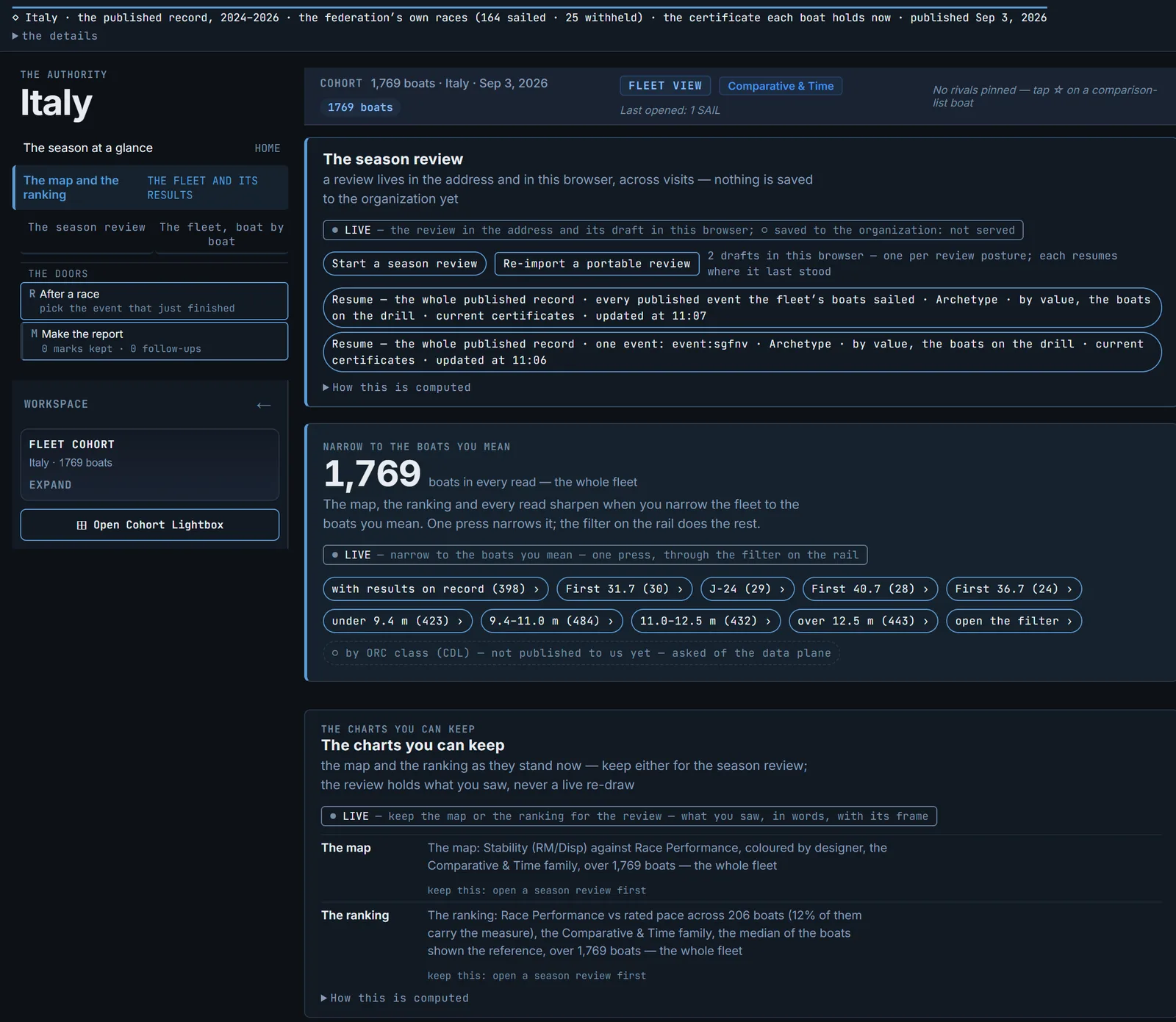
Which boats are we talking about?
Before any share, an officer needs the population. The dashboard answers rung by rung: the boats that hold a certificate from the federation; the ones with a result on record at one of its own races; the ones with a finishing place; the ones whose pace against the rating can be read, and read well. Each rung is a count from the published results and a door to its boats. The two rungs the published record cannot yet support say so, in the record’s own words, instead of pretending.
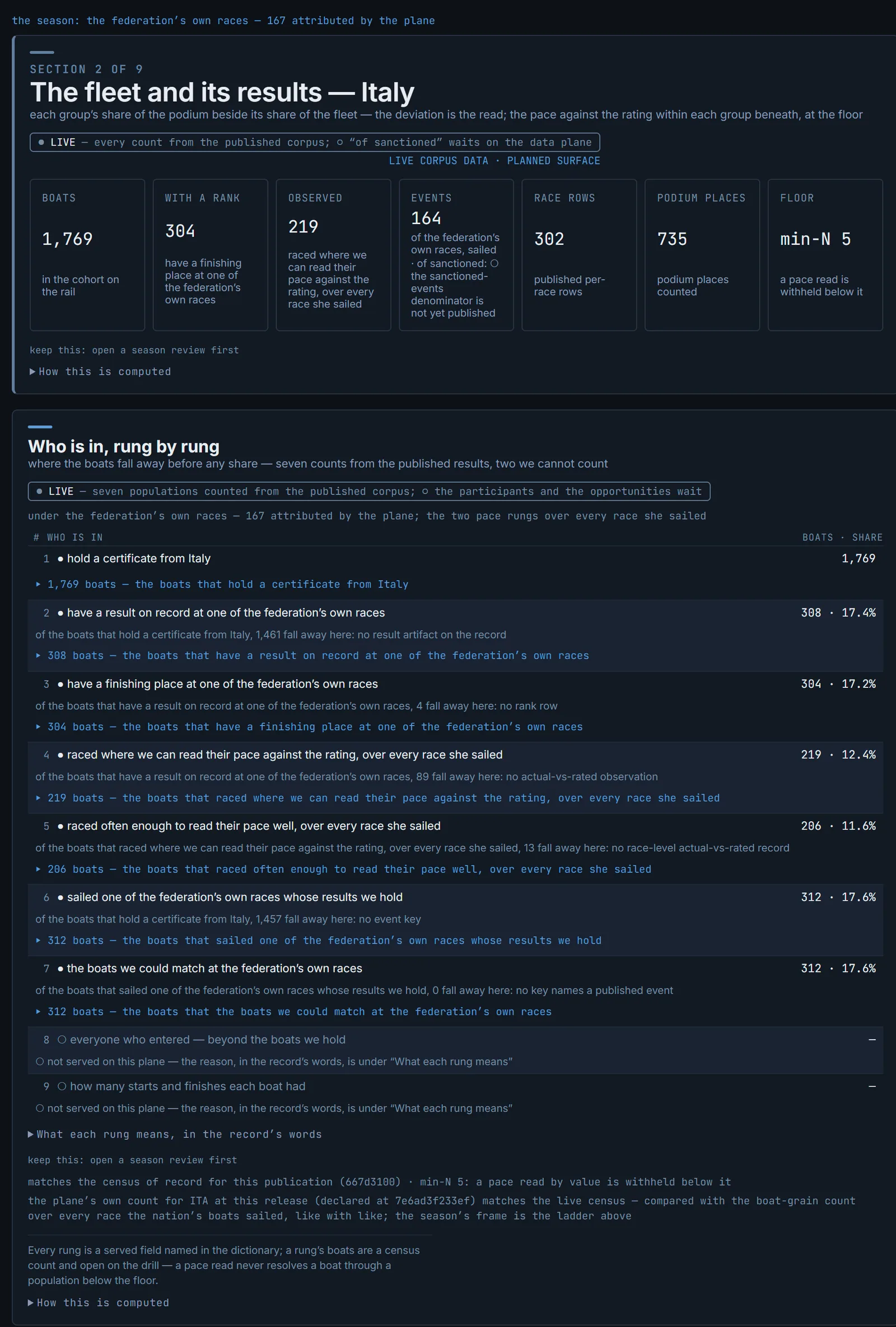
Which designs won?
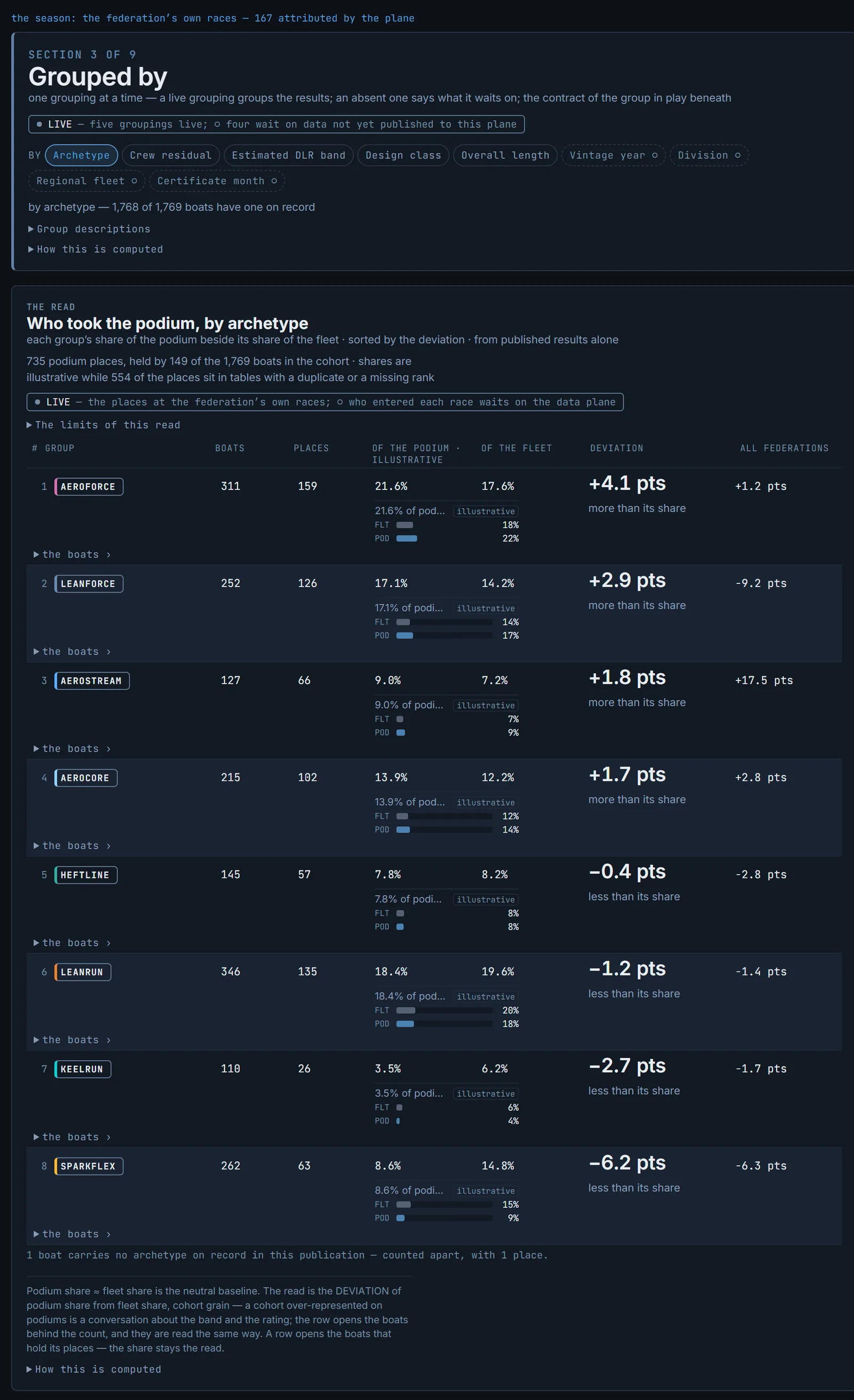
Grouped by archetype (one of the fleet’s eight recurring design types), the podium is read the way an authority should read it: each group’s share of the podium beside its share of the fleet. Equal shares are the neutral baseline; the deviation is the read. A row opens the boats behind the count, and the share stays the read. Other groupings — design class, overall length — are one press away; the ones the published record cannot yet support say what they wait on.
Did the boats or the crews make the difference?
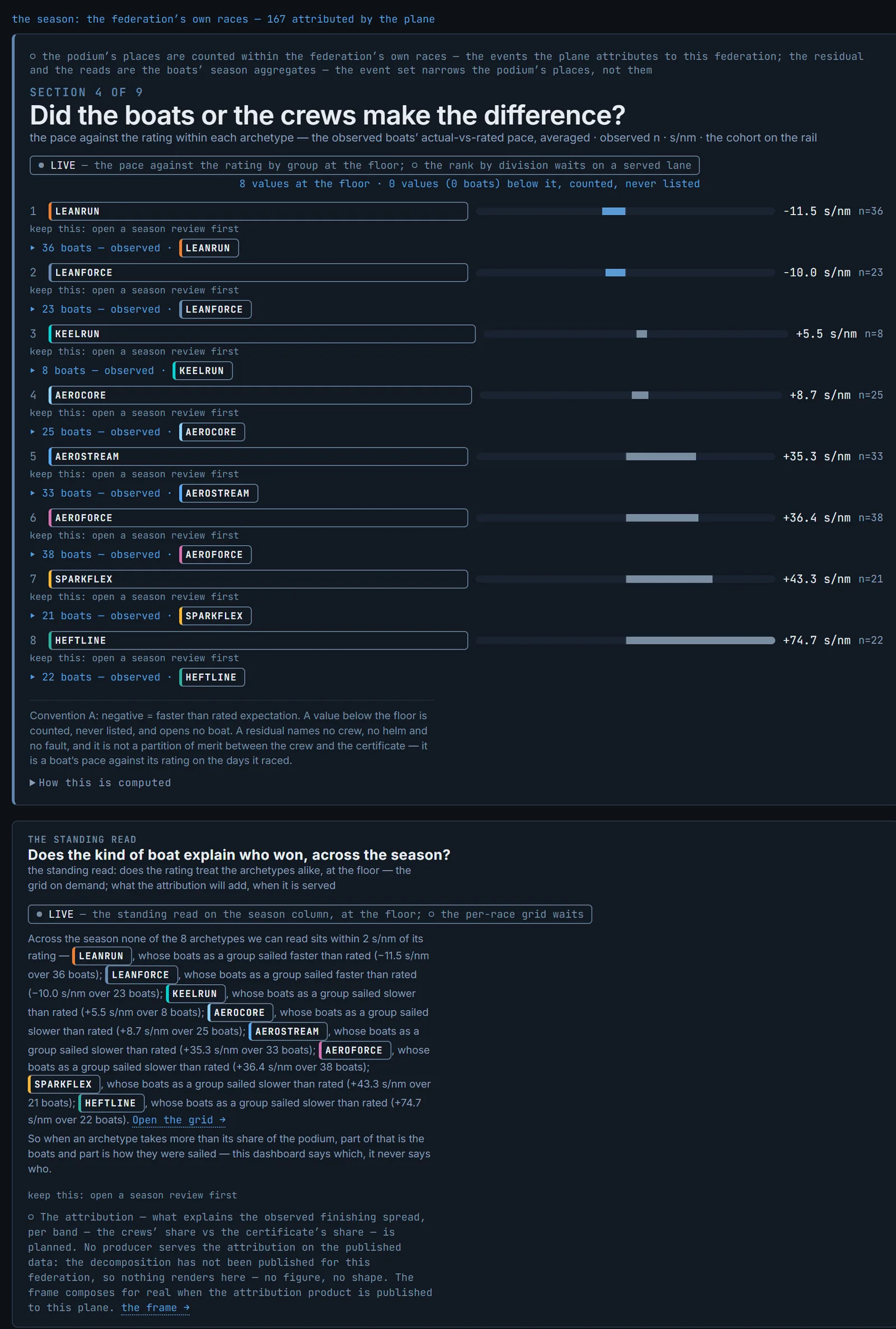
Within each archetype, the boats’ pace against their rating over the season, averaged and shown at the floor — a group with too few boats is counted, never listed. Faster than rated sits to one side, slower to the other. The dashboard’s own words stand under the read: a pace against the rating names no crew, no helm and no fault. So when an archetype takes more than its share of the podium, part of that is the boats and part is how they were sailed — the dashboard says which; it never says who.
What happened at the events?
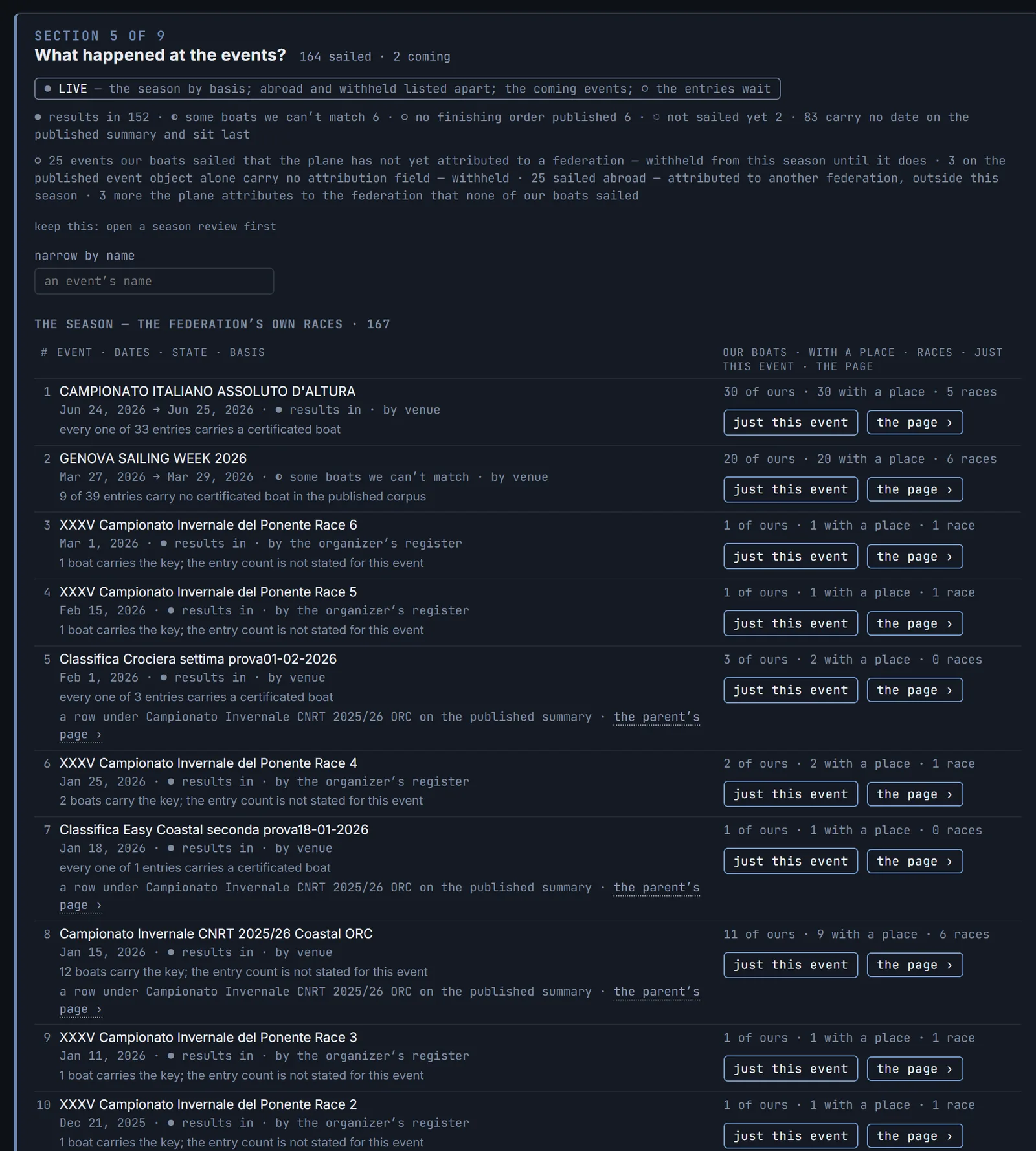
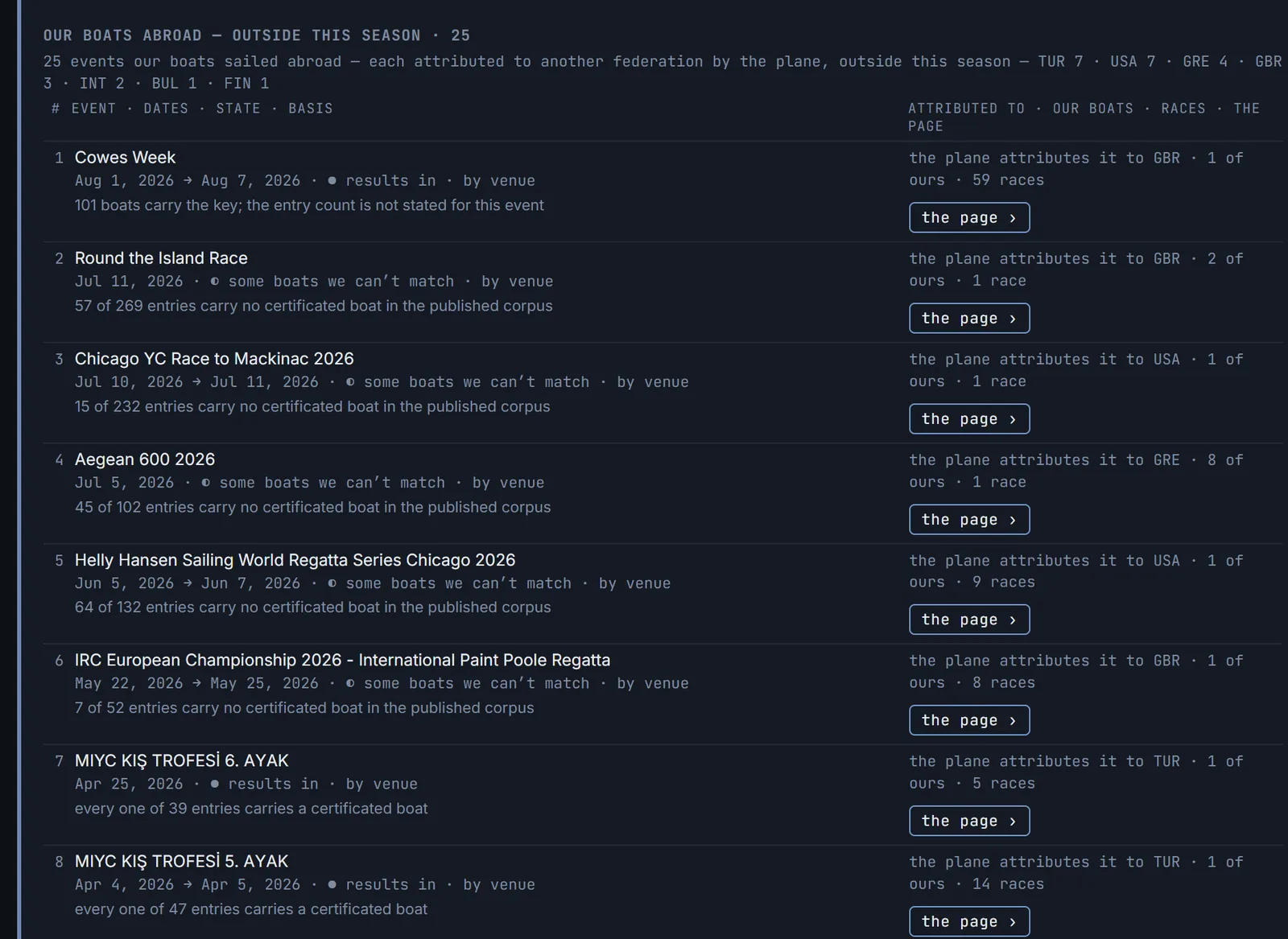
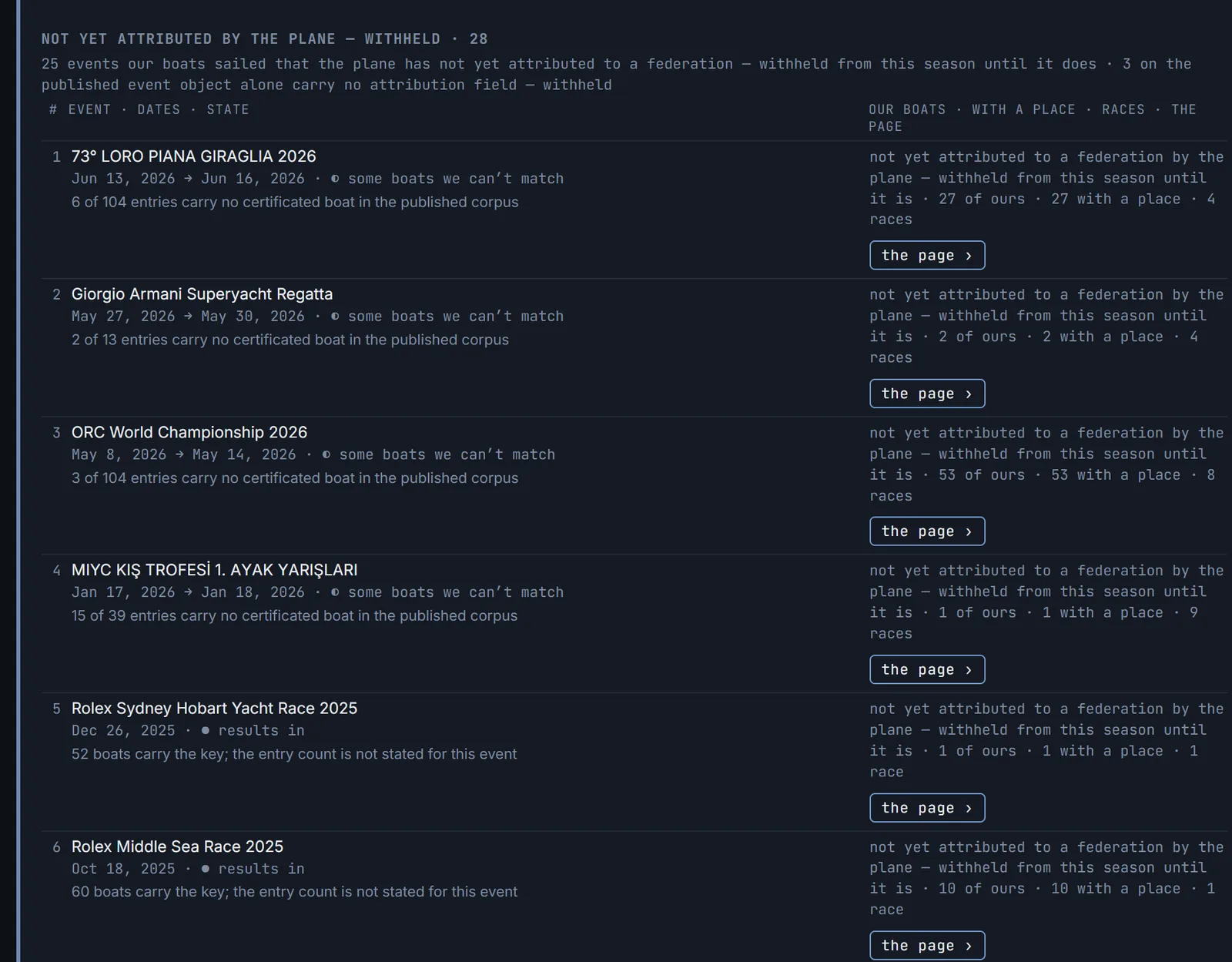
Three lists, and the honesty between them. The season is the federation’s own races as the published record attributes them, newest first, the basis beside each row — by venue, or by the organizer’s register — with our boats, their places and the races counted per event. Our boats abroad, attributed to another federation, are listed apart, outside the season. And the events the record has not yet attributed to any federation are withheld from the season until it does, and shown — a gap the dashboard names rather than papers over. Each row is a door to its event.
What is the story — and what speaks against it?
The review closes the way a good committee paper does. What is the story? The read the season supports, in the officer’s own words, with the charts kept as they stood. What speaks against the story? The reads the officer marked as speaking against it ride alongside, never dropped. What will we do? The follow-ups kept during the season — each with the reason it was kept — become the actions. The report for the board is issued with a number and a date, prints as one document at A4 and Letter, and travels as a package that carries its own content hash, so the version in the room is the version on record.
Which event just finished?
The second door. Pick the event that just finished from the same three lists — the season by basis, our boats abroad, and the not yet attributed — narrowed by name if you know it. Behind the door: our boats and how they placed, whether the kind of boat explains it, and two boats side by side.
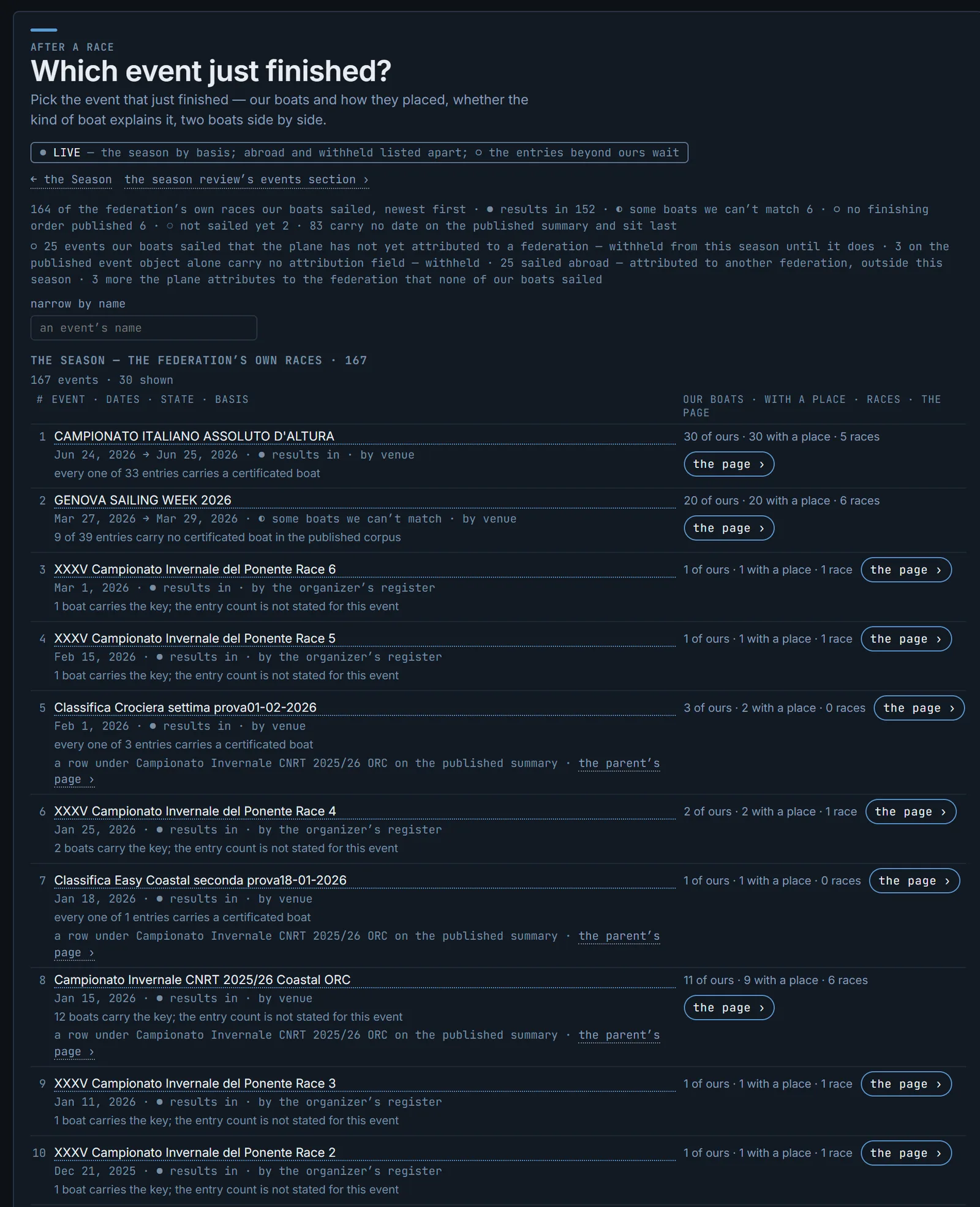
An event page: our boats, and whether the kind of boat explains it.
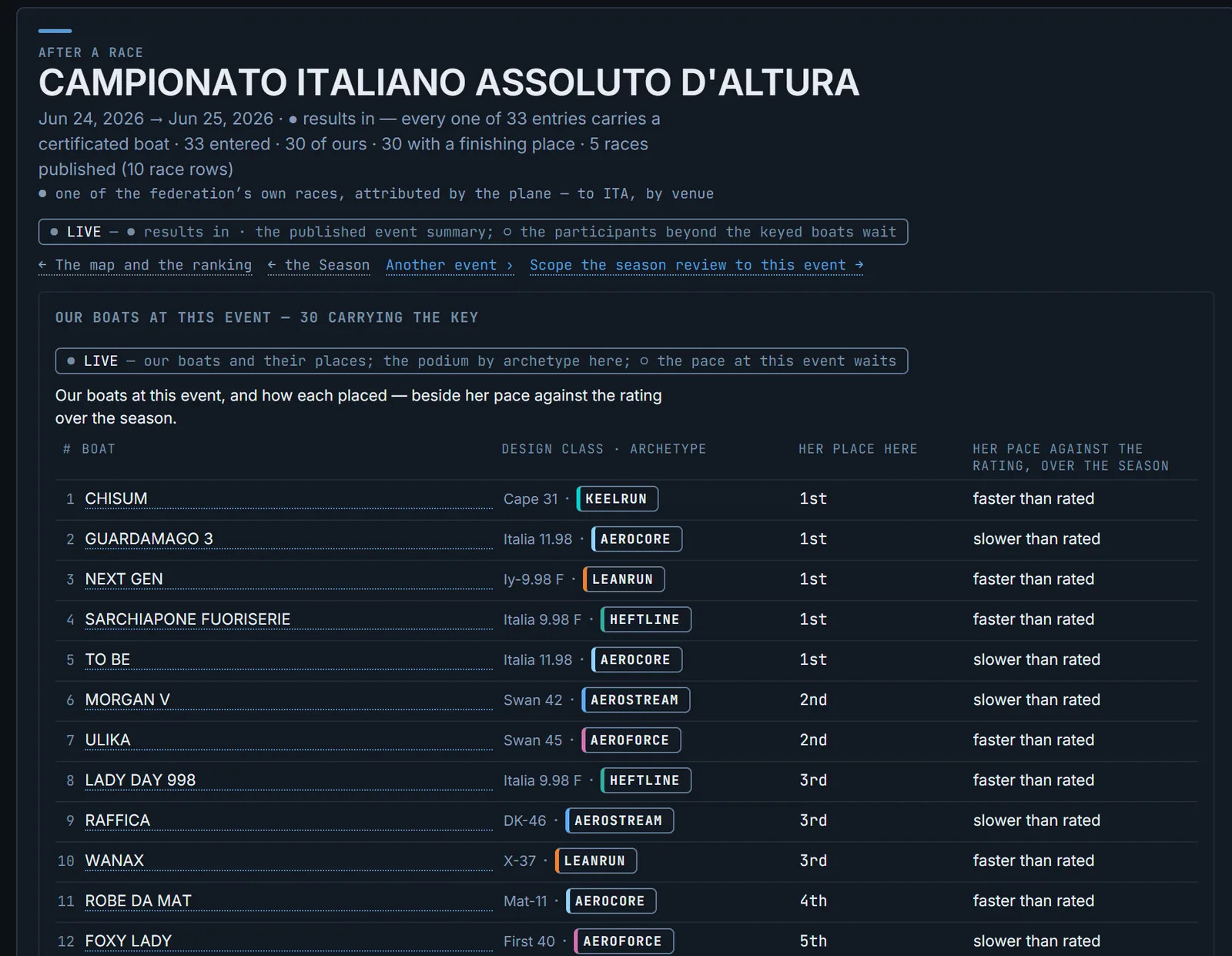
The event’s lead line carries the published record’s own words — the dates, the entries, how many of ours, how many with a finishing place, the races published — and the basis on which the record attributes it to the federation. Beneath, our boats at this event and how each placed, beside her pace against the rating over the season. The pace at this one event is not published yet, and the page says so rather than guessing.
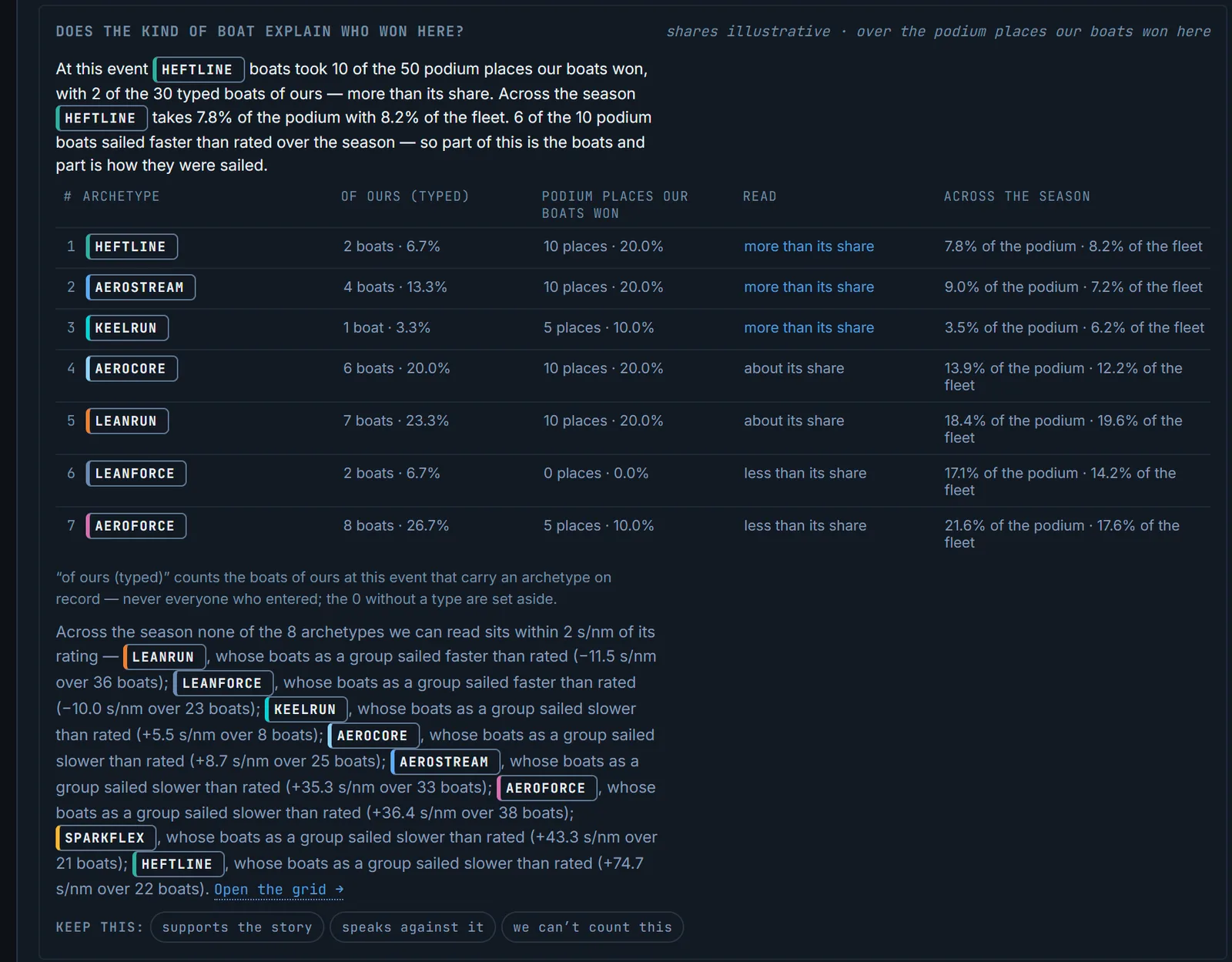
Then the officer’s question at this event: does the kind of boat explain who won here? The podium places our boats won, by archetype, beside each group’s share of our boats at the event and its read across the season — more than its share, about its share, less. The season’s pace read sits beneath, and the same sentence closes it: part is the boats and part is how they were sailed. Each read can be kept — supports the story, speaks against it, or we can’t count this.
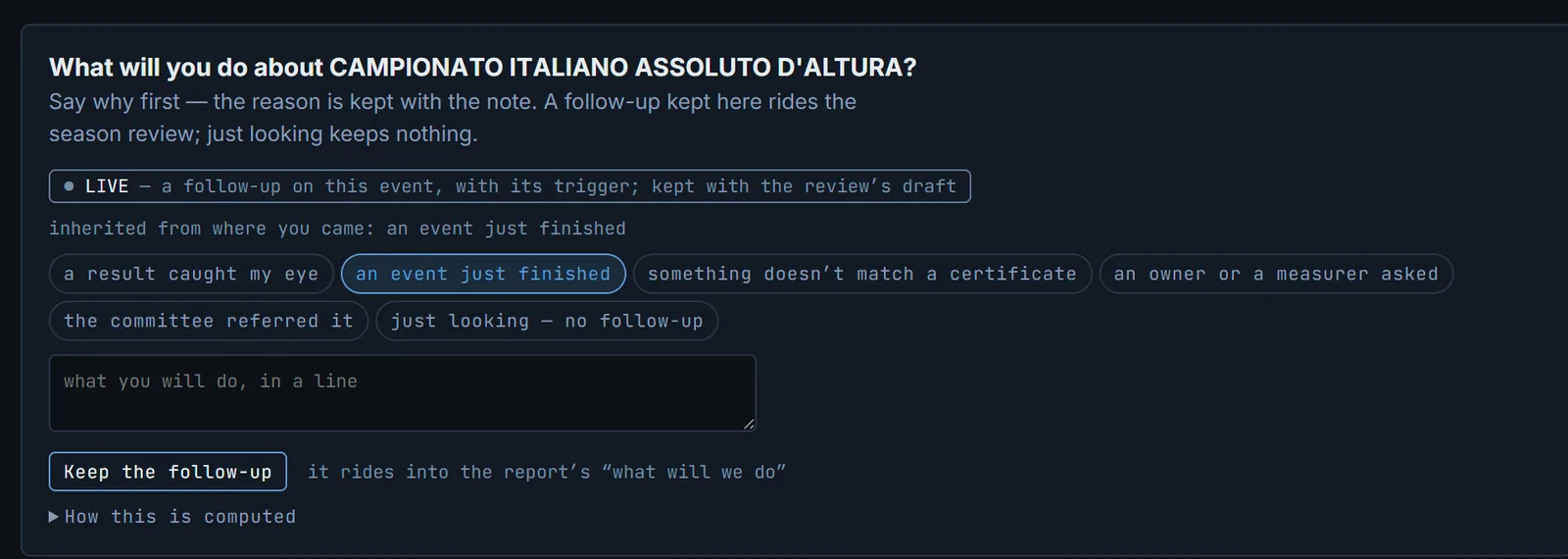
And the door back to the review: what will you do about it? A follow-up is kept with its reason first — a result caught my eye, an event just finished, something doesn’t match a certificate, an owner or a measurer asked, the committee referred it — and rides into the report’s what will we do. Just looking keeps nothing.
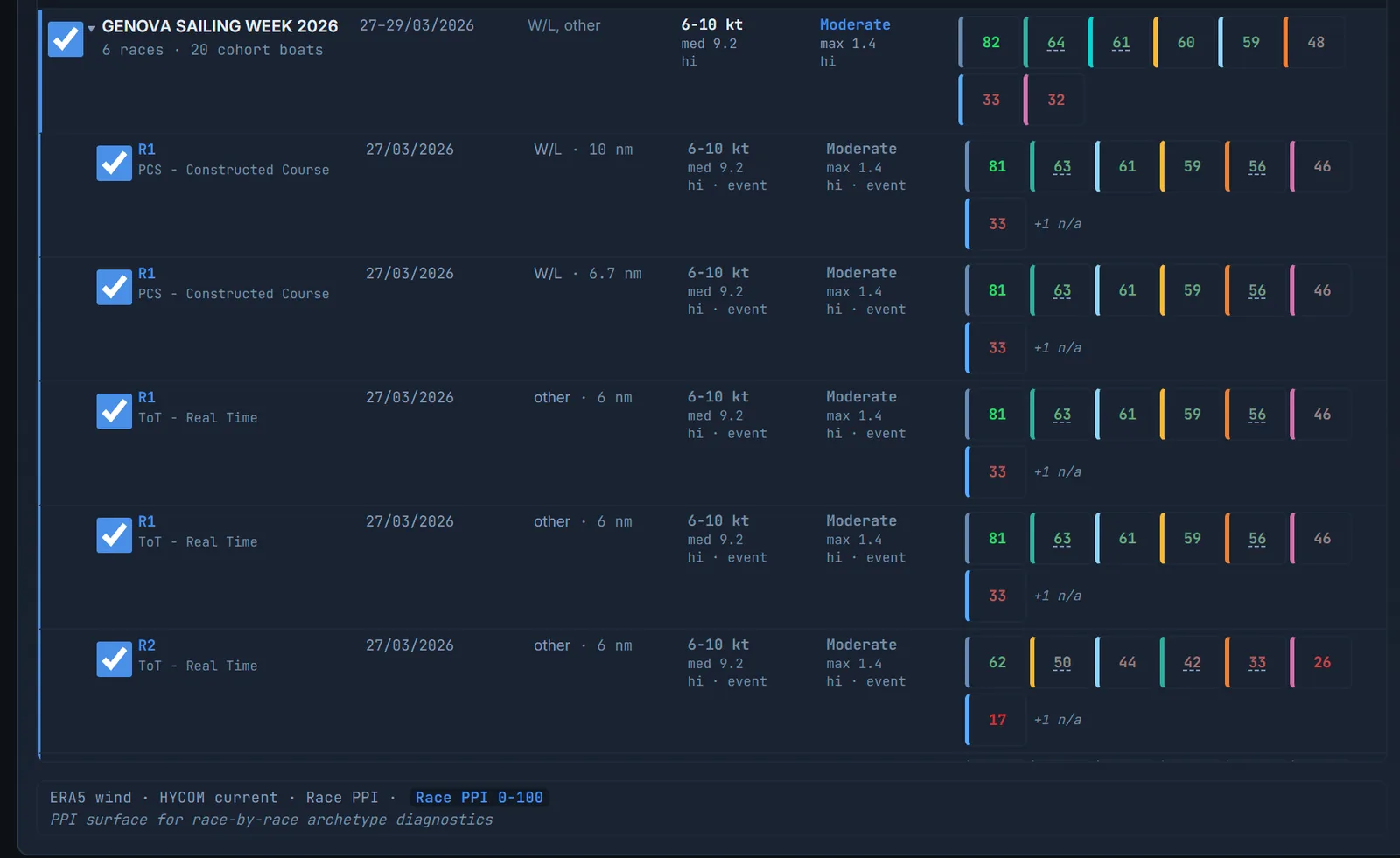
What the races say.
The dashboard’s other tab reads the same fleet boat by boat — how the fleet breaks down, the headlines, the map, what the races say, the ranking. One read from it here: an event opened race by race, each race with its wind and current beside how each archetype fared in it — the read an officer wants when a member says the conditions decided the regatta.
The season review, and the report.
Aggregate views only, on data FleetEdge already publishes — the certificate each boat holds now and the published results. There is no blended score: you read the questions in order and keep what you saw.
The season review
Nine questions on the rail, in the order an officer asks them. A review lives in the address and in your browser across visits, resumes where it stood, and travels as a portable review you can re-import.
Which boats
Who is in, rung by rung — the counts the published results support, each a door to its boats; the rungs the record cannot yet support say so in the record’s words.
Which designs won
The podium by archetype, each group’s share of the podium beside its share of the fleet; the deviation is the read, and a row opens the boats behind it.
The boats or the crews
The pace against the rating within each group, at the floor — a read that names no crew and no fault. The dashboard says which, never who.
The events
The season by basis — by venue or by the organizer’s register; our boats abroad and the not-yet-attributed listed apart; every row a door to its event page.
The report for the board
Issued with a number and a date; prints as one document at A4 and Letter; travels as a package with its own content hash.
After a race
The picker, the event page — our boats and their places, whether the kind of boat explains it, two boats side by side — and a follow-up kept with its reason that rides into the report.
Narrow to the boats you mean
One press narrows every read to a design, a size band, or the boats with results; the filter on the rail does the rest, and the review keeps the frame you chose.
The status marks
Every panel carries its own mark in the screen — live, planned, or demonstration — and a panel’s mark governs its claims; nothing here claims an unshipped tier early.
Built on the FleetEdge platform’s shared core, reading the published record at fleet level. The dashboard’s own faces run at zero accessibility violations under axe at four viewport classes, and the season report prints as one document at A4 and Letter.
Deliberately not here: a blended fairness score — you read the questions. Aggregate views only: no boat is opened on its own, no crew is blamed, and another organization’s private rows never render. Evidence for a conversation with your rating office — not a ruling.
Arrive. Ask. Keep. Report.
For national rating offices and class authorities — the officials lane — who arrive with a season of results and a recurring question from their members: was it fair?
- Arrive — sign in to your federation’s dashboard and land on the season at a glance: the season line, the rail, the two doors.
- Ask the nine questions — which boats, which designs won, the boats or the crews, what happened at the events, then the story and what speaks against it.
- Pick the event that just finished — after a race, open its page: our boats and their places, and whether the kind of boat explains it.
- Keep what you saw — the charts as they stood, the reads that support or speak against the story, the follow-ups with their reasons.
- Make the report — issued with a number and a date, one printable document, portable with its content hash.
Italy’s published record, as the binding shown.
Every screen above is the dashboard on Italy’s published record: a 1,769-boat national fleet on the site’s published Italy page, the certificate each boat holds now, and the federation’s own races as the record attributes them. No federation is a customer yet; Italy is the demonstration binding. Your federation’s own dashboard stays private to your federation.
A note on the numbers above.
· Every figure on this page reads from the product screens pictured — the dashboard’s own season review on Italy’s published record, captured 9 September 2026 at the product’s publication of 3 September 2026.
· The counts in the screens are that capture’s own reads, and they move as the published record’s attribution lands; this page restates none of them. The one site figure is Italy’s fleet total, keyed to the site’s published Italy page.
· The status marks — live, planned, demonstration — are the product’s own vocabulary, declared panel by panel; a panel’s mark governs its claims, and nothing here claims an unshipped tier early.
· The pace against the rating names no crew, no helm and no fault.
· Italy is the demonstration binding; no federation is named as a customer.
· Beta access is by request.
The dashboard reads the published FleetEdge fleet layer: the Fleet Overview, Fleet Analytics, and the leadership view at For ORC Leaders.
See it against your own season.
Scope: your federation’s certificated boats and its own races · visible to your federation only · in beta, access by request.