Hull & Platform
Where speed begins — the hull, its stability, and its geometry: the platform's contribution to the performance equation.
Every fleet has a fingerprint.
From the Solent to the Aegean — see how the physics plays in your waters.
Hidden ShapeThe hidden shape of the fleet.
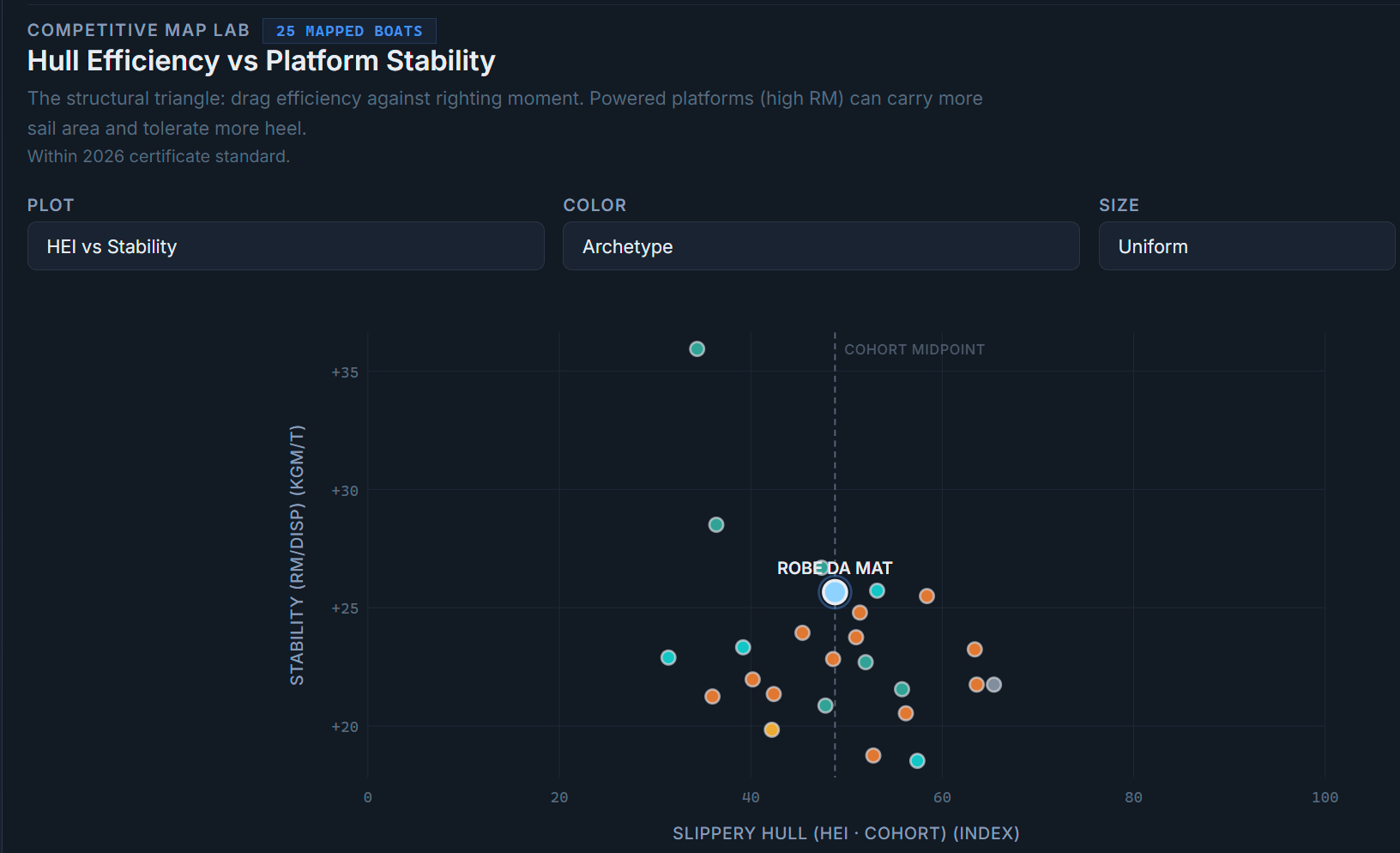
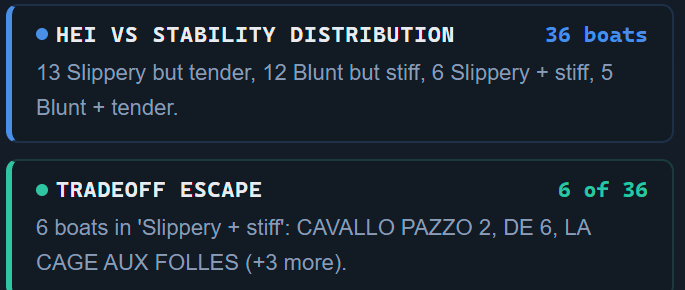
The kinds of boat that keep appearing when every hull is measured the same way.
The shape of the fleet, before the scoreboard has anything to say.
In beta as a product. Hull-and-platform analysis is part of Design Benchmarks — the private peer-benchmarking workspace for naval architects and lofts. See Design Benchmarks →
Hull form comes first in FleetEdge's dimensional analysis. Before rig, before rating, before crew — the hull defines the envelope of what is physically possible. Every design decision a naval architect makes about the hull constrains and enables everything that follows. Hull & Platform is the FleetEdge dimension family (one of the nine groups of FleetEdge readings — six on the Fleet View ribbon — each reading one aspect of the boat or its racing) that reads that envelope.
What Hull & Platform measures.
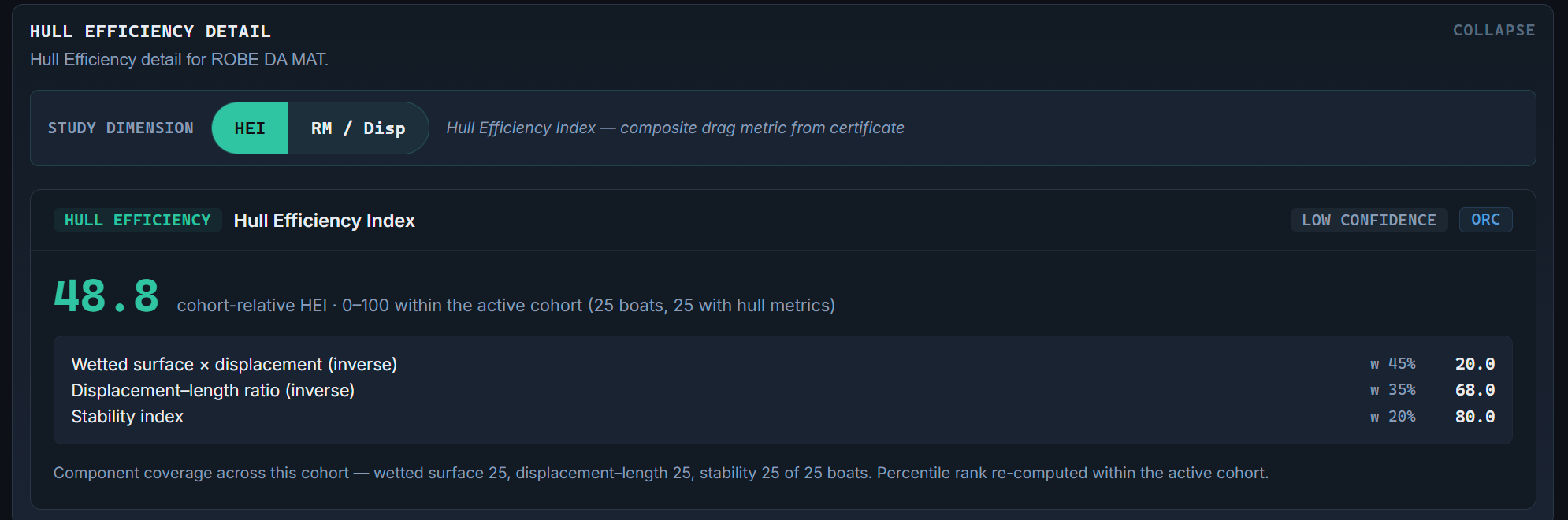
Hull & Platform (registry short label: Hull) is the FleetEdge dimension family that ranks every boat on the structural platform its certificate describes: how efficiently the hull converts power into speed, how stiff it is, how far it heels on the beat and how fast heel grows with the breeze, where the helm balances, and the certified geometry all of that rests on. Every reading needs only the ORC certificate and the SailEdge physics evaluation (pace computed from the boat's certificate physics) of it — no race result required.
| Dimension | Unit | Reading |
|---|---|---|
| Hull Efficiency (HEI) | percentile | A drag-derived index of the hull form, ranked against its cohort (the boats a figure is computed over — a real entry list, a class, a fleet — named on every figure) — higher is better |
| Stability (RM/Disp) | kgm/t | Rated righting moment per metric ton of displacement — the stiffness the platform brings to a breeze; higher is better |
| Heel at 12kt Upwind | ° | The heel angle on the beat at twelve knots of breeze — lower is better |
| Heel Sensitivity | °/kt | How fast heel grows with each knot of breeze — lower is better |
| CE-CLR Balance | m | Helm balance — the fore-and-aft relationship between the sail plan’s center of effort and the hull’s center of lateral resistance; a typology reading, not a score |
| Length Overall | m | Certified geometry — typology, not a score |
| Displacement | kg | Certified geometry — typology, not a score |
| Beam | m | Certified geometry — typology, not a score |
| Draft | m | Certified geometry — typology, not a score |
Reading the polarity. Higher is better for Hull Efficiency (HEI) and for Stability (how much righting moment the boat carries relative to its displacement); lower is better for the two heel readings — a stiffer platform heels less and heels more slowly as the breeze builds. Helm balance and the four geometry readings are typology, not quality: they say what kind of platform a boat is, never how good. The labels and units are the App’s own — the same family you see in the Fleet View ribbon and the Boat View.
Four parameters that shape the archetype.
FleetEdge reads four hull-efficiency parameters directly from the ORC certificate — length-displacement ratio, sail area to wetted surface, the certificate's rated righting moment, and displacement-length ratio. Each captures a different aspect of how the hull converts power into forward speed, and together they inform the archetype model; the family roster above is what the App ranks boat by boat.
These are not abstract quantities. Length-displacement ratio describes how easily the hull parts the water at speed. Sail area to wetted surface captures the fundamental trade-off between the power available and the drag surface that absorbs it.
The same speed, different strategies.
Hull form is not a single number. A KEELRUN is a compact, narrow, efficient platform on the higher side of the hull-proportion axis, upright in posture with a neutral righting reserve — and in race results its reaching showing runs in line with the fleet norm. A LEANRUN sits near the middle of the same axis: mid-beam and efficient, upright in posture, and moderately demanding of its crew. Both are competitive answers to the same design question.
The archetype framework captures these trade-offs as structural coordinates, not rankings. When you examine where your boat sits on the hull-efficiency features, you see the specific choices your designer made — and how those choices position you relative to every other boat in the fleet.
L/Disp¹ᐟ³ · SA/WS · RM · Δ/L
Understanding your Hull & Platform profile.
When you examine your boat's Hull & Platform profile in FleetEdge, you see where it sits relative to the fleet on each dimension — the efficiency index, the stability and heel readings, and the geometry beneath them — not just an aggregate score, but the specific trade-offs your hull designer made.
A boat with a high L/Disp¹ᐟ³ and generous sail area for its wetted surface is optimized for speed in light air and flat water. A boat with a high rated righting moment for its displacement and moderate wetted surface is built for stability in a seaway. These dimensions feed directly into the archetype model.
Hull-efficiency features are the primary axes along which boats differ from one another. Understanding these four features is the first step toward understanding your archetype assignment.
Hull & Platform readings are derived entirely from the ORC certificate and the SailEdge physics evaluation of it. Every boat with a valid certificate has a Hull & Platform profile in FleetEdge — no additional instrumentation, no sensor data, no manual input, no race result required.
See Hull & Platform in the Italy ORC fleet.
Italy ORC racing brings hull and platform into sharp relief — see how the physics meets the fleet's regime and rivalries.
Explore Italy ORCWhat certificate-derived hull evidence can and cannot say. These dimensions place a hull’s certified geometry among the fleet’s — the designer’s recorded choices, read comparatively. They cannot see build quality, foil condition, bottom finish, or how a crew sails the platform; those live outside the certificate.
FleetEdge alters no rating and no score — ORC remains the rating and scoring authority.
Every hull tells a story. FleetEdge reads it.
The Hull & Platform family — hull efficiency, stability, heel and geometry, read from the ORC certificate and the physics — feeding FleetEdge's fleet-wide analysis.