For ORC Leaders
FleetEdge provides fleet-outcome evidence consistent with ORC's equal-chance objective.
Every fleet has a fingerprint.
Fleet-health intelligence for class and circuit leadership — across 29 countries of ORC racing.
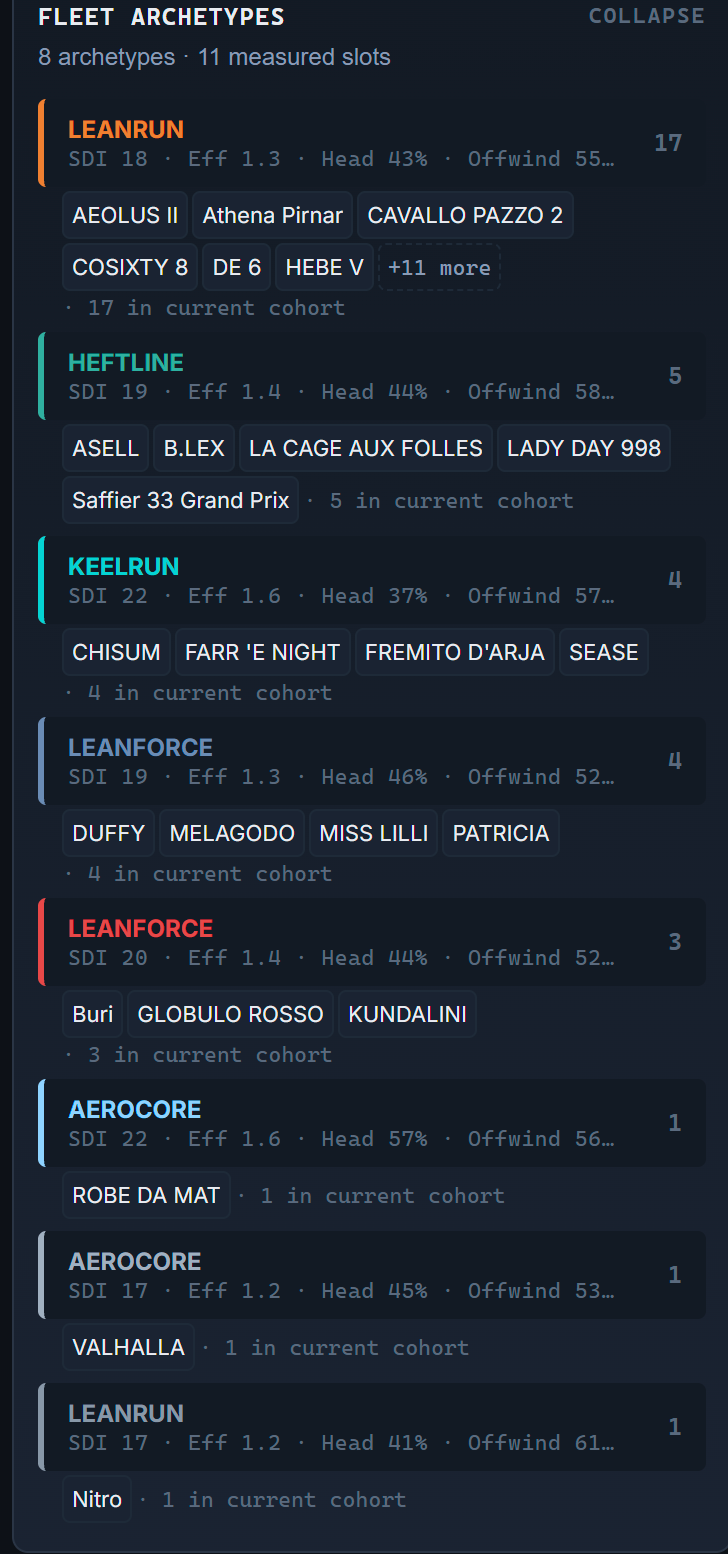
Hidden ShapeThe hidden shape of the fleet.
The kinds of boat that keep appearing when every hull is measured the same way.
The shape of the fleet, before the scoreboard has anything to say.
In beta as a product. This leadership view feeds the Federation Dashboard — the private governance workspace for officials. See Federation Dashboard →
The ORC founding promise is that if the boat is rated fairly, the difference in results is the crew. FleetEdge measures this at fleet scale — decomposing results, at their stated scopes, into the boat's design contribution and the crew's performance contribution.
For class officials, national authorities, and regatta organizers, this measurement has a specific implication: it provides fleet-outcome evidence consistent with ORC's equal-chance objective.
The fleet-wide evidence is published, with confidence intervals: across every scored race in the corpus, each archetype’s share of podium places stays within a bounded range of its share of participation — no design strategy dominates the podium, and none is shut out. Single-event results, where trophies scatter across design strategies, illustrate the same pattern. Read the published fairness distribution →
FleetEdge does not evaluate ORC's methodology. It evaluates outcomes — and each outcome claim is stated at its own scope: platform coverage of 11,207 analyzed boats (July 2026); a race archive of 967 race events, with 959 races scored; a published fairness-validation cohort of 7,652 boat-race results across 572 eligible class-level fields, from scored races under ORC and IRC rating rules (as of 2026-07-01); and empirical crew-residual coverage on 1,244 boats in the current publication. How the counts reconcile →
Three capabilities for the ORC community.
Fleet-Outcome Evidence
FleetEdge's archetype analysis is consistent with what ORC has long maintained: the rating system produces fair competition across diverse design strategies. At the 2025 ORC Worlds, eight of that era’s eleven published archetypes were represented in the comparative race group, and the two published class titles fell in two different archetypes — standings as captured in FleetEdge's published view. See the worked example →
Fleet Intelligence
Understand the composition of any fleet before racing begins. Archetype distributions reveal how many design strategies are represented, which dimension families (the nine groups of FleetEdge readings — six on the Fleet View ribbon — each reading one aspect of the boat or its racing) dominate, and where the competitive field is concentrated — information that was previously available only through years of institutional knowledge.
Analytical Transparency
Every FleetEdge analysis begins from inputs officials can verify at the source: public ORC certificate data and published race results. The physics and archetype layer that interprets those inputs is SailrScience's own model — and every score it produces is auditable on its face: reason chains trace each number to its data sources, confidence tiers state the statistical reliability, and contextual limitations declare what the score does not measure.
See the fleet before the start.
For any ORC-scored event, FleetEdge can produce a measured profile of the fleet: archetype distribution, competitive balance across design strategies, and the range of boat types that determines how different boats will perform in different conditions.
This analysis is derived entirely from certificate data and historical race performance. It does not require boat-specific input from teams, and it does not reveal proprietary setup information. It measures the structural characteristics that are already encoded in the public certificate.
Auditable by design.
FleetEdge's archetype engine groups each boat into one of 8 distinct performance archetypes (the fleet's eight recurring design types) from its ORC certificate and SailEdge physics profile, across 11,207 analyzed boats (July 2026).
The methodology is designed to be scrutinized. The certificate data and race results it starts from are public, and every published score carries its reason chain, its confidence tier, and its stated limitations.
How the analytical framework works — what goes in, how archetypes are assigned, and where the boundaries are — is described in the Methodology section, and its published results can be tested against the validation analyses. Class officials and technical reviewers are encouraged to examine both.
Named contact.
Direct briefing inquiries from ORC leadership, class officials, and national rating authorities are handled by Kevin Farley, Principal — FleetEdge program. Kevin is based in Annapolis, Maryland, and is the named technical contact for discussions of rating-system outcomes, fleet-level analytical briefings, and governance-adjacent inquiries from the measurement community.
To schedule an institutional briefing, use the Contact desk and flag the inquiry as ORC/IRC Officials; Kevin responds directly.
Fleet-outcome evidence for the ORC promise.
FleetEdge provides fleet-outcome evidence consistent with ORC's equal-chance objective. It does not validate the ORC methodology or certify any individual rating.