Crew & Execution
When you account for the boat, what remains is the crew.
Every fleet has a fingerprint.
From the Solent to the Aegean — see how the physics plays in your waters.
Hidden ShapeThe hidden shape of the fleet.
The kinds of boat that keep appearing when every hull is measured the same way.
The shape of the fleet, before the scoreboard has anything to say.
In beta as a product. The crew-execution analytics here power the Team Diagnostic — the private, per-boat decomposition for racing teams. See Team Diagnostic →
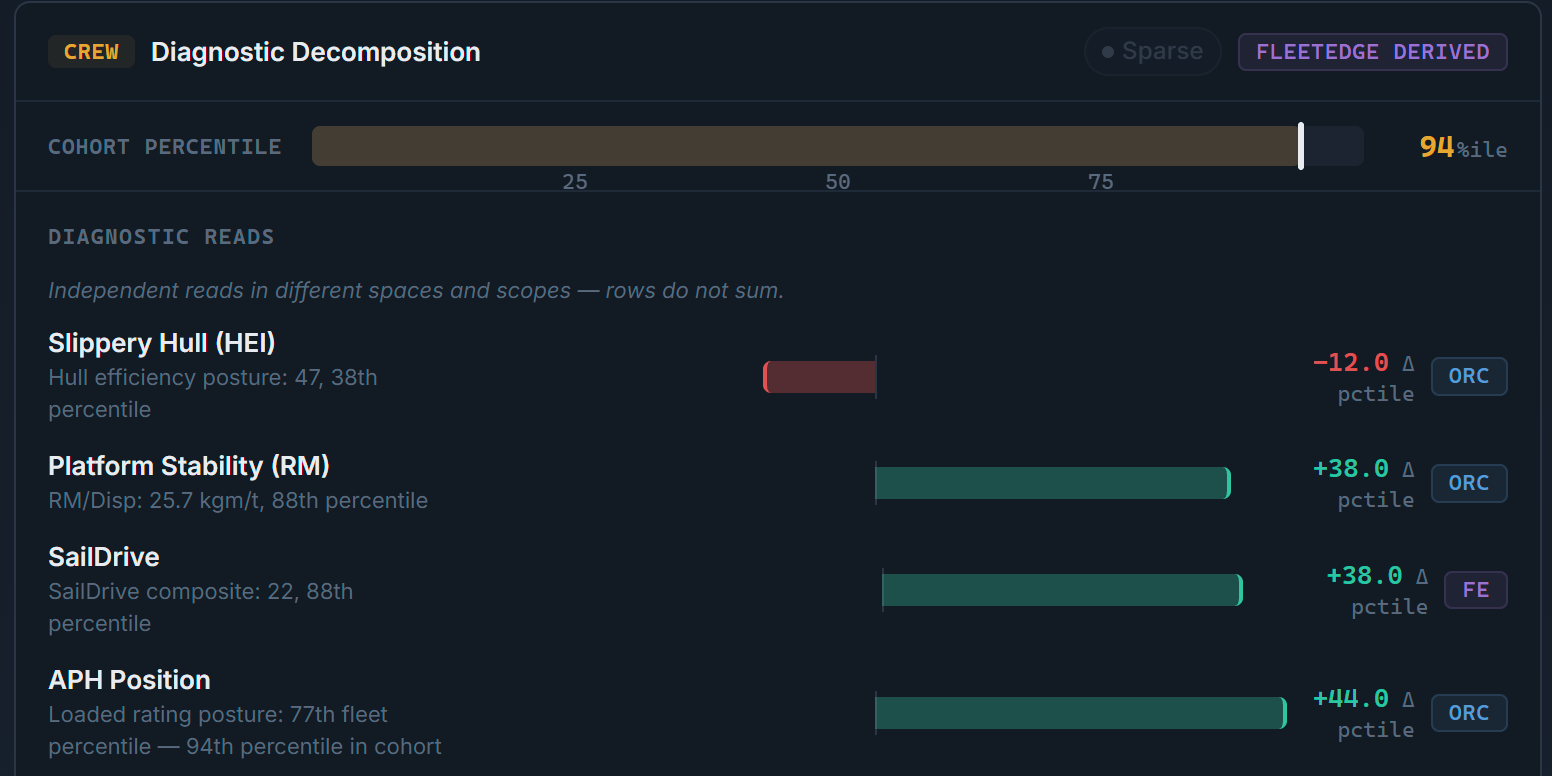
When you account for hull efficiency, rig power, stability characteristics, and rating position (APH (the certificate's single-number rating, as a time allowance), the primary rating dimension) — the design contributions that FleetEdge measures — what remains is the crew's contribution. Tactics, execution, preparation, and the decisions that separate identical boats on the racecourse. Crew & Execution is the FleetEdge dimension family (one of the nine groups of FleetEdge readings — six on the Fleet View ribbon — each reading one aspect of the boat or its racing) that reads that remainder.
This is the crew performance residual: the gap between the pace the boat's evaluated profile indicates and the pace the crew actually sailed — in seconds per nautical mile (sec/nm), where a negative residual means the crew sailed faster than the profile indicates.
It is not a single number but a multi-dimensional signal — a crew that excels at upwind VMG extraction produces a different residual signature than one that excels at downwind positioning or tactical decision-making in shifty conditions.
The residual is meaningful only when the design contribution is measured accurately. That is why FleetEdge begins with the archetype framework — you cannot isolate what the crew adds until you understand what the boat gives.
What Crew & Execution measures.
Crew & Execution (registry short label: Crew) is the FleetEdge dimension family that reads what the boat cannot explain. Its readings are the crew residual at one event and across a boat’s race history, the crew pillar of the Performance Potential Index, and the record count that stands behind the reading. The residual readings and the crew pillar of PPI need race results with elapsed times and a usable course distance — the pace behind a residual is normalized in seconds per nautical mile; the record count reports how many of those results stand behind the residual. A result with a time but no usable distance still contributes identity and finishing-order evidence — it never becomes a residual or a crew attribution.
| Dimension | Unit | Reading |
|---|---|---|
| Event Crew Residual | sec/nm | The crew residual at one event — negative is faster than evaluated pace (the pace the certificate physics say the boat should hold), so lower is better |
| Mean Crew Residual | sec/nm | The residual averaged across the boat’s race history — lower is better |
| Crew Execution (PPI) | percentile | The crew pillar of the Performance Potential Index, ranked against its cohort (the boats a figure is computed over — a real entry list, a class, a fleet — named on every figure) — higher is better |
| Crew Support Records | count | How many race comparison records stand behind the residual — higher is better |
Reading the polarity. A crew residual is seconds per nautical mile against the boat’s evaluated pace: negative means the crew sailed faster than the boat’s profile indicates, so the most negative residual is the strongest crew reading and a ranked residual board lists it first. Crew Execution (PPI) (the PPI pillar no certificate can compute — what happened against what was expected) and Crew Support Records read the other way — higher is better. The labels and units are the App’s own, the same family you see in the Fleet View ribbon and the Boat View.
Same metric. Different meaning.
Upwind Precision
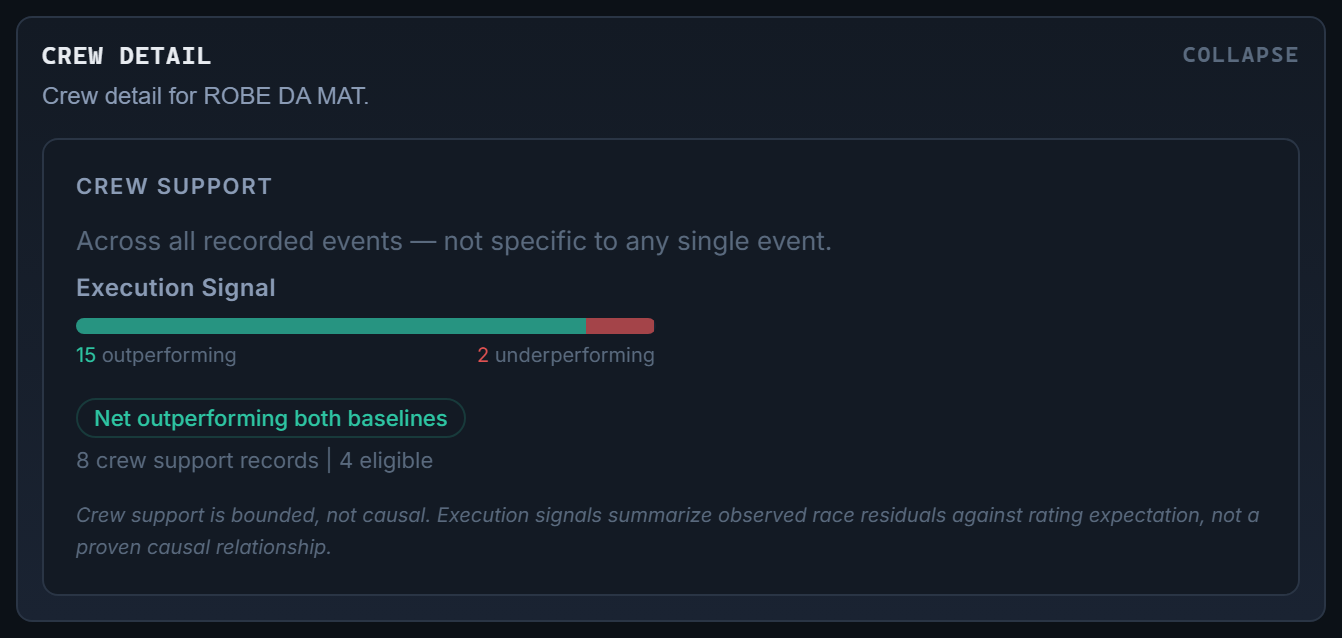
Crew residual is what's left when SailEdge's physics model has explained everything it can about a boat's expected speed. When a boat sails faster than its evaluated pace, the residual runs negative — fewer seconds per nautical mile than the profile indicates; when slower, positive. The residual is per-boat per-race, not a property of the archetype (one of the fleet's eight recurring design types) the boat belongs to.
Consider one example boat from the fleet — an AEROSTREAM-class design: a towering, beamy, efficient platform. Across this boat's race history, the favorable residual — negative, faster than evaluated pace — concentrates in upwind VMG: across many beats, this crew has consistently extracted more upwind speed than the boat's measured profile alone indicates. That observation is specific to this boat and this crew. It is not a claim about AEROSTREAM boats in general — other AEROSTREAM boats with different crews show residuals in different dimensions.
What the example illustrates is the method, not a prediction: PPI's three-pillar decomposition isolates a residual that, on a specific boat across enough races, becomes observable as a pattern. The structural archetype is what the boat is; the residual is what the crew does. They are different things.
Downwind Positioning
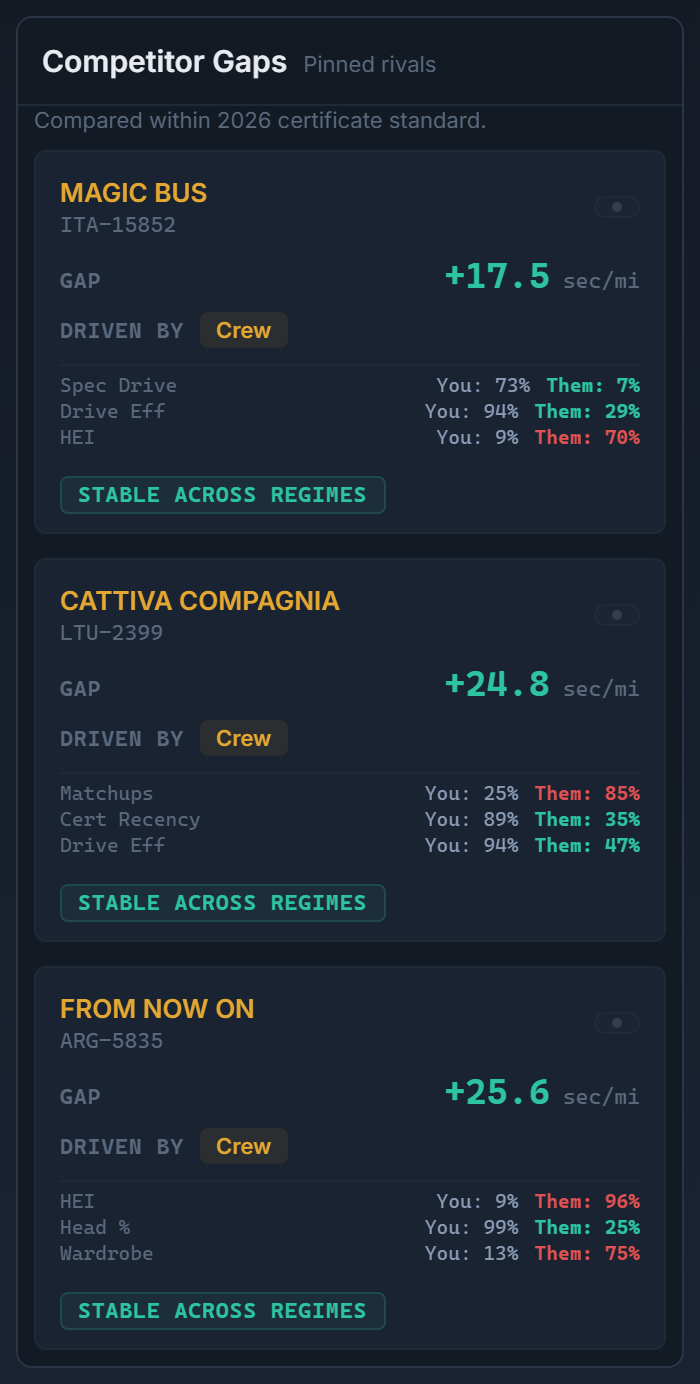
A second example tells a different story. A LEANRUN-class boat — an upright, efficient mid-beam platform — shows its strongest favorable residual not in upwind VMG but in downwind positioning. Across a season's worth of races, the gap between this boat's actual finishes and SailEdge's physics evaluations (pace computed from the boat's certificate physics) is largest on the run legs.
The structural facts about LEANRUN — an upright posture and an efficient mid-beam platform — are the same across every LEANRUN in the fleet. What this particular crew does with that platform on the run legs is theirs alone: the angle decisions, the gybe timing, the ability to hold pressure through maneuvers. PPI isolates the residual; the crew earns it.
Two different boats, two different residual signatures, two different stories about what their crews do well. The archetype tells you what the boat is. The residual tells you what the crew has built on top of it.
Where we are today.
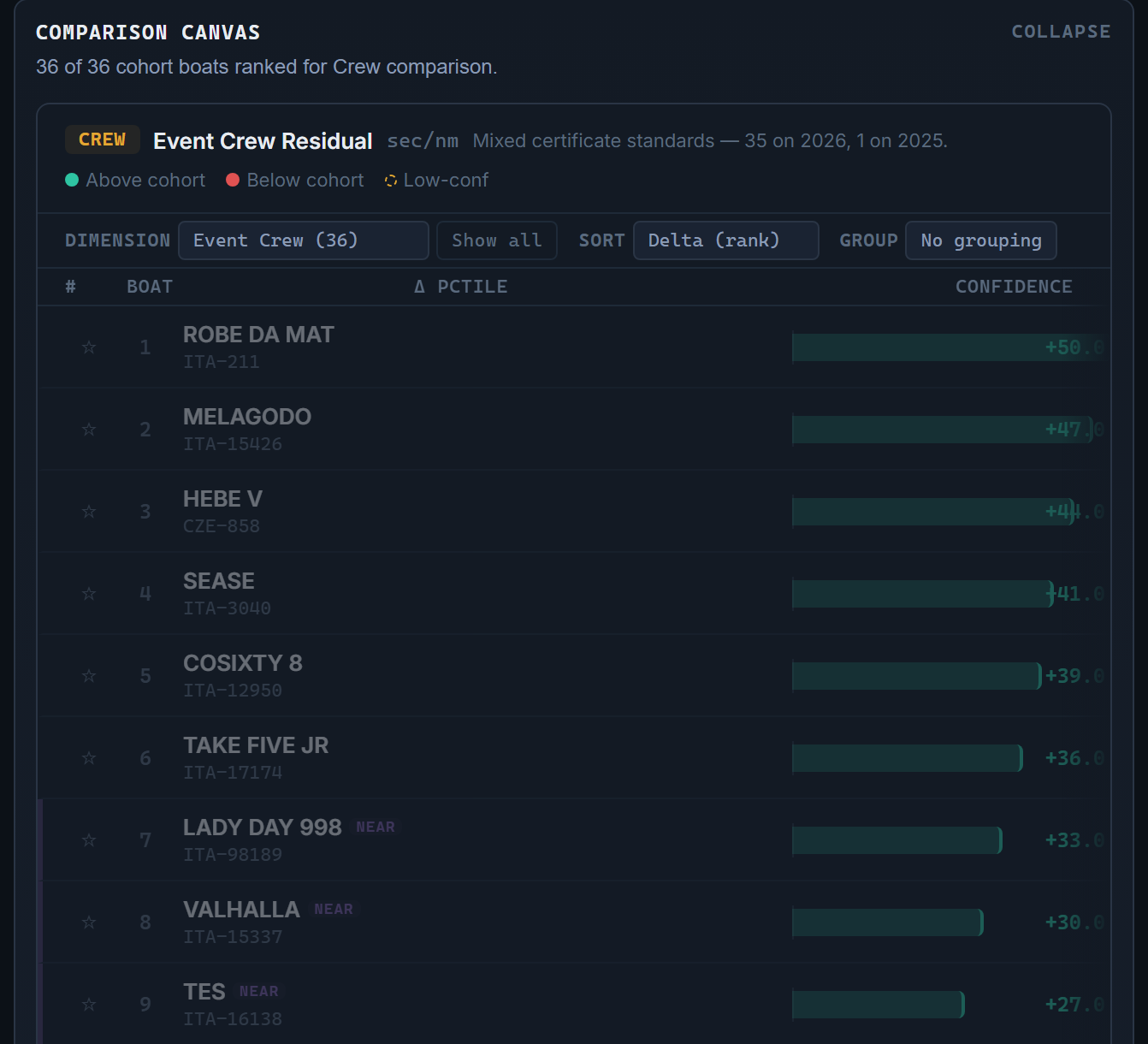
FleetEdge's Crew & Execution framework exists at two levels. Measured profiles and archetype assignment are production capabilities — every analyzed boat receives a measured profile based on its ORC certificate and SailEdge physics evaluations, and the classified fleet carries archetype assignments. This is live across the analyzed fleet (how the counts reconcile).
The crew performance residual — the isolation of crew contribution from design contribution — requires race results with elapsed times and a usable course distance. Boats with such results, across any fleet or event, receive crew residual measurement. As the results dataset grows, the residual estimates sharpen: more observations (one boat's result in one scored race, joined to the weather of its race window), more conditions, more confidence.
What FleetEdge delivers today: the measured profile across the analyzed fleet and archetype assignment across the classified fleet, and crew performance residual measurement for boats whose race results carry the timing and distance the residual needs — including at ORC Worlds, Fastnet, Sydney Hobart, and the Middle Sea Race. The analytical framework is complete; the signal improves with every race added to the dataset.
Noise becomes signal.
A single race is an anecdote — wind shifts, current, and luck contribute as much as skill. But when you accumulate observations across an entire season, the noise averages out and the persistent signal remains. A crew that consistently outperforms its boat's archetype-expected pace across varied conditions is demonstrating real, measurable skill.
The confidence in crew residual estimates increases with three factors: the number of races observed, the variety of conditions encountered, and the depth of the archetype cluster.
A boat with 20 race observations in a well-populated archetype cluster produces a more reliable residual than one with 3 observations in a sparsely populated one. FleetEdge formalizes this into three confidence tiers — low, medium, and high — based on observation count, condition variety, and venue diversity. The Performance Potential Index page details the full confidence framework.
See Crew & Execution in the USA ORC fleet.
USA ORC racing brings crew execution into sharp relief — see how the physics meets the fleet's regime and rivalries.
Explore USA ORCWhat the residual can and cannot say. The crew performance residual bounds the part of a result that the design and the measured conditions do not account for — a diagnostic signal at a stated confidence. It cannot attribute that remainder to any single decision, sailor, or maneuver, and where observations are sparse the reading stays directional rather than definitive.
The residual alters no rating and no score — ORC remains the rating and scoring authority.
Measure what the crew contributes.
FleetEdge isolates the crew signal from the design — the payoff of the ORC promise.