Comparative & Time
What the race actually said — a boat's sailed pace against its rating expectation, record by record.
Comparative & Time (registry short label: Performance) is the FleetEdge dimension family that reads the race record itself: how a boat's elapsed pace compared with its rating expectation, how many comparison records stand behind that reading, its Race PPI (the Performance Potential Index), and its best finish on record. Every reading here needs a race result — these are the race-dependent dimensions that open the Fleet View ribbon and the Boat View.
What Comparative & Time measures.
Four readings, each one a race-record fact. The comparative reading is the spine of the family: the boat's sailed pace set against what its certificate rating expected, in seconds per nautical mile (sec/nm). The rest say how much evidence stands behind it, how the Performance Potential Index scores the race record, and how high the boat has finished.
| Dimension | Unit | Reading |
|---|---|---|
| Race Performance vs Rating Expectation | sec/nm | The boat's sailed pace against its rating expectation, race by race — negative is faster than expected, so lower is better |
| Comparison Records | count | How many race comparison records stand behind the reading — higher is better |
| Race PPI | 0-100 | The Performance Potential Index scored on the boat's race record — the full score, crew execution (the PPI pillar no certificate can compute — what happened against what was expected) included; higher is better |
| Best Finish Rank | # | The boat's best finishing position on record — a finishing order, so lower is better |
Reading the polarity. A comparative reading is seconds per nautical mile against the rating expectation: negative means the boat sailed faster than its rating expected, so the most negative reading is the strongest and a ranked board lists it first. Race PPI and Comparison Records read the other way — higher is better. Best Finish Rank reads like a finishing order — lower is better. The labels and units are the App's own, the same family you see first on the Fleet View ribbon and as the Comp & Time story in the Boat View.
What a comparative reading requires. Two things from the race record: an elapsed time and a usable course distance — that is what normalizes pace to seconds per nautical mile. A result that carries a time but no usable distance still contributes identity and finishing-order evidence to a boat’s record; it does not produce a sec/nm reading, and no crew attribution is built on it.
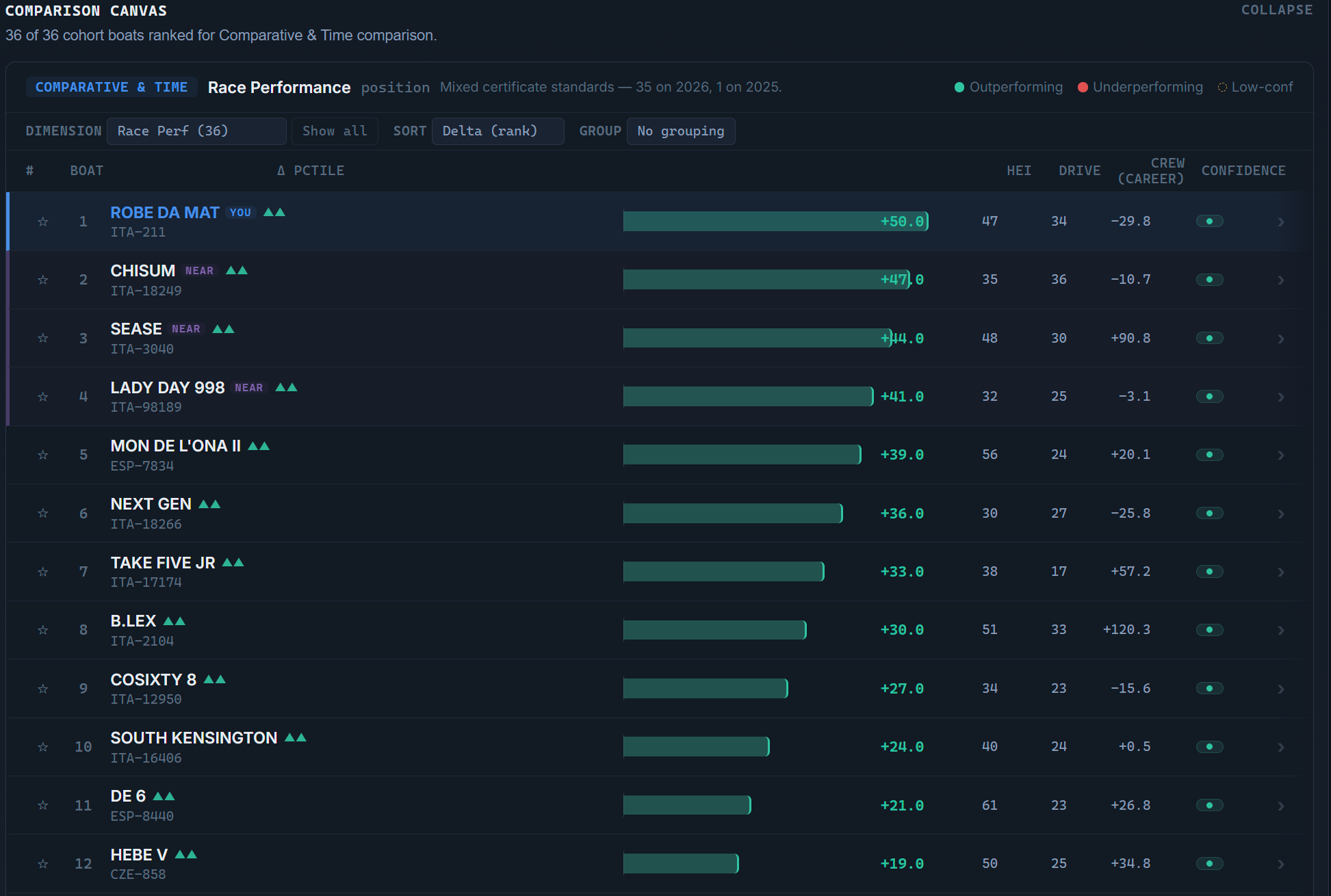
Where the family renders.
In the Fleet View, Comparative & Time is the first family on the dimension ribbon: the fleet in view ranked on its comparative reading, with the rating expectation as the zero line on the career board (an event-filtered board re-centers on its cohort). In the Boat View, it is the Comp & Time story — the boat's race record read against expectation, one record at a time, with the crew and condition families explaining what the comparative reading alone cannot.
The expectation a comparative reading is set against is the boat's certificate rating. FleetEdge reads that expectation; it never revises it.

Go deeper.
Crew & Execution
What remains when the boat is accounted for — the crew residual family (what remains after the boat's evaluated pace is accounted for — negative is faster, in s/nm).
Performance Potential Index
The three-pillar decomposition behind the Race PPI score.
Race Micro-Cohorts
Filter by race and study the competition the comparative reading was sailed against.
What a comparative reading can and cannot say. It places a boat's sailed pace against its rating expectation on the races in coverage, at a stated record count. It cannot say why — design, crew, and conditions are read by their own families — and a single race is an anecdote until the record accumulates.
FleetEdge alters no rating and no score — ORC remains the rating and scoring authority.
Read the race record against expectation.
Comparative & Time — the race-dependent family of FleetEdge's fleet-wide analysis.