How It Works
Three data authorities. Fifty-two dimensions. Eight archetypes.
Every fleet has a fingerprint.
One physics model. Every fleet. Every result — find the waters that made it possible.
Hidden ShapeThe hidden shape of the fleet.
The kinds of boat that keep appearing when every hull is measured the same way.
The shape of the fleet, before the scoreboard has anything to say.
The whole system in sixty seconds.
Everything on this site is built from four ideas, in order. Read these and every page will make sense.
1 · Certificate
The boat’s measured identity on paper — hull, rig, and stability (how much righting moment the boat carries relative to its displacement), as recorded by the rating authority. Every FleetEdge analysis starts here, with public data.
2 · Physics
What those measurements say the boat should do — its evaluated pace across wind ranges and angles, derived by force-balance analysis from the certificate.
3 · Archetype
Which of the eight performance archetypes (the fleet's eight recurring design types) the boat belongs to, assigned from certificate and physics measurements before a single race is sailed: how the boat creates speed, where that speed pays off, and what it demands of the crew. The type is established before the scoreboard has anything to say — so every comparison that follows starts against true peers.
4 · Crew residual
The gap between the pace the physics evaluations indicated and the pace the boat actually sailed — the part of the result the crew owns, in seconds per nautical mile.
One reading builds on the archetype: where a boat’s relative edge lives by wind regime — upwind, reaching, or downwind — is its Regime Affinity (how favorably a boat suits a defined wind regime), read from the same certificate-derived physics.
Two companions complete the vocabulary: every analytical card carries an evidence badge saying what kind of claim it makes, and every count names its cohort (the boats a figure is computed over — a real entry list, a class, a fleet — named on every figure) per Data Definitions.
FleetEdge does not invent data. It triangulates three independent sources that already exist in the ORC ecosystem — the certificate, the physics, and the results — and finds the structure that connects them.
The ORC Certificate.
Every ORC-rated boat carries a certificate — a detailed technical profile that defines its rated identity. Hull dimensions, rig geometry, displacement, stability, and the scoring allowances that ORC uses to establish fair competition.
FleetEdge reads this certificate not as a handicap number but as a multi-dimensional design fingerprint. Each parameter becomes a feature in the analytical model — length-displacement ratio, sail area to wetted surface, the certificate's rated righting moment, and the ratios between them.
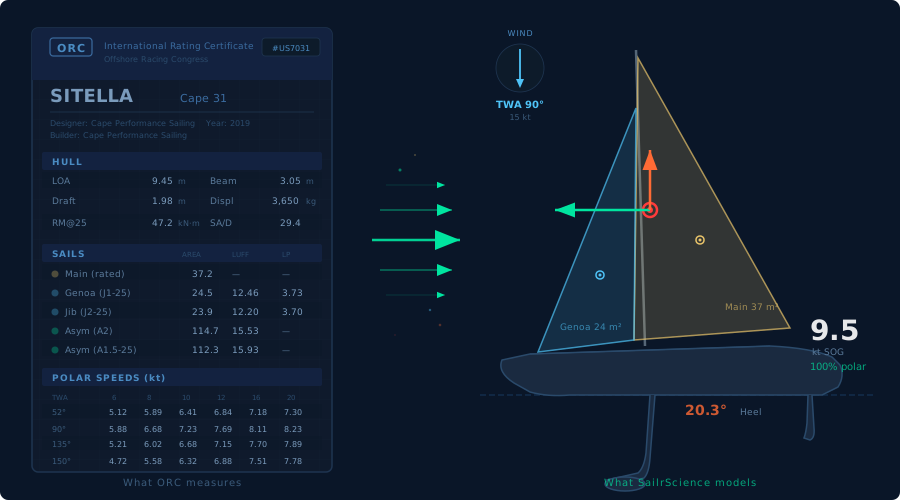
SailEdge Physics.
SailEdge provides an ORC-anchored force-balance analysis built on the Delft Systematic Series — one of the most extensive published series of hull resistance experiments in naval architecture. SailEdge is not a competing VPP.
It is a proprietary force-delta model that takes the ORC certificate polar as its baseline and applies Delft Series physics to compute speed deltas against that baseline for each boat's certificate geometry.
Where the ORC certificate defines what the boat IS, SailEdge physics computes how Delft Series force-balance analysis INTERPRETS the hull form — speed deltas at every wind angle and velocity that become dimensional features in the archetype model.
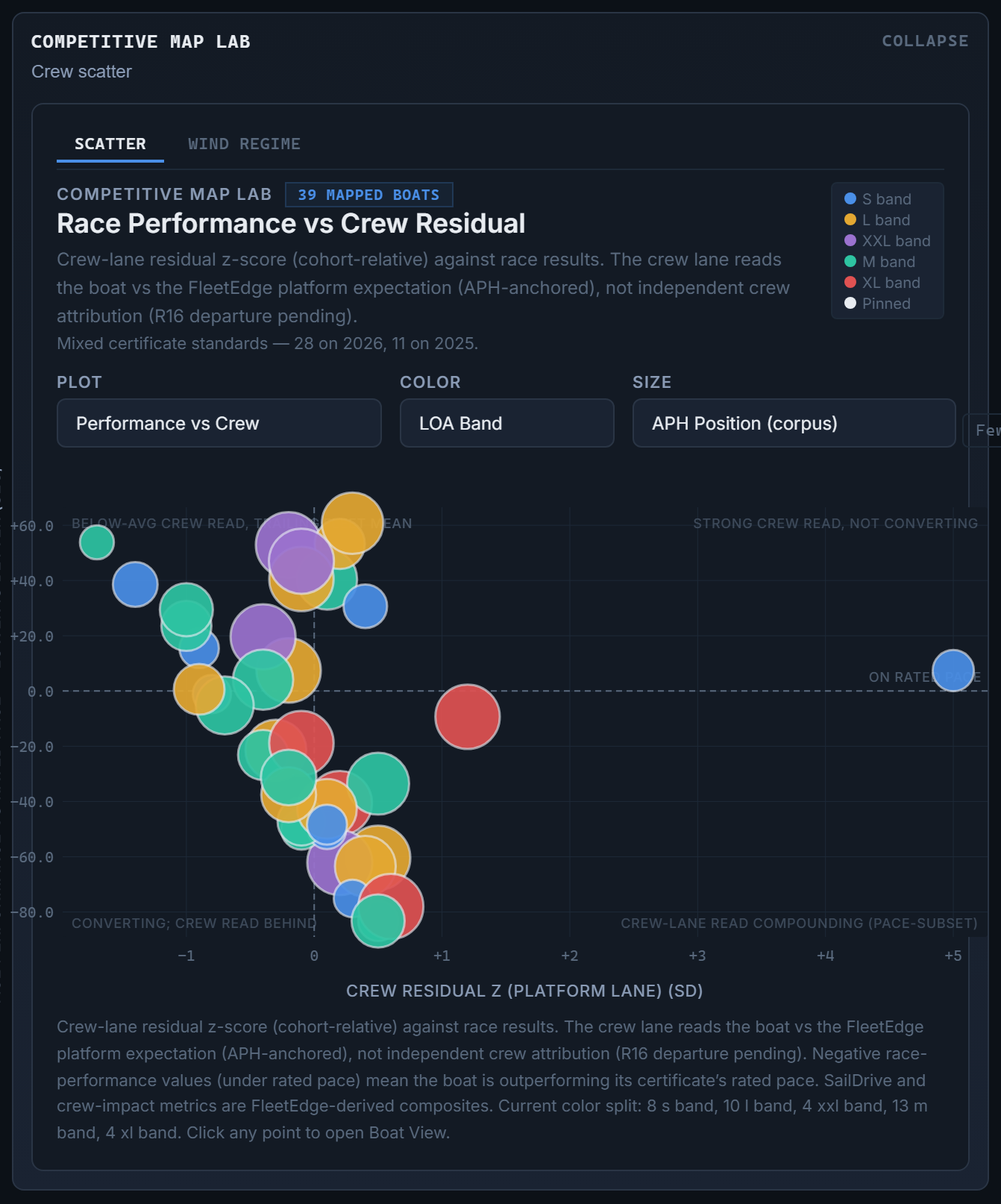
Race Results.
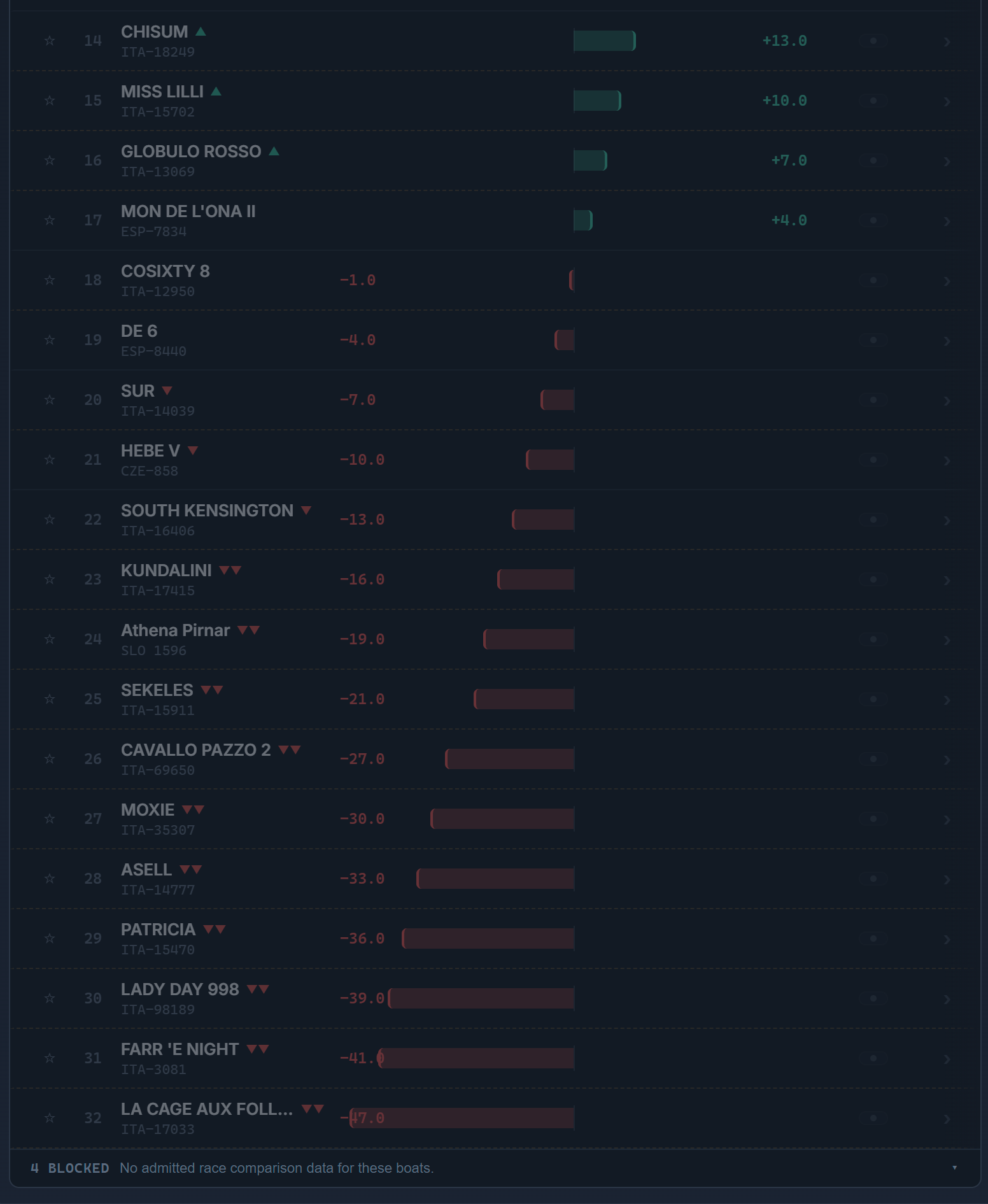
The ground truth. ORC Scorer events produce elapsed times, corrected positions, and the conditions that shaped each race. When you combine hundreds of race observations across multiple events, the noise of individual races gives way to persistent signal.
FleetEdge ingests results from ORC World Championships, continental championships, and major regattas — over 39,000 race observations. Each observation is a data point that either confirms or challenges what the certificate and physics evaluations indicated.
From fifty-two dimensions to eight archetypes.
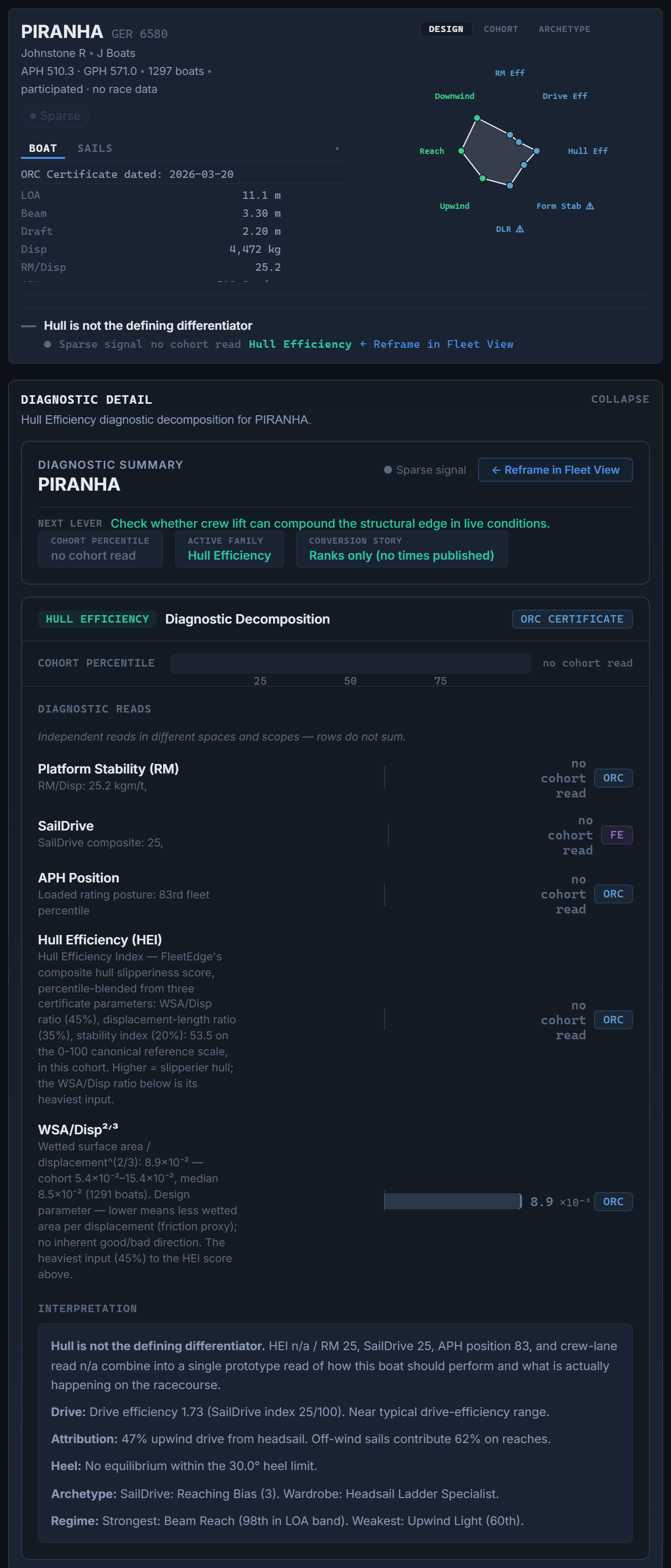
The three authorities converge into 52 raw measurement dimensions per boat — capturing hull efficiency, rig performance, stability characteristics, rating position (APH (the certificate's single-number rating, as a time allowance), the All-Purpose Handicap — the current ORC single-number reference), and the physics deltas between evaluated and actual performance.
FleetEdge then assigns each boat to one of the 8 performance archetypes.
Every answer shows its reasoning.
- PPI (the Performance Potential Index)
- physics potential (the PPI pillar that captures hull and sail-plan efficiency, from the certificate alone)
- crew execution (the PPI pillar no certificate can compute — what happened against what was expected)
Because FleetEdge triangulates three independent authorities, every analytical output can be traced back to its data sources. The Performance Potential Index assigns each boat a score decomposed into physics potential, archetype condition fit (how well the design type suited the conditions it met, ranked against its cohort), and crew execution — and every score includes a structured reason chain, a confidence tier, and a statement of what it does not measure.
Confidence tiers follow a weakest-link rule: a boat with strong physics data but limited race observations receives a low overall confidence, because the system is transparent about where it is certain and where it is not. Interpretation language enforces a neutral deadband — no directional claims in the middle of the distribution. The result is an analytical platform built for citation, not speculation. See the full explainability framework.
Five public evidence badges.
Every analytical card on FleetEdge carries a badge telling you what kind of claim it is. The lexicon is closed: five values, stable, auditable.
- Latest published view
- Live fleet-wide measurement. Results are stable enough for comparative use.
- Validation
- Methodology is under on-site validation. Results are directional while the validation run completes.
- Structural-only
- Dimensional or archetype analysis without race-result attribution. Describes what the fleet IS, not what it did.
- Low-sample
- Cohort is too small for comparative analysis. The card carries a structural profile only; no comparative takeaways.
- Pre-race scenario
- Forward-looking analysis using forecast or historical-prior inputs. Not a measurement; a projection under stated conditions.
Badges say what kind of claim a figure makes; its scope label says what it counts. Every cohort term on FleetEdge is defined on the Data Definitions page.
What the three-source structure can and cannot say. Certificates, physics, and published results converge into a measured picture of the fleet’s structure — what kinds of boats exist, and how their results sit against expectation. It does not measure sail condition or inventory beyond the certificate, individual maneuvers, or unraced conditions, and it renders a verdict on no boat and no rule.
FleetEdge alters no rating and no score — ORC remains the rating and scoring authority.
The data already exists. FleetEdge finds the structure.
Three authorities, fifty-two dimensions, eight archetypes — applied to every boat in the ORC fleet.