The Physics
ORC-anchored force-balance analysis built on Delft Series hydrodynamics.
Every fleet has a fingerprint.
From the Solent to the Aegean — see how the physics plays in your waters.
Hidden ShapeThe hidden shape of the fleet.
The kinds of boat that keep appearing when every hull is measured the same way.
The shape of the fleet, before the scoreboard has anything to say.
FleetEdge's second data authority is SailEdge — an ORC-anchored force-delta model built on the Delft Systematic Series, one of the most extensive published series of hull resistance experiments in naval architecture.
SailEdge takes the ORC certificate polar as baseline truth and applies Delft Series physics to compute speed deltas against that baseline. The delta is the dimension — a force-balance measurement at every wind angle and velocity.
The Delft Systematic Series.
The Delft Systematic Series is a decades-long program of towing-tank experiments conducted at Delft University of Technology. Hundreds of hull forms tested under controlled laboratory conditions, producing resistance coefficients that predict how real hulls move through real water at speed.
SailEdge applies these experimental results through a force-balance computation that takes ORC certificate geometry — hull dimensions, appendage configuration, rig parameters — and computes speed deltas against the ORC baseline at every wind angle and velocity.
The analysis is a physics-based, semi-empirical force balance grounded in DSYHS towing-tank data, documented aerodynamic formulations, and certificate-derived inputs — independent of race-result fitting.
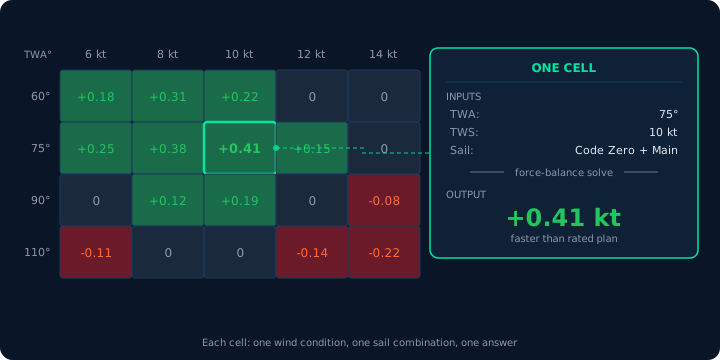
Certificate baseline, force-balance delta.
The ORC certificate polar provides the authoritative baseline — the rated performance that defines each boat in competition. ORC and SailEdge are both rooted in Delft Series hydrodynamics.
SailEdge applies Delft Series force-balance analysis to the same certificate geometry and computes speed deltas against that baseline at every wind angle and velocity.
The ORC baseline is the anchor. The force-balance delta is the dimension.
Where the delta is small, the force-balance analysis and the ORC baseline are in close agreement. Where it is large, the delta reveals hull form characteristics that the certificate alone does not surface — sensitivity to wind angle, heel-dependent behavior, or Froude-number transitions.
These deltas become dimensional features in the archetype model — they capture how Delft Series physics interprets each hull form relative to the certificate baseline.
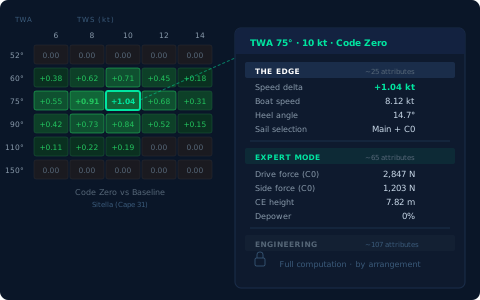
The force-balance delta at every wind angle.
The ORC Delta captures the difference between SailEdge's Delft Series force-balance analysis and the ORC baseline at each combination of true wind angle and true wind speed.
It is not an error term — it is a dimensional feature that shows how the force-balance analysis interprets the hull form relative to the certificate polar.
A positive delta at deep running angles means SailEdge's force-balance analysis indicates higher downwind speed than the ORC baseline.
A negative delta at upwind angles means the force-balance analysis sees less pointing ability than the ORC baseline. These angle-specific deltas become dimensional features in the archetype model — they capture how the hull form responds across the full wind envelope.
Δ(TWA, TWS) = V_SailEdge(TWA, TWS) − V_ORC(TWA, TWS)
Upwind and downwind — two different stories.
Upwind Delta
The force-balance delta at upwind angles. Positive values mean SailEdge's analysis indicates more pointing ability than the ORC baseline. Captures how the hull form's upwind characteristics — lift, induced drag, and heel-dependent resistance — translate into speed deltas against the certificate.
Downwind Delta
The force-balance delta at reaching and running angles. Captures hull form advantages — planing tendencies, surfing stability, low-Froude-number efficiency — that become visible as speed deltas against the ORC baseline.
See The Physics in the ORC Superyacht fleet.
ORC Superyacht racing brings the physics into sharp relief — see how the physics meets the fleet's regime and rivalries.
Explore ORC SuperyachtWhat the delta can and cannot say. A delta shows where the force-balance reading of the hull form diverges from the certificate polar — a dimensional feature, not an error and not a verdict on the certificate. The semi-empirical model is least certain toward the edges of its reference geometry, and a large delta there is a prompt for scrutiny, not a conclusion to race on.
FleetEdge alters no rating and no score — ORC remains the rating and scoring authority.
ORC-anchored physics. The delta is the dimension.
ORC baseline and Delft Series force-balance analysis, applied across the analyzed fleet.