Rating & Classification
The ORC certificate as a multi-dimensional design fingerprint.
Every fleet has a fingerprint.
From the Solent to the Aegean — see how the physics plays in your waters.
Hidden ShapeThe hidden shape of the fleet.
The kinds of boat that keep appearing when every hull is measured the same way.
The shape of the fleet, before the scoreboard has anything to say.
The ORC certificate is one of the most detailed technical profiles a racing yacht carries. Most of the sailing world reads it as a handicap number. FleetEdge reads it as a multi-dimensional design identity — and the difference matters.
The certificate produces the ORC single-number ratings and time allowances — the ToD and ToT scoring outputs that level the playing field for corrected-time racing. APH (the certificate's single-number rating, as a time allowance), the All-Purpose Handicap, has been ORC’s standard single-number rating since 2022 — an average of the boat’s time allowances across the full rated range of wind speeds and directions. But the certificate contains far more than a single rating. Hull geometry, rig dimensions, appendage configuration, rated stability fields, and the VPP-predicted polars that underpin the rating are all encoded in the document.
Each parameter describes a design choice that the naval architect made and the rating system evaluated. FleetEdge treats each of these parameters as a feature in the dimensional model — preserving the multi-dimensional structure rather than compressing it into a single time-correction coefficient.
What the certificate reveals.
| Dimension | Source | Unit | Role in Model |
|---|---|---|---|
| APH | ORC Certificate | sec/nm | Fleet speed positioning — where the boat sits in the overall performance hierarchy. ORC’s standard single-number handicap since 2022; the platform’s primary rating basis |
| ToT (Time-on-Time) | ORC Scoring | ratio | Time correction baseline — the scoring multiplier that defines corrected-time performance |
| Upwind Allowance | ORC Scoring | sec/nm | Predicted upwind strength relative to fleet — angle-specific rating advantage |
| Reaching Allowance | ORC Scoring | sec/nm | Predicted reaching performance — captures hull efficiency at intermediate angles |
| Downwind Allowance | ORC Scoring | sec/nm | Predicted downwind advantage — reveals rig and hull form contributions at depth |
| Rating Band Position | Derived | percentile | Relative position within the fleet rating distribution — normalized for cross-event comparison |
What Rating & Classification measures.
Rating & Classification (registry short label: Rating) is the FleetEdge dimension family (one of the nine groups of FleetEdge readings — six on the Fleet View ribbon — each reading one aspect of the boat or its racing) that places a boat on its certificate rating: where its APH sits in the fleet's rating distribution, as a percentile. It needs only the certificate. The classification half of the page — what kind of boat the certificate describes — is the archetype framework, taught on its own page.
| Dimension | Unit | Reading |
|---|---|---|
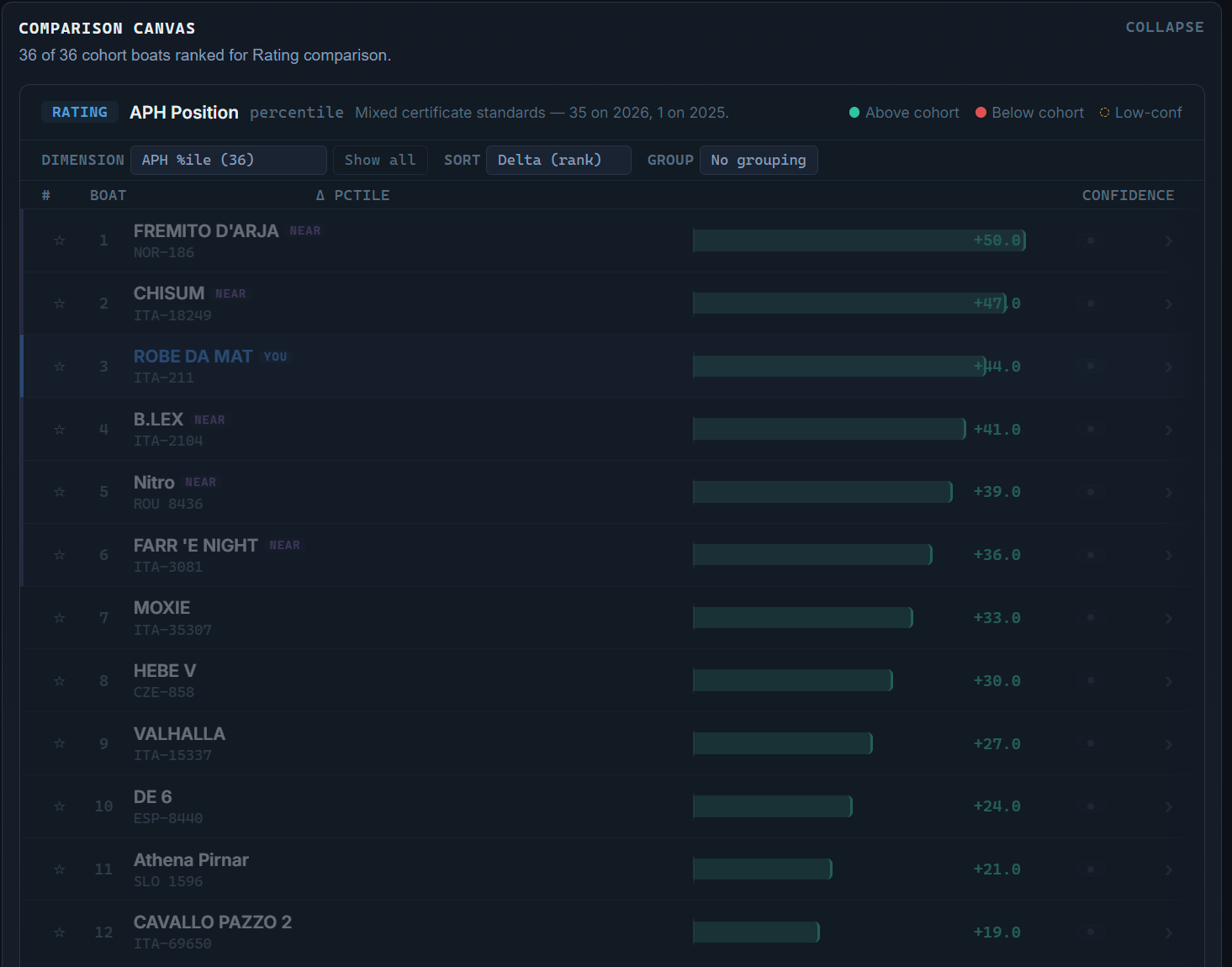
| APH Position | percentile | Where the boat's APH sits in the fleet's rating distribution — a higher percentile is the faster-rated end of the fleet in view; higher is better |
Reading the polarity. APH Position is a percentile of the fleet in view on the primary rating dimension: the faster-rated end of the fleet reads higher, so higher is better. It places a boat among its peers on rating; it never changes the rating. The label and unit are the App's own — the same family you see on the Fleet View ribbon and as the Rating Identity Card in the Boat View.
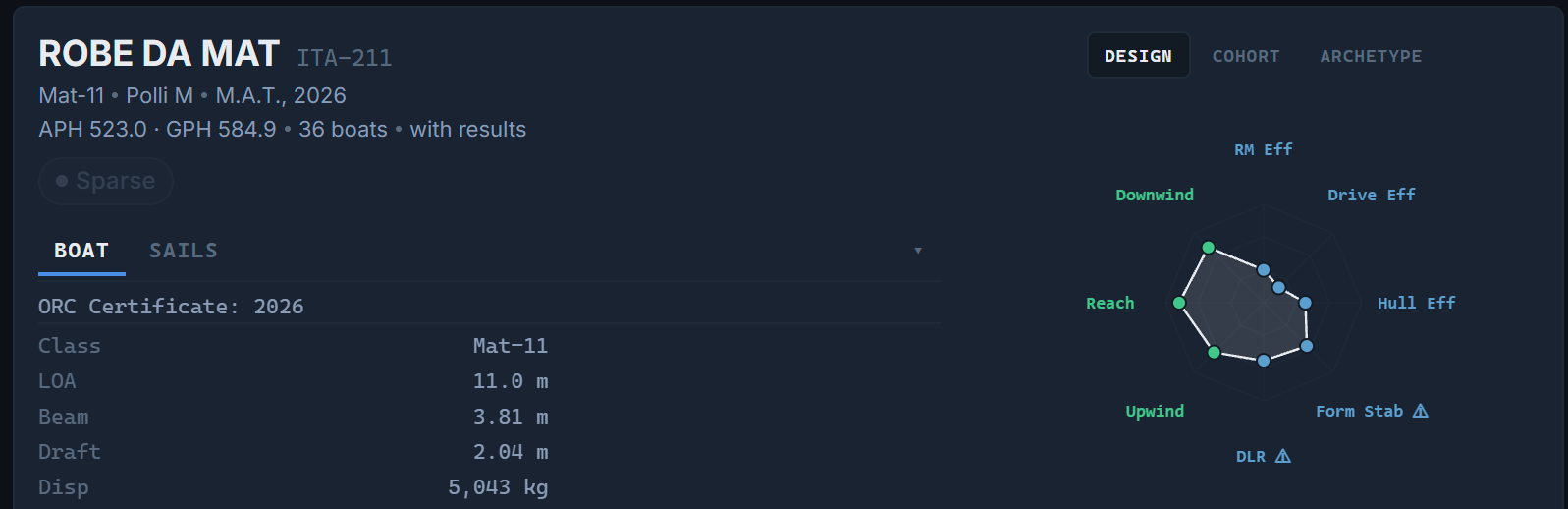
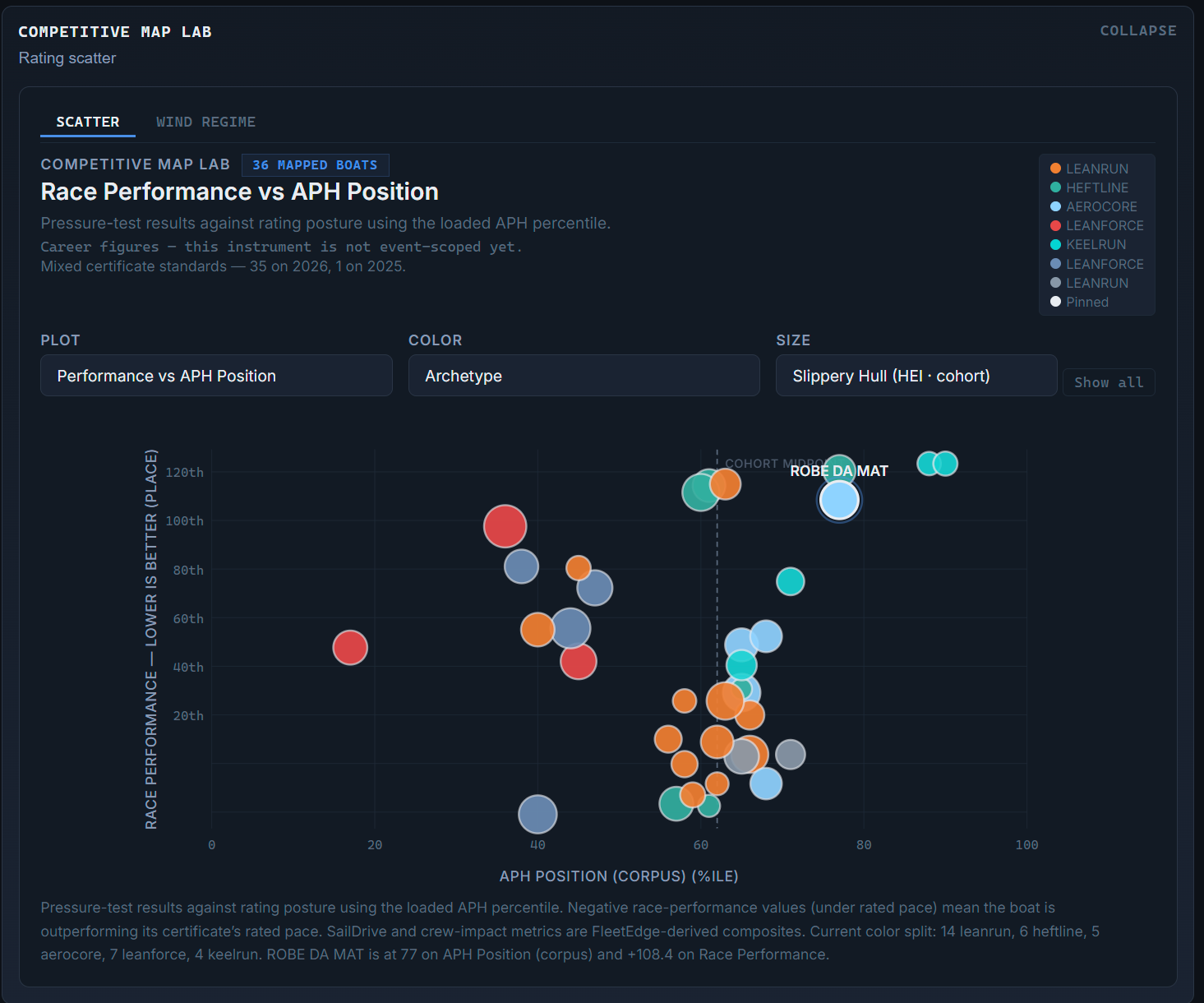
Rating tells you how fast. Classification tells you what kind.
Two boats with closely matched APH can belong to different archetypes. One is a towering, beamy platform with a level posture and a stiff righting reserve — an AEROSTREAM. The other reaches comparable corrected-time performance as a narrow, compact platform of higher drag — a LEANFORCE, the archetype where crew execution (the PPI pillar no certificate can compute — what happened against what was expected) spreads results more than in any other. The rating reads nearly the same. The boats are fundamentally different.
FleetEdge's archetype system is a classification, not a ranking. It groups boats by kind — the specific combination of hull, rig, and stability characteristics that define how each design converts wind into speed. Two boats in the same archetype share the same structural signature, regardless of their rating.
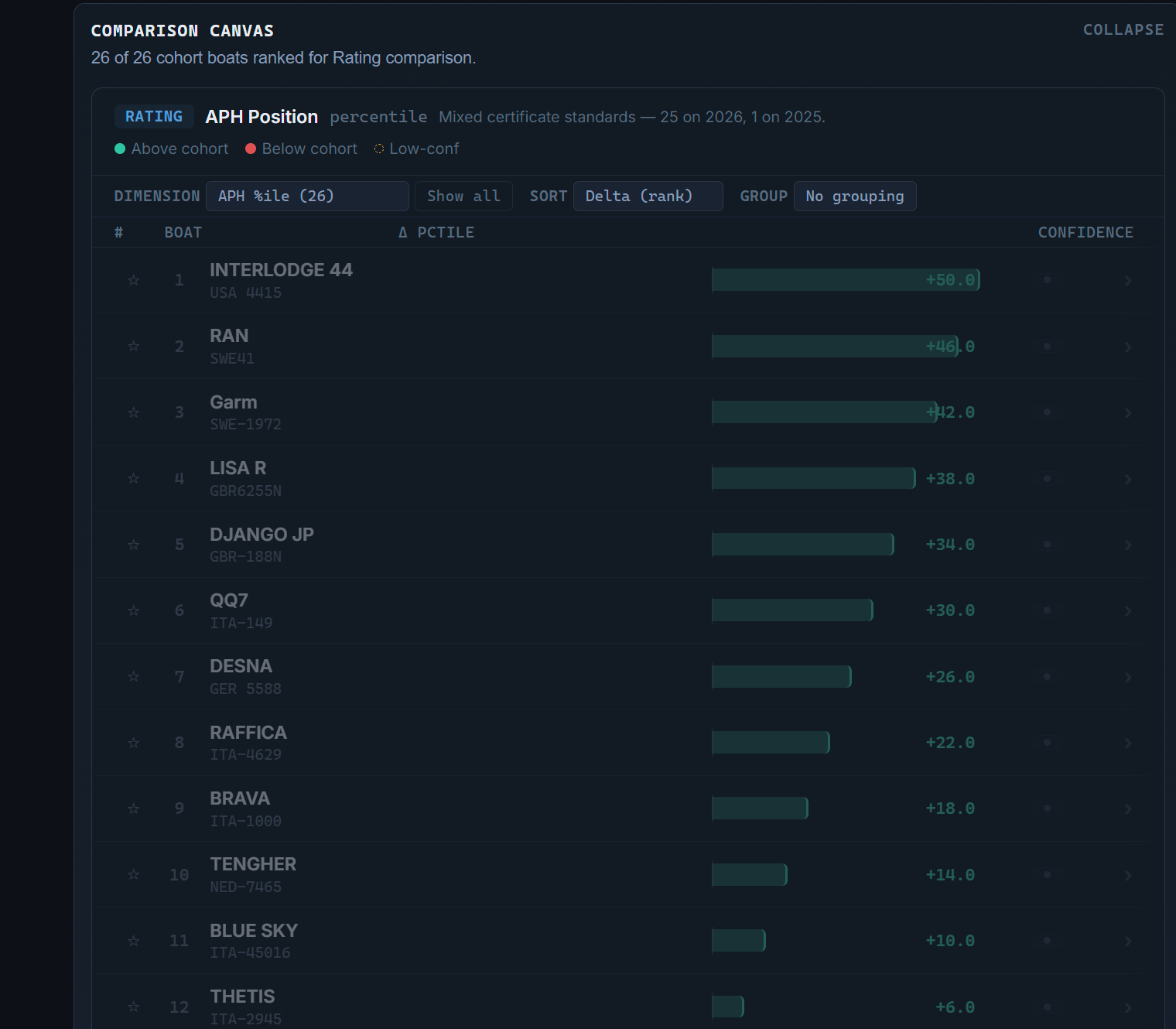
Where the rating expects you to excel.
ORC scoring allowances vary by wind angle — upwind, reaching, downwind. These angle-specific allowances reveal the boat's predicted strengths and weaknesses across the wind range. A boat with a strong upwind allowance and a weak downwind allowance has a different performance signature from one that is fast at depth but slow on the beat.
FleetEdge uses these scoring allowances as dimensional features, capturing not just how fast the boat is rated overall, but where in the wind range the rating expects it to perform. These angle-specific features contribute directly to the archetype assignment — they help distinguish between boats that achieve the same aggregate speed through different wind-angle strategies. The board alongside shows the aggregate end of that read — the class ordered on APH Position; the angle-specific view has its own App surface.
FleetEdge does not modify, challenge, or replace ORC ratings. It reads the certificate as data — the same data ORC publishes to every boat owner, every class association, and every regatta organizer — and finds the multi-dimensional structure that individual numbers obscure.
The rating remains ORC's domain. The classification — understanding what kind of boat you have and how it compares structurally to every other boat in the fleet — is where FleetEdge begins.
Go deeper.
Hull & Platform
The platform's contribution to the performance equation — hull efficiency, stability (how much righting moment the boat carries relative to its displacement), heel and geometry, read from the ORC certificate and the physics.
Methodology
The full analytical pipeline — from fifty-two dimensions to eight archetypes.
See Rating & Classification in the ORC World Fleet.
ORC World Fleet racing brings rating & classification into sharp relief — see how the physics meets the fleet's regime and rivalries.
Explore ORC World FleetThe certificate tells you more than you think. FleetEdge shows you how.
Every ORC certificate becomes a multi-dimensional design fingerprint in the FleetEdge analytical framework.