Fleet Archetypes
Eight kinds of boat. One fleet.
Every fleet has a fingerprint.
From the Solent to the Aegean — see how the physics plays in your waters.
Hidden ShapeThe hidden shape of the fleet.
The kinds of boat that keep appearing when every hull is measured the same way.
The shape of the fleet, before the scoreboard has anything to say.
In beta as a product. The archetype taxonomy here is the comparison basis for Design Benchmarks — the private peer-benchmarking workspace for designers. See Design Benchmarks →
How does the boat create speed — a faster hull, a stiffer platform, a larger sail plan? Where does that speed pay off — upwind, reaching, or downwind, and in which wind band? And what does it demand — demanding boats deliver a higher ceiling and require precise trim to reach it; forgiving boats give up less when trim wanders. FleetEdge™ by SailrScience measured those three answers for 11,207 boats analyzed within a 12,965-boat governed corpus; the 2026 census resolves the fleet into eight recurring types: the 8 performance archetypes. Experienced sailors will recognize every one of them — the archetypes give shared names, and measured evidence, to distinctions crews already make on the water.
11,207 boats analyzed (July 2026 — how the counts reconcile); 10,623 carry archetype assignments — 9,493 directly assigned, 1,130 inherited via sister-hull lookup.
Archetype names have vintages: race and event sections render the taxonomy as published nearest that event’s date, so an older race section can carry a name that differs from the current eight. See Data Definitions.
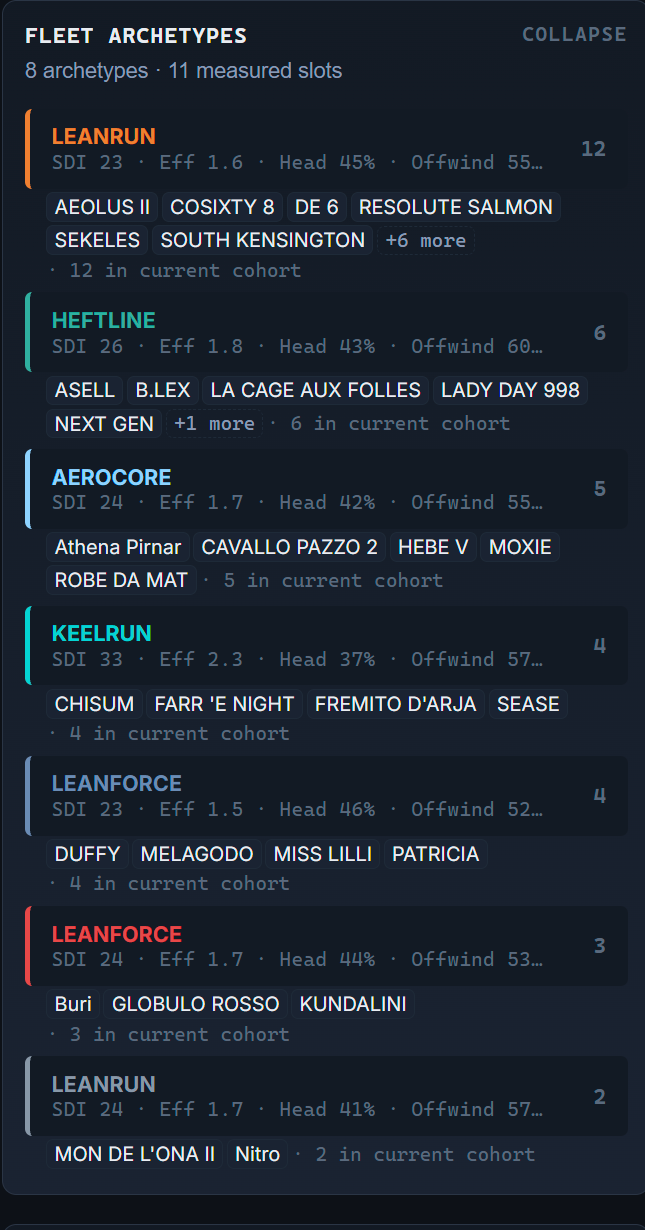
The 2026 census: eight archetypes.
Special Note — the 2026 census (August 2026). Two independent developments came together this season, and together they justified a set of studies testing how the fleet actually clusters. First, the fleet itself moved: a growing majority of certificates now carry ORC VPP 2026, which includes ORC’s published, revised residuary-resistance treatment. Second, the R16.4 physics refresh brought a more accurate righting-moment (RM) calculation. Run against the VPP 2026 fleet, the census converged on eight archetypes; the VPP 2025 census had held a slightly stronger cohesion around eleven. Eight is not a redesign — it is what the 2026 measurements resolve to, and we follow the evidence. SailrScience is committed to accuracy and transparency, building on the foundational truth of the ORC Certificate.
How the 2026 physics refresh resolved eleven archetypes into eight
FleetEdge’s R16.4 analysis of the ORC VPP 2026 fleet resolved the public taxonomy from eleven archetypes into eight—a discovery in the data, not a redesign of the system. Two predecessor archetype labels were consolidated under AEROCORE in the current taxonomy. Their remaining differences lay principally in boat-specific righting reserve, which FleetEdge preserves on each boat’s Form-Factor line rather than treating it as a separate archetype identity.
The finding emerged against a material, nonuniform shift in the ORC 2026 hydrodynamic representation. ORC’s 2026 VPP introduced safeguards around the residuary-resistance model following the XR-41 study, limiting unreliable extrapolation for hull forms near the model’s validated design-space boundaries. In a SailrScience audit of 5,270 boats with matched 2025 and 2026 certificates, 60.2% moved toward a higher, slower rating, 15.2% toward a lower, faster rating, and 24.4% showed no material change; 22.6% recorded a large absolute change. This design-dependent movement altered the certificate-derived feature space in which FleetEdge identifies fleet populations.
The convergence does not mean that the physical hulls became more alike, or that stability differences disappeared. It means that, under the ORC 2026 VPP representation, the three former pairs no longer supported distinct identities on the principal factors defining their form and performance. Righting reserve remains operationally important, but as a continuous characteristic of each boat—not, by itself, a separate class of hull.
HEFTLINE is the census's one renaming of a different kind: renewed analysis placed its existing population in the LINE family — a classification correction, not a fourth convergence. AEROSTREAM, AEROFORCE, SPARKFLEX and KEELRUN remain unchanged.
FleetEdge therefore maintains eight public archetypes for the 2026 VPP vintage (the dated data cut a figure or an archetype assignment is computed at — never a display rule) while preserving all eleven internal classifier cells and their analytical lineage. Earlier certificate vintages retain the taxonomy derived under their own VPP physics, and the 2027 refresh will test whether the three shared populations continue to cohabit.
The convergence is associated with—and technically consistent with—the 2026 residuary-resistance update. SailrScience does not claim that the update alone caused each specific pair to converge without a controlled, frozen-input comparison across VPP versions.
A vocabulary for decisions, not a verdict
Two boats with the same rating can hold opposite bargains: one buys its ceiling with trim discipline; the other buys consistency and gives up some top-end speed. The archetype names which bargain a boat holds, so a team can match boat to crew, program, and season before the entry fee is paid — and so a mid-fleet result can be read fairly: was that the boat’s trade, the weather’s timing, or the crew’s execution? Rate the boat fairly. Reveal what the crew controls.
Demanding or forgiving — the axis crews feel first.
Some boats deliver a higher ceiling and demand precise trim and constant attention to reach it. Others are forgiving — a lower ceiling, but less given up when trim wanders. Neither is better; each is a different deal between a boat and its crew. FleetEdge measures where every boat sits on this axis, from heel sensitivity, race-to-race consistency, and the crew residual (what remains after the boat’s evaluated pace is accounted for — negative is faster, in s/nm).
Three families, eight archetypes.
Large-Platform · Compact · Displacement-Led. The family says which identity axis leads the boat’s structure; it carries no downwind meaning — every family contains boats across all downwind classifications.
Each name carries two governed factors; the Form Factors line carries all four; any factor the name does not carry is stated in the opening public definition. Names never carry race-evidence claims.
Form Factors describe where an archetype sits across platform scale, hull proportion, heel posture, and righting reserve. They are derived from certificate physics and recalculated when the taxonomy is refit. Three archetype words each span two measured slots — one population wearing one name, with each slot keeping its own measured signature; their word cards below render one aggregated card per word — the word’s combined fleet count with its larger slot’s measured signature — and say so.
Identity set by scale above the fleet median.
The large-platform family: archetypes whose identity is set by scale above the fleet median — waterline, rig height, and wetted platform lead the structural signature. Four archetypes — AEROSTREAM, AEROCORE, LEANRUN, and AEROFORCE — across six measured slots.
AEROSTREAM
A towering archetype on the higher side of the present hull-proportion axis, with a level posture and stiff righting reserve. At boat grain, it is beamy, efficient, and forgiving. Downwind — race results: in line with the fleet norm. A member of the Large-Platform family. Best-observed conditions in race results: light air upwind (under 6 kt); moderate-fresh reaching (10-14 kt). A forgiving archetype — the most consistent race to race in the fleet. Representative designs: TP-52, XP-44, Farr 40.
AEROCORE
One word, two measured slots, one card. The word is the archetype; the signature and profile shown are its larger measured slot’s, and each boat’s own Form-Factor line carries its slot’s exact signature.
A large archetype near the middle of the present hull-proportion axis, with an upright posture and tender righting reserve. At boat grain, it is beamy, of median drag, and moderately demanding. Downwind — race results: in line with the fleet norm. A member of the Large-Platform family. Best-observed conditions in race results: light air upwind (under 6 kt); durable as breeze builds. Crew demands are moderate — execution still separates boats. Representative designs: First 45, First 40, Oceanis 43.
LEANRUN
One word, two measured slots, one card. The word is the archetype; the signature and profile shown are its larger measured slot’s, and each boat’s own Form-Factor line carries its slot’s exact signature.
A large archetype near the middle of the present hull-proportion axis, with a level posture and tender righting reserve. At boat grain, it is beamy, of higher drag, and demanding. Upwind — race results: in line with the fleet norm. A member of the Large-Platform family. Best-observed conditions in race results: fresh breeze (14-18 kt), offshore and mixed courses. A demanding archetype — crew execution carries a real premium. Representative designs: First 36.7, J-109, First 35.
AEROFORCE
A large archetype near the middle of the present hull-proportion axis, with a level posture and neutral righting reserve. At boat grain, it is mid-beam, of higher drag, and moderately demanding. Reaching — race results: a stronger showing than the fleet norm. A member of the Large-Platform family. Best-observed conditions in race results: moderate breeze (6-10 kt), upwind and downwind. Crew demands are moderate — execution still separates boats. Representative designs: First 40.7, X-43, Grand Soleil 40.
Identity set by compact scale and structural efficiency.
The compact family: archetypes whose identity is set below the fleet’s scale median — efficiency and proportion lead the structural signature. Three archetypes — SPARKFLEX, KEELRUN, and LEANFORCE — across four measured slots.
SPARKFLEX
A minimal archetype on the higher side of the present hull-proportion axis, with an upright posture and tender righting reserve. At boat grain, it is narrow, of median drag, and moderately demanding. Downwind — race results: a weaker showing than the fleet norm. A member of the Compact family. Best-observed conditions in race results: moderate breeze (6-10 kt). Crew demands are moderate — execution still separates boats. Representative designs: J-80 OD, J-24, J-70 ONE DESIGN.
KEELRUN
A compact archetype on the higher side of the present hull-proportion axis, with an upright posture and neutral righting reserve. At boat grain, it is narrow, efficient, and forgiving. Upwind — race results: in line with the fleet norm. A member of the Compact family. No results-derived conditions window is claimed at the current evidence floor. A forgiving archetype — execution separates boats less here than in most of the fleet. Representative designs: First 31.7, J-105, Sunfast 3200.
LEANFORCE
One word, two measured slots, one card. The word is the archetype; the signature and profile shown are its larger measured slot’s, and each boat’s own Form-Factor line carries its slot’s exact signature.
A compact archetype on the lower side of the present hull-proportion axis, with a leaning posture and neutral righting reserve. At boat grain, it is narrow, of higher drag, and demanding. Downwind — race results: a stronger showing than the fleet norm. A member of the Compact family. No results-derived conditions window is claimed at the current evidence floor. A demanding archetype — crew execution carries a real premium. Representative designs: Fortuna 9, Mat 10.10, Aphrodite 101.
Identity set by displacement leading the structural signature.
The displacement-led family: identity set by displacement leading the structural signature. One archetype — HEFTLINE — on one measured slot.
HEFTLINE
A compact archetype on the higher side of the present hull-proportion axis, with a level posture and stiff righting reserve. At boat grain, it is mid-beam, of median drag, and forgiving. Upwind — race results: a stronger showing than the fleet norm. A member of the Displacement-Led family. Best-observed conditions in race results: moderate breeze VMG downwind (6-10 kt). A forgiving archetype — execution separates boats less here than in most of the fleet. Representative designs: J-111, Farr 30, Cape 31.
The 2025 ORC Worlds — two published titles, two archetypes.
The 2025 Garmin ORC World Championship at Tallinn drew a 64-boat entry list onto the Baltic for 21 races, and 61 of those boats reached the FleetEdge comparative race group. Eight of that era’s eleven published archetypes were populated across them — a broad, flat spread in which the leading family, LEANRUN, took under a quarter of the group at 24.6%. The Mediterranean cohort that contested the same championship a year later at Sorrento went the other way: a 101-boat race group with AEROSTREAM alone at 44.6%.
Two class titles are published, and they went to two different archetypes. Class A went to RAN (SWE-41, Carkeek 40+) on 12 points — an AEROSTREAM: the towering-scale, leaning-posture platform. Class B went to FORMULA X (DEN-1, Xr-41) on 9 points across 18 boats — an AEROCORE: the large-scale upright platform the X-Yachts line brings to this circuit. Class C, the championship's largest standings at 30 boats, carries no first-place row in the current published view. Standings and points are quoted from the championship standings as captured in FleetEdge’s published view.
This is what fair rating can look like in action. Two different kinds of boat, two different optimizations against the same race week, two trophies, two flags. If the rating systematically rewarded one archetype, you would expect both titles to cluster in that archetype. At this event they did not — the two published titles fell in two archetypes. That is a two-title observation, not a fleet-wide fairness proof: the strongest opposing signal sits on the same board, where the championship’s largest class carries no first-place row in the current published view, so the read rests on the two classes that publish one.
RAN carries a first-place series row at both editions. SWE-41 RAN raced Tallinn 2025 and Sorrento 2026 on the same Carkeek 40+ hull and holds a first-place row in the published standings at each — Class A at Tallinn on 12 points, and a first place on 16.5 points at Sorrento — across two race groups that could hardly have been less alike. See the 2025 Tallinn race result page →
See Fleet Archetypes across the fleets.
FleetEdge reads fleet archetypes across every governed fleet — ORC domestic, IRC events, and Superyacht.
Browse Fleet AnalyticsWhat this page’s evidence can and cannot say. The archetype view describes what the fleet is — the recurring kinds its certificates and physics reveal — and where race results exist, each card says so with its badge. It certifies no rating, settles no result, and ranks no crew.
FleetEdge alters no rating and no score — ORC remains the rating and scoring authority.
Eight kinds of boat. One fleet.
Two boats with the same rating can be different kinds of boat. FleetEdge measures the difference — before the gun.